


The killing of an 11-year-old schoolgirl in France has triggered strong criticism of the country’s judicial system, leading the justice minister to order a large-scale review of child abuse cases. Nonetheless, experts remain divided regarding the practicality of this initiative.
French Justice Minister Gérald Darmanin has directed prosecutors to examine approximately 70,000 pending cases of child sexual abuse by 14 July, in response to widespread condemnation of how the justice system managed the recent murder of a schoolgirl.
 ADVERTISEMENT
  ADVERTISEMENT
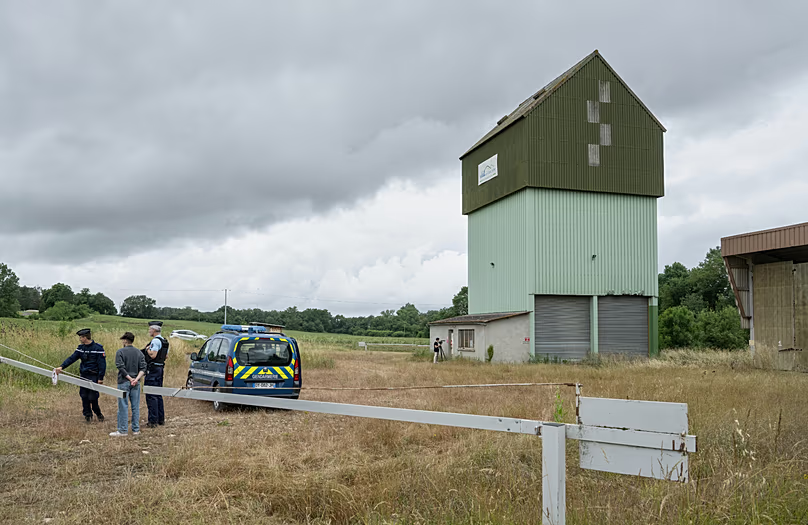
The 11-year-old girl, identified as Lyhanna in news coverage, disappeared on 29 May in southwestern France and was found deceased six days afterward. Following a wave of mourning, it became evident that authorities had neglected to thoroughly investigate her alleged offender, Jérôme Barella, despite earlier accusations of child sexual assault against him.
Darmanin revealed his plan on 8 June, assuring that «no senior judge will take a vacation» — nor would he — until he had met with «all chief prosecutors» to assess the public concerns. The deadline was set for 14 July, allowing just over five weeks for prosecutors to accomplish the task.
In practical terms, reviewing 70,000 cases implies handling roughly 14,000 cases each week, which equates to over 2,000 per working day.
The viability of this ambitious effort has been questioned, given France’s known sluggish judicial procedures and the fact it has one of the lowest numbers of professional judges in Europe, according to Council of Europe statistics.
The plan is considered feasible by the French government
From the government’s perspective, there is no doubt — the “70,000 cases in five weeks” objective is attainable.
A Justice Ministry spokesperson explained that the target’s realistic because, theoretically, these cases are already active; the current process involves reviewing existing investigations.
«The goal in revisiting these files isn’t to ‘discover’ new cases since these matters are already in the hands of courts, prosecutors, and investigators,» clarified Sacha Straub-Kahn.
The Ministry seeks to establish a detailed summary of the cases, including their general characteristics, locations, and the number of files managed by each appellate court.
«Another objective is to create a secondary priority to focus on cases involving minors who remain underage during this period,» Straub-Kahn added. «When a person is 45, even when offenses are severe and will be addressed, the expected level of protection from the justice system is not the same as when the victim is a 12-year-old child who has filed a complaint.»
A major unknown is whether the government will allocate extra resources to assist prosecutors in processing the large volume of cases. However, current indications suggest no additional support will be provided.
Straub-Kahn mentioned that, for now, no special task force will be appointed to aid the judiciary throughout this extensive review.
«This responsibility primarily lies with the public prosecutors, chief prosecutors, and their teams, including deputy prosecutors,» he emphasized. «We recognize this adds to their workload, but the question remains which priorities we designate.»
«Following 14 July, local authorities can negotiate any extra resources—including additional personnel—that may be necessary to handle the caseload,» Straub-Kahn concluded.
‘A mere publicity stunt’
The perspective varies significantly among private lawyers and trade unions, many of whom have dismissed Darmanin’s initiative.
Ségolène Marquet, permanent secretary of the Magistrates’ Union and former juvenile judge, expressed concerns that the pace set for the case review could cause errors.
«This appears to be a publicity move unlikely to improve case handling and may even have unintended negative consequences,» she stated. «Processing sexual violence cases too rapidly risks dismissing them without proper follow-up, which is quicker than conducting comprehensive investigations.»
Marquet also pointed out that, during the five-week review, new complaints will emerge, many potentially more urgent than the old cases under evaluation.
«This review only covers the 70,000 cases recorded by courts, but the backlog of complaints lodged at police stations—unknown to prosecutors—remains unquantified,» she noted.
Lawyers have voiced mixed reactions about the plan’s feasibility, with stances ranging from cautious optimism to outright doubt.

Jérome Navy, a lawyer from Paris who practices criminal, commercial, and intellectual property law, characterized the review as «ambitious yet achievable,» emphasizing that it demands «extra human and financial resources» and that giving precedence to cases involving minors may «result in less attention to other types of cases.»
«This review is unlikely to significantly change the number of trials or convictions,» he remarked. «Judges handling investigations and court proceedings will remain overwhelmed unless significant criminal procedure reforms occur or the justice system’s budget is greatly increased.»
Criminal attorney Gwendoline Tenier expressed deep concern that the review might be rushed, causing crucial cases—which require thorough evaluation—to be neglected in an effort to reduce the backlog quickly.
«These situations are extremely serious, involving minors who must be interviewed and decisions made about psychological and forensic evaluations,» she stated.
Tenier concurred that reforming the handling of child abuse cases is necessary but noted that judges and lawyers have been requesting action for many years.
«Some politicians have proposed establishing a specialized public prosecutor’s office, similar to the system in Spain,» she explained, referring to Spain’s units dedicated to juvenile and domestic violence cases that centralize child protection.
«Given the societal issues the country faces, and considering domestic violence is also a challenge here, such a system has merit,» Tenier added. «However, this differs greatly from resolving 70,000 cases by 14 July.»