
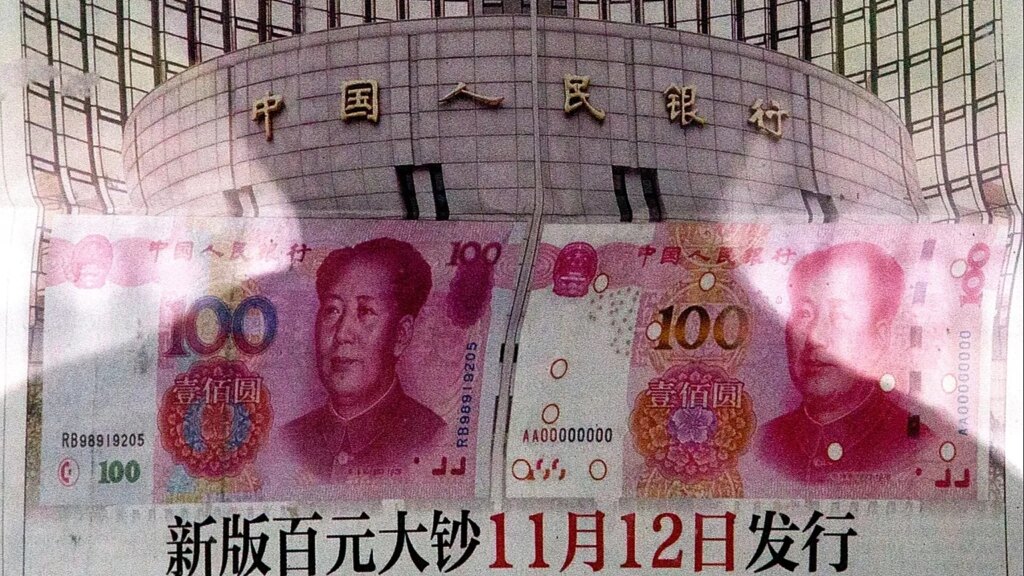
The undervaluation of the yuan was identified last week by EU leaders as a key factor in the bloc’s record trade deficit with China, prompting Brussels to take action.
Facing a daily €1 billion trade deficit with China, the European Union’s leaders increasingly highlight currency manipulation as a major cause. They argue that Beijing uses this tactic to make its products even more affordable in an EU market already saturated with Chinese goods.
 ADVERTISEMENT
  ADVERTISEMENT
«An artificially depressed currency favors those aiming to enhance their competitive position in the economy,» stated German Chancellor Friedrich Merz after the 19 June European Council summit.
The topic of China’s currency management was also prominently discussed during last week’s G7 meeting in France.
Indications suggest that this issue is becoming a new dimension in Europe’s trade conflict with Beijing. To grasp the significance of the yuan’s devaluation, consider these three key points.
What issues affect the Chinese currency?
A report from the Haut Commissariat à la Stratégie au Plan, a French advisory institution, estimates the yuan’s undervaluation to be approximately 20-25 percent.
“Although there is no universally accepted standard to definitively measure whether a currency is substantially overvalued or undervalued, the view that the renminbi (RMB) is notably undervalued is broadly supported, including by international organizations,” the report notes.
In principle, China’s trade surpluses should naturally increase demand for the yuan, causing its value to rise, yet this is not observed.
The renminbi’s devaluation, however, is not necessarily a direct outcome of central bank intervention. Alicia Garcia-Herrero, an analyst at the Brussels-based think tank Bruegel, told Euronews that China slows the currency’s appreciation by holding part of its export revenues outside the mainland.
“These funds remain in Hong Kong and are not converted into RMB,” she explained.
How does this affect trade between China and the EU?
The EU’s trade deficit with China reached an unprecedented €359.9 billion in 2025. That year also saw every EU member state, including Germany—the bloc’s largest economy—register a trade deficit with Beijing for the first time.
“This situation is clearly unsustainable,” stressed European Commission President Ursula von der Leyen last Friday.
The Haut Commissariat au Plan report highlights that the yuan’s undervaluation significantly contributes to maintaining the competitiveness of Chinese goods; EU industries estimate these products are roughly 30-40 percent less expensive than comparable European-made items.
Nonetheless, Garcia-Herrero noted that differences in inflation rates also play an important role.
“Based on my analysis, the inflation gap and its cumulative effect in Europe since the Ukraine invasion account for about 75 percent of the decline in external competitiveness,” she remarked.
What measures can the EU take?
During his comments last Friday, Merz recommended initiating talks with China concerning the currency issue.
“We must engage in a dialogue on this matter,» he affirmed. «It serves the interests of both parties.”
The German chancellor referenced the 1985 Plaza Agreement, in which the US, Japan, West Germany, the UK, and France agreed to devalue the US dollar relative to the Japanese yen and Deutsche Mark. This aimed to prevent the US from adopting protectionist policies amid a growing trade deficit.
Merz also mentioned the European Monetary System, which used fixed exchange-rate bands to restrict currency fluctuations before the euro was introduced.
“That system allowed countries to coordinate exchange rates within set corridors,” he added.
In contrast, Garcia-Herrero observed that the US did not advocate for similar negotiations when economic imbalances were discussed at last week’s G7 summit.
She suggested Europe should track China’s export prices carefully for sector-specific discrepancies; such monitoring could reveal overcapacity issues, as falling prices often indicate products are not selling.