
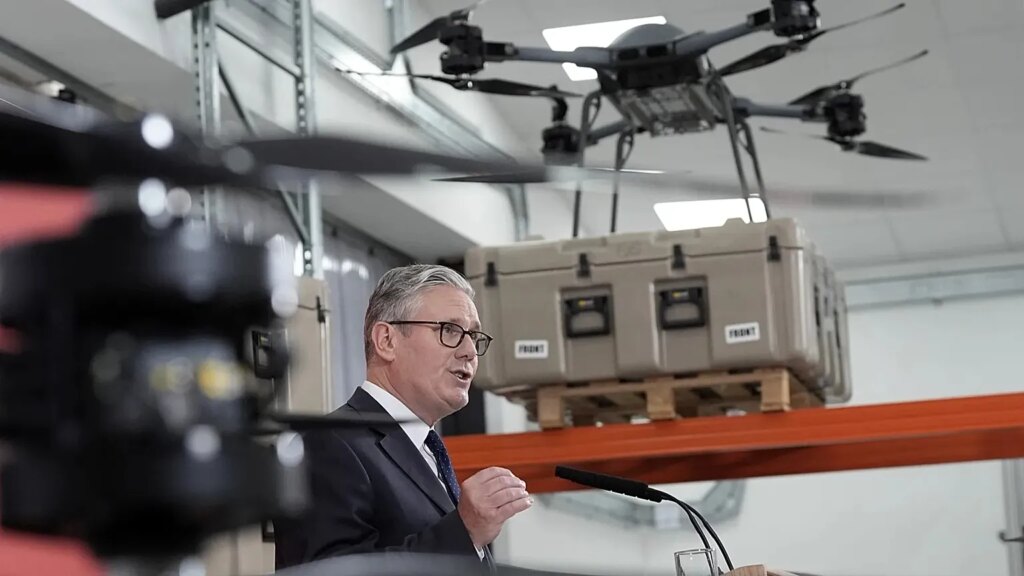
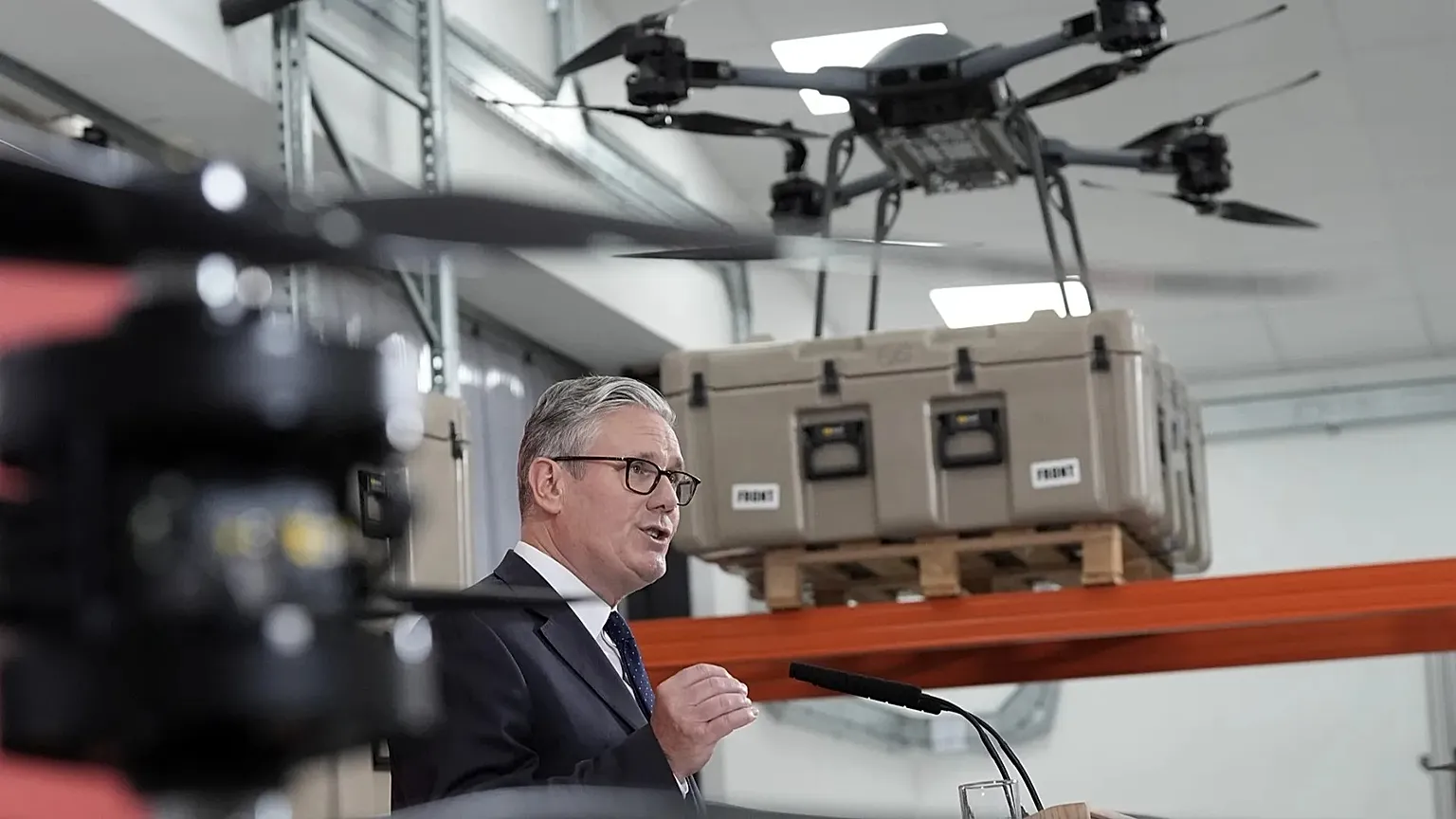
The departing UK prime minister has finally revealed a much-anticipated Defence Investment Plan designed to rejuvenate a sector previously described as “underfunded.” The strategy highlights the increasing reliance on unmanned aerial vehicles to counter foreign threats.
British Prime Minister Keir Starmer has officially introduced his administration’s Defence Investment Plan, a funding initiative intended to secure the UK’s military capabilities by increasing defence expenditure to £80 billion (€92.8 billion) annually by 2029.
 ADVERTISEMENT
  ADVERTISEMENT
The plan allocates funding for the production of stealth fighter jets, submarines, and warheads, while dedicating £5 billion (€5.8 million) exclusively for drone development—a figure Starmer described as “the largest investment in this technology ever made by the UK.”
“Our goal is to create an arsenal ten times more lethal, with attack drones complementing Apache helicopters, a fresh fleet of reconnaissance drones gathering intelligence and detecting targets, as well as an increase in low-cost, one-way attack drones that have demonstrated high effectiveness in Ukraine,” he stated during Tuesday’s press briefing.
Future defence spending will prioritize autonomous systems, including “hybrid” Royal Navy ships equipped with artificial intelligence and smaller autonomous aircraft operating alongside RAF Typhoon fighter jets that remain “invisible” to radar detection.
Drone testing will also take place at the “Uncrewed Systems Centre,” a 50,632-square-meter facility promoted as the largest drone testing site in Europe.
The Russia factor
In his address, Starmer explicitly named Russia, identified by multiple intelligence agencies as preparing a potential attack on a NATO ally by 2030.
He reaffirmed that should Russia extend its full-scale invasion beyond Ukraine’s borders, Europe could become the Kremlin’s next target.
“A Russian victory in Ukraine would not be the end; Putin would then focus on additional allies, escalating instability across our continent, increasing security threats and cost-of-living pressures, and amplifying the urgency to allocate more resources towards defence,” Starmer warned.
Earlier in April, the former UK Defence Secretary John Healey revealed that three Russian submarines had covertly operated near pipelines and cables in waters north of the UK, echoing similar sabotage events across Europe, especially in the Baltic Sea. The UK and Norway are actively developing frigates designed to detect and engage Russian submarines entering European waters.
Surprisingly, Healey resigned two weeks before Starmer announced the defence plan, citing concerns over insufficient funding to safeguard national security and fulfill the NATO target of dedicating 3.5 percent of GDP annually to defence by 2035.
In his resignation letter, Healey criticized the originally proposed budget as “significantly below what is necessary given the current threat level.”
On Tuesday, the prime minister reaffirmed his belief that the investment plan adequately supports both the UK and broader European security interests.
“We are upholding our commitment to British and European security and ensuring our country is left stronger and more secure than when we assumed office,” he stated.
Nonetheless, in Parliamentary remarks following the plan’s release, Healey maintained his stance, emphasizing the need for “a clear and credible funding strategy” in preparation for a possible Russian assault.
Britain in Europe
Starmer outlined that the plan seeks to enhance European defence decision-making, involving contributions from European partners, including joint development of “deep precision strike weapons” with Germany.
This initiative follows signals from the United States that it will reassess its defence posture in Europe, encouraging European allies to increase their commitments.
When Euronews inquired with the Ministry of Defence about EU involvement in the plan through capability development or testing, a spokesperson referred to Starmer’s earlier comments without sharing further details.
The UK’s new strategy is being unveiled just ahead of the 2026 NATO summit scheduled for 7-8 July in Ankara. NATO Secretary General Mark Rutte stated that the initial day of the summit will provide an occasion for the alliance’s 32 members to finalize “large volumes of new contracts, memorandums of understanding (MOUs), and letters of intent” to meet defence spending targets.