
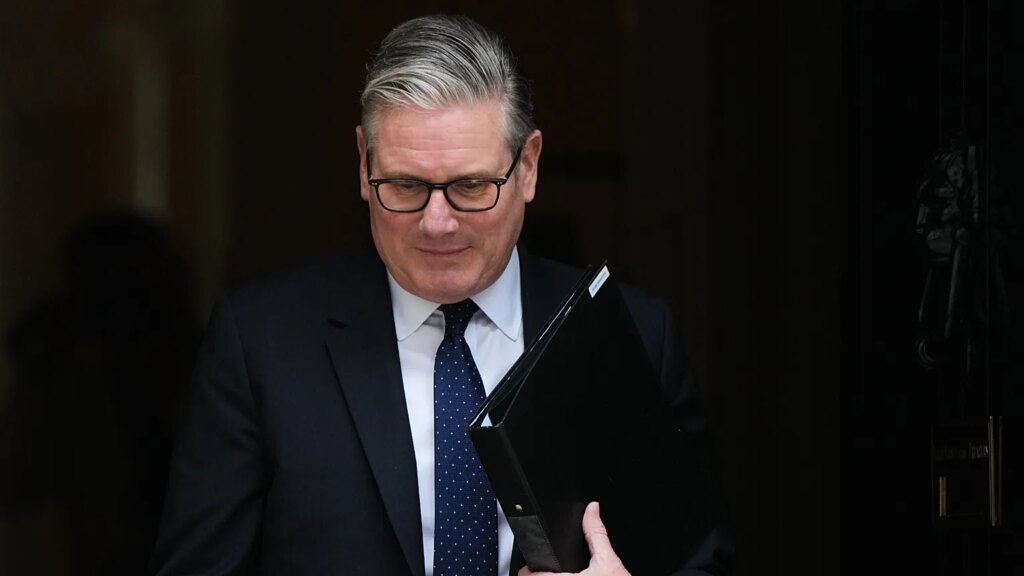
Starmer will maintain his role as caretaker prime minister until the Labour Party elects a new leader, while Reform UK has called for a general election.
Keir Starmer, the British Prime Minister, has declared his intention to resign as the Labour Party leader but will remain as interim prime minister until a successor is chosen.
 ADVERTISEMENT
  ADVERTISEMENT
Faced with increasing demands inside the party for leadership change, Starmer has initiated the arrangements for transferring power.
His announcement arrives mere hours before Andy Burnham, the former Greater Manchester mayor and a leading contender to succeed Starmer, was officially sworn in as an MP, having secured a seat in the House of Commons through a recent by-election.
“Every choice I have made sought to prioritize the country I cherish. This is why I have decided to resign as Labour Party leader,” said Starmer during an emotional address outside 10 Downing Street, his voice faltering.
Starmer indicated that the leadership election will commence in July, and he will continue as prime minister until a new leader assumes office, expected by September.

Burnham has advocated for a «peaceful and responsible» transfer of leadership, announcing on social media: «I will submit my candidacy as part of this process.»
Leader of Reform UK, Nigel Farage, has called for a general election, remarking, «If Labour believes it can simply install another career politician at No 10, they are mistaken.»
The former MEP stated Reform UK «demands an election and is prepared to implement significant change».
European Commission President Ursula von der Leyen commended Starmer for reinforcing «European» security.
“It often takes leaders years to develop into a statesman, yet you achieved this in just two years. European and Ukrainian security has been strengthened thanks to you. Thank you, Keir,” von der Leyen wrote online.
The succeeding prime minister will be the seventh head of government in a decade, following David Cameron, Theresa May, Boris Johnson, Liz Truss, Rishi Sunak, and Starmer.
Labour’s regulations require the party leader to be a sitting MP, and Burnham will officially assume his position on Monday after winning the Makerfield by-election.
Prior to this week, Starmer had maintained he would resist any leadership challenges. However, his stance came under increasing scrutiny following a challenging local election cycle that dealt significant losses to Labour against Farage’s Reform UK.
Challenging leadership
Starmer’s tenure was marked by multiple controversies, including not declaring gifts early in his leadership and appointing Peter Mandelson as the ambassador to the US, despite Mandelson’s known ties to the convicted paedophile Jeffrey Epstein.
The decision to dismiss Mandelson was among several policy reversals that faced criticism across the political spectrum, including retreats from welfare reforms, the introduction of digital IDs, and the cancellation of winter fuel payments.
Distractions also arose from actions by his colleagues, such as Deputy Prime Minister Angela Rayner, who resigned after initially failing to pay duty on a new residence, overshadowing achievements like enhanced relations with the EU.
Starmer’s leadership has been further weakened by the sudden resignations of his health and defence secretaries, while prominent Labour figures have lined up to contest his leadership.
Former health secretary Wes Streeting claimed in May to have garnered support from 81 Labour MPs to initiate a leadership challenge but later confirmed on Monday that he would back Burnham’s candidacy instead.
Additional sources • AFP, AP