
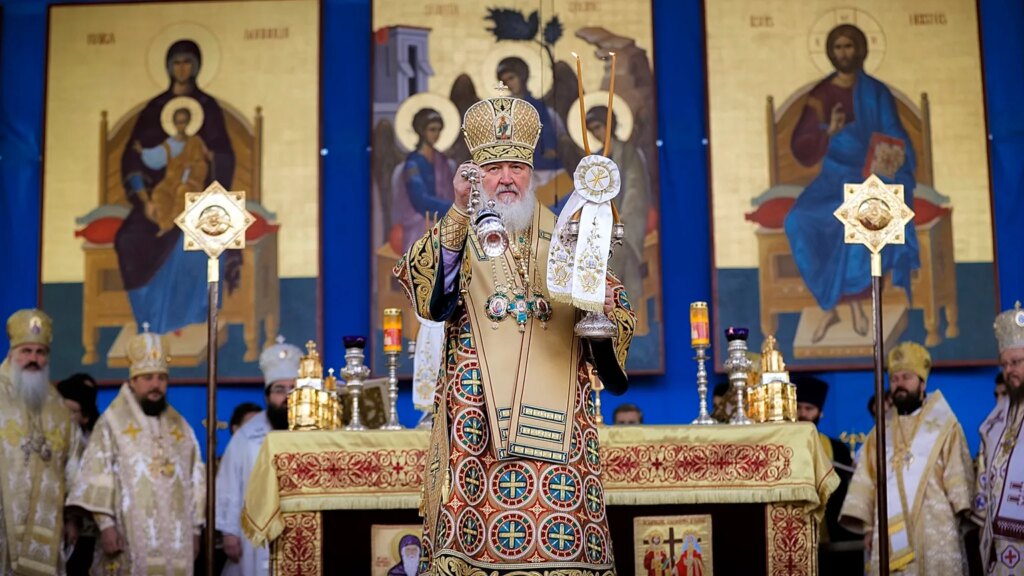
A «mini» sanctions package is planned for discussion by EU ambassadors this week, focusing on roughly ten individuals who had been shielded by Viktor Orbán’s administration, along with several Russian ships.
The incoming Hungarian government has indicated its willingness to consent to the European Union sanctioning Patriarch Kirill, the leader of Russia’s Orthodox Church, as well as other figures previously protected by former Prime Minister Viktor Orbán, Euronews has confirmed.
 ADVERTISEMENT
  ADVERTISEMENT
This step could open the door to including one of Russia’s most politically influential religious figures on the bloc’s sanctions list. Officials reported that preparations for a «mini» sanctions package are already underway.
The EU initially attempted to blacklist Kirill in 2022, accusing him of backing the full-scale invasion of Ukraine and disseminating revisionist propaganda. However, Hungary, under Orbán’s leadership, blocked this initiative, citing religious freedom concerns.
Brussels is hopeful that Orbán’s successor, Péter Magyar, will now approve the sanction. Magyar is eager to distance his administration from Orbán’s noted use of veto rights.
«Sanctions that could destabilize Hungary’s economy are absolutely off the table,» Márton Hajdu, a close associate of Magyar and chair of the Hungarian parliament’s foreign affairs committee, told Euronews.
«Nevertheless, where the previous government employed the Hungarian State’s power to negotiate private deals, I anticipate the new government will not obstruct collective EU efforts to intensify pressure on Russia to end the conflict.»
Some Russian individuals who were once included on the sanctions list but later removed at Orbán’s insistence—such as Sports Minister Mikhail Degtyaryov and oligarch Viatcheslav Kantor—may now return to consideration.
«Updating the list is a common practice,» an EU diplomatic source told Euronews.
Sanctions require unanimous agreement, and the roster of proposed names can evolve during negotiations. Slovak Prime Minister Robert Fico, who also exercised veto power to protect certain Russian individuals, was not in office when the EU sought to sanction Kirill in 2022.
‘Shadow fleet’ under review
Furthermore, the forthcoming proposal, which is modest in scale, aims to target several vessels from the «shadow fleet» that Russia utilizes to evade Western restrictions on oil exports.
The «shadow fleet» has been accused of operating under false flags and inadequate insurance, participating in sabotage, and posing environmental risks. Recently, countries including France, Sweden, and Poland have boarded suspect ships, underscoring increased determination to address such circumvention.
High Representative Kaja Kallas has called on the EU to accelerate actions against the «shadow fleet,» rather than waiting for a comprehensive sanctions package.
«We have adopted a rolling approach regarding sanctions on the ‘shadow fleet,’ avoiding large packages; once we identify ships, we place them on the list,» she stated last month.
Consequently, the EU will begin targeting vessels from the «shadow fleet» and related individuals progressively — a new approach for the bloc.
Ambassadors are scheduled to hold an initial discussion on the proposal this Friday, aiming for approval at the Foreign Affairs Council meeting on 15 June.
The 21st package of economic sanctions is anticipated to be presented in June, with hopes for final ratification by 15 July.
Riding the momentum following Orbán’s departure, the EU is also considering extending the sanctions renewal period from six months to one year, a measure the Hungarian prime minister previously opposed to maintain veto influence.