
Bulgaria, Spain, Slovenia and Austria lead the ranking.
For those seeking to fully engage with pristine nature this summer, discovering landscapes scarcely influenced by human activity and hosting hundreds of bird species, this list could be very relevant.
 ADVERTISEMENT
  ADVERTISEMENT
The ranking includes Europe’s 75 most untouched national parks, evaluated by factors such as the quantity of protected zones, species diversity, and levels of artificial illumination.
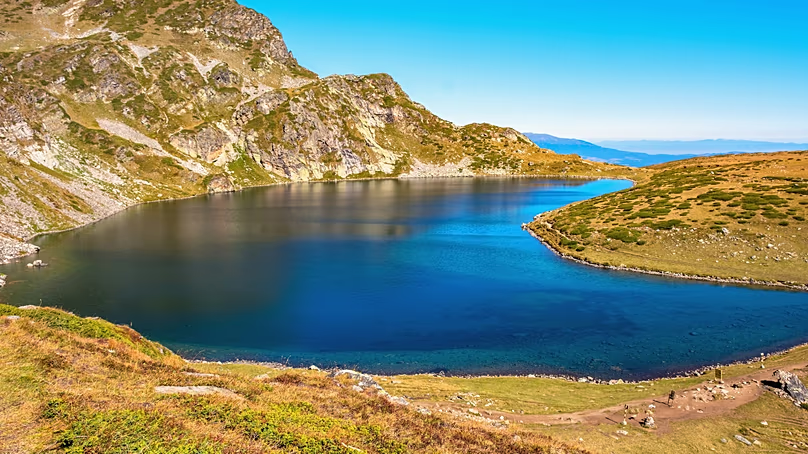
Bulgaria’s Rila National Park, situated at 1,400 metres above sea level and encompassing 28 protected areas, secures the top spot, according to the British cycling tour platform Love Velo.
The park’s highlight is the Seven Lakes, a series of glacial basins set within a thick emerald green pine forest.
The park’s challenging mountain landscape and its winding trails through wilderness areas may also appeal to cyclists.
Ranked second are the peaks of Spain’s Sierra Nevada, which intriguingly combine elements of African and European environments.
Thanks to its high elevation, the terrain allows a rapid transition over roughly 100 kilometres from snowy summits down to the Mediterranean beaches.
Cyclists can experience both easy valley rides and demanding climbs at high altitudes within the park.
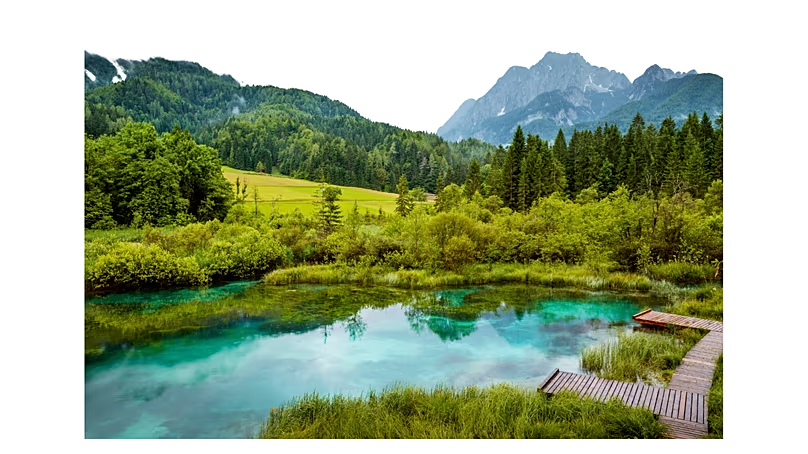
Slovenia’s Triglav National Park, placed third, attracts enthusiasts of water sports, who can raft along the Soča River, stretching 138 kilometres, or explore the Julian Alps.
Occupying the fourth position is another Spanish park, the National Park of Cabañeros.
This park is smaller relative to the previously mentioned ones, yet it boasts significant biodiversity, supporting over 220 species of birds, including the Spanish imperial eagle and the black vulture, as the report highlights.
Situated in Castilla-La Mancha, this expansive Mediterranean woodland and scrubland represents one of the best remaining instances of its habitat type within Europe, the report confirms.
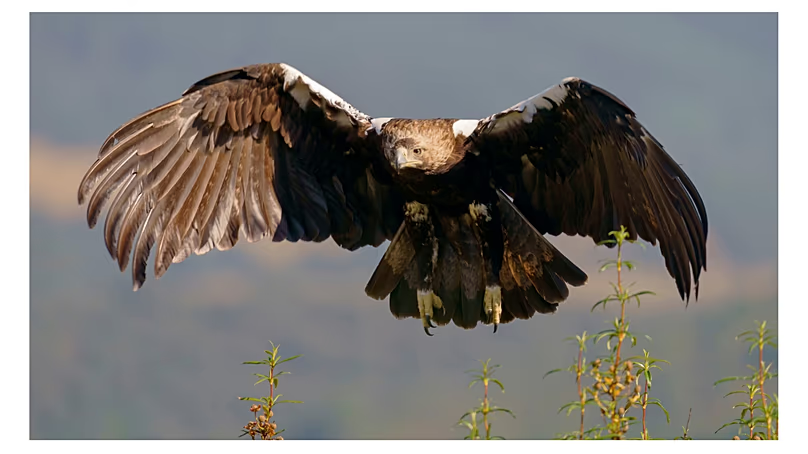
Austria’s Hohe Tauern completes the top five. Covering an impressive 185,600 hectares, it represents the largest national park in the Alps and ranks among the biggest in Central Europe.
The park borders over 300 glaciers, situated on more than 30 peaks exceeding 3,000 metres, including Austria’s highest peak, the Grossglockner, at 3,798 metres.
However, in terms of total area, the Nordic countries surpass these figures. Finland’s vast Urho Kekkonen park, listed ninth, covers 255,100 hectares, while Lemmenjoki, placed 13th, spans 285,000 hectares.
Yet, these are overshadowed by Sweden’s Fulufjället (25th) and Abisko (23rd), measuring 38 million hectares and nearly 8 million hectares respectively.
A notable feature distinguishing Nordic parks is the total absence of artificial lighting, which not only locates visitors far from urban areas but also significantly improves the chances of observing starry night skies.
For those prioritizing elevation, France and Italy remain preferred destinations.
Both nations host two national parks with average altitudes exceeding 2,000 metres: France’s Vanoise (2,378m) and Écrins (2,056m), and Italy’s Gran Paradiso (2,135m) and Stelvio (2,041m).
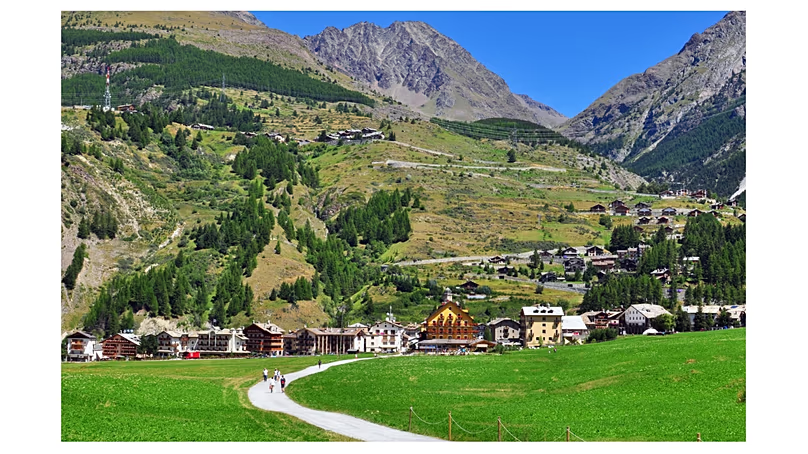
Although not occupying leading positions, Germany is represented by six national parks in the top 75: Berchtesgaden, Harz, Bayerischer Wald—characterized by mountainous and forest landscapes—and Müritz, Sächsische, and Schwarzwald, which feature more lakes and hills.
These parks ranked slightly lower because of a relatively higher human presence compared to others, as noted by Love Velo.
Across Europe, numerous parks face escalating challenges from overtourism and climate change.
Among the EU’s recent significant initiatives to safeguard nature is the Nature Restoration Law.
Effective since August 2024, this is the EU’s inaugural legislation obliging member states not only to conserve but also to rehabilitate the environment.
Countries are required to submit their restoration and protection strategies by September 2026, detailing the regions targeted and the methods planned.