
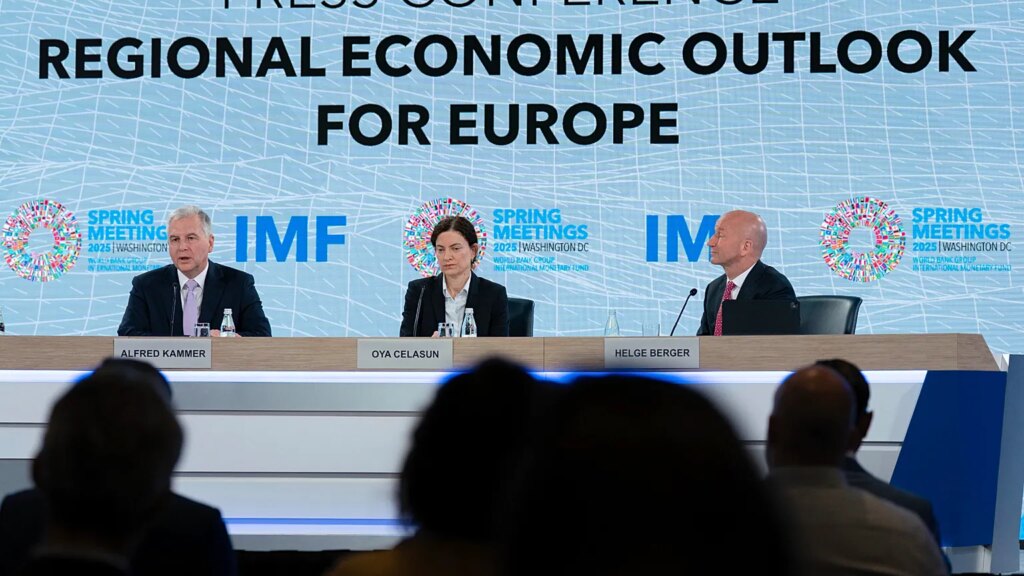
The IMF’s perspective on Europe remains strongly influenced by geopolitical events. A prolonged crisis could push Europe into recession.
The economic forecast for Europe has worsened considerably, largely due to energy interruptions linked to conflict, which are anticipated to tighten financial conditions, according to the latest International Monetary Fund report.
 ADVERTISEMENT
  ADVERTISEMENT
The IMF notes that while the European economy shows resilience, it is increasingly vulnerable to external shocks amid an energy crisis triggered by the war in Iran and the blockage of the Strait of Hormuz.
It emphasizes the need for rapid reforms, including finalizing the EU single market through better interconnection of power grids, enhanced financial integration, and increased productivity.
Oil prices have climbed approximately 70%, and gas prices in Europe remain about 45% higher than before the conflict. Though less drastic than the 2022 spike, these rises still pose a significant drag on growth, warns the IMF.
Europe’s ongoing transition to renewable energy — which now constitutes more than half of electricity production — has mitigated some effects of the energy crisis, yet the IMF states this provides only limited protection.
Growth projections have been adjusted downward, with the eurozone now expected to grow slightly over 1% in 2026, compared to about 1.4% before the Iran conflict, based on IMF forecasts. Inflation remains elevated due to sustained pressures from energy costs and supply chain disruptions.
Fiscal stability hinges on the conflict’s length
The IMF’s forecast heavily depends on geopolitical progress, warning that a brief conflict in the Middle East could constrain damage, whereas an extended crisis risks plunging Europe into recession.
«The overall economic consequences will rely on how the Middle East conflict unfolds, especially regarding energy supply and infrastructure,» Economy Commissioner Valdis Dombrovskis stated during a press briefing on Monday evening after a meeting of eurozone finance ministers.
He warned that the bloc cannot afford to repeat mistakes from the past, stressing that any assistance must be temporary, precisely targeted, and should avoid increasing overall demand.
Europe faced high energy prices even before the US-led conflict with Iran disrupted global markets on 28 February.
European industry incurred energy costs two to three times higher than those faced by competitors in the United States and China. The IMF highlighted that this persistent disparity stems from structural weaknesses rather than a short-term imbalance.
Retain the ETS and modernize the electricity grid, IMF advises
In this context, sustaining progress in energy reforms is vital.
The IMF report calls on the EU to uphold its carbon pricing scheme, the Emissions Trading System (ETS), which had approached collapse but is recognized by the IMF as a key driver for the ongoing adoption of wind and solar technologies.
The report cautions that abandoning the ETS could undermine significant achievements in reducing carbon emissions.
Beyond this, the IMF stresses that Europe must finalize its internal energy market, noting that the Commission’s grid package introduced last December represents an important advancement.
Upgrading the electricity grid and expanding storage capabilities are essential for the EU to succeed in its energy transition; these issues will shape the bloc’s policymaking — and likely political debates — in the coming months, as Commission President Ursula von der Leyen has urged the Parliament and Council, the EU’s co-legislators, to reach a political agreement on the grid proposal by summer.
European preference risks unintended consequences
The IMF report also reviews the Commission’s proposed Industrial Accelerator Act (IAA), acknowledging that it includes beneficial measures such as efforts to diversify supply chains.
However, it warns that “Made in Europe” procurement policies and foreign investment requirements conditioned on local value creation might distort markets and erode comparative advantages.
While protecting strategic sectors is a valid goal, the IMF emphasizes that such protectionism should be grounded in rigorous cost–benefit analysis.
Policy tools differ greatly in terms of effectiveness and expense; interventions should be reserved for situations where market mechanisms cannot adequately adjust.
The report further warns against common policy errors, noting that relaxing competition rules, implementing uncoordinated industrial policies, or scaling back climate commitments could ultimately diminish Europe’s competitive standing instead of reinforcing it.