
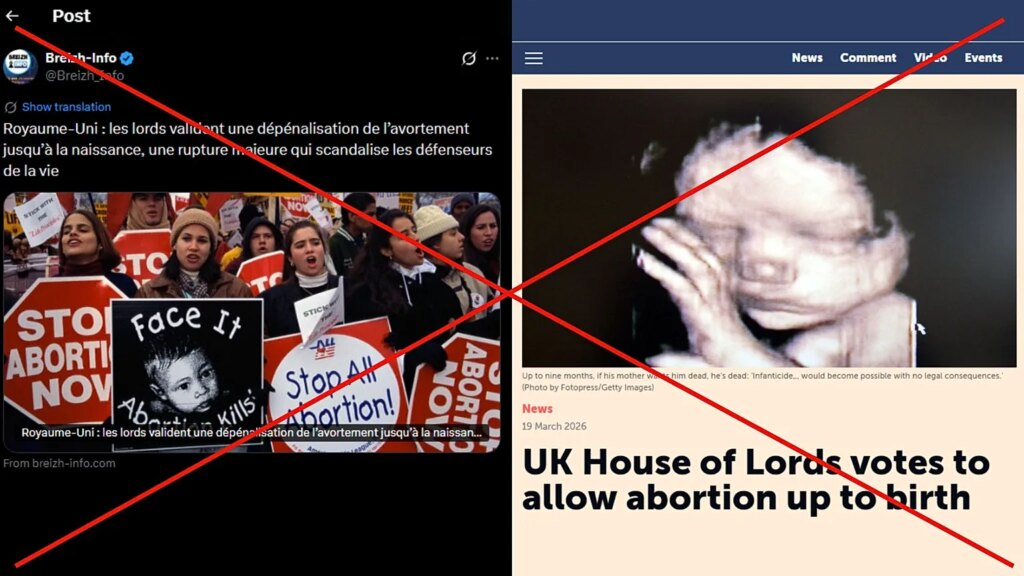
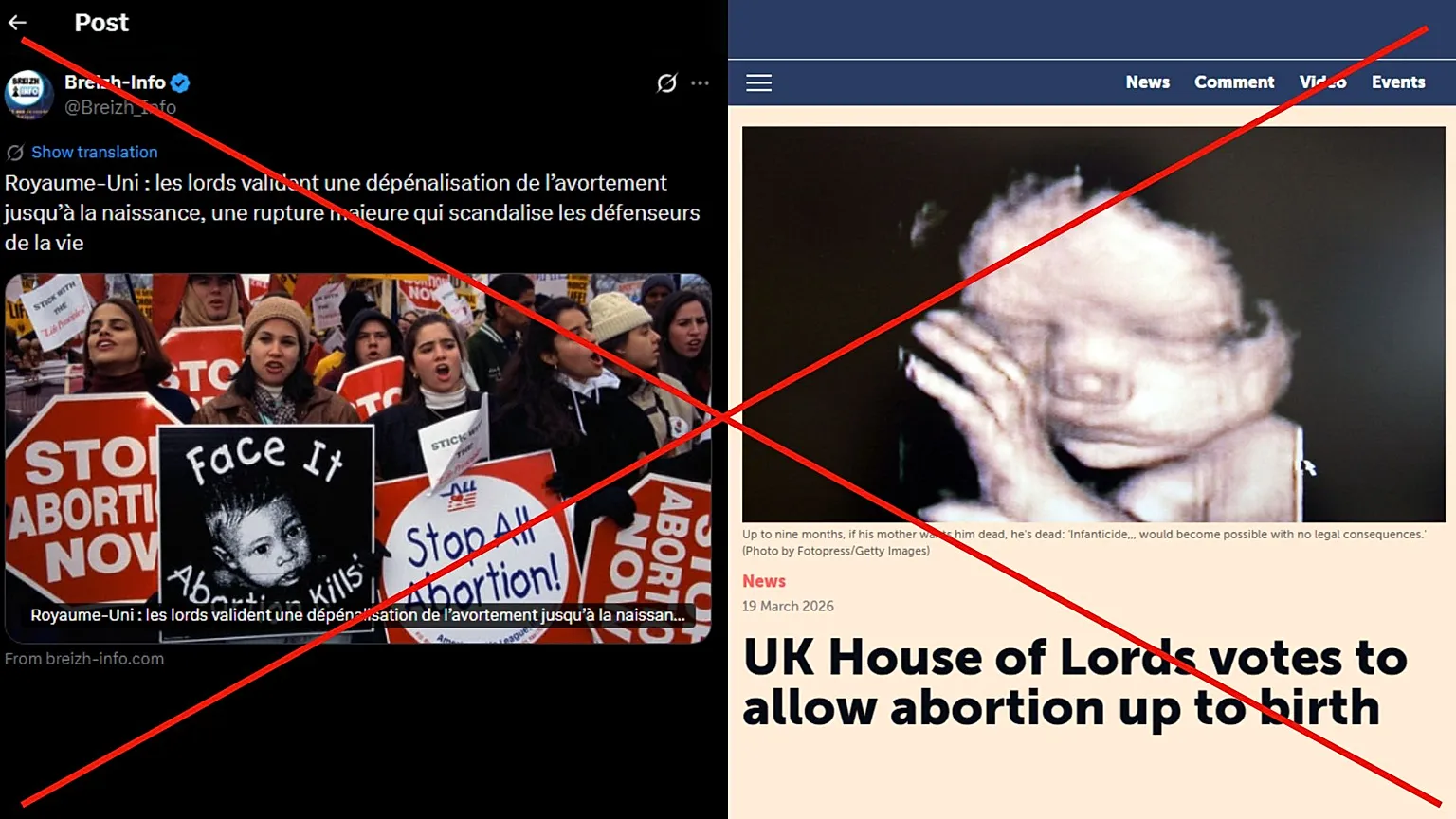
A collection of European online media outlets and social media accounts are reporting that the United Kingdom will permit abortion up to birth, based on a misunderstanding between the terms “decriminalisation” and “legalisation”.
On March 18, the House of Lords—Britain’s upper parliamentary chamber—voted to end the criminal penalties for women who terminate their pregnancies up to the point of birth.
 ADVERTISEMENT
  ADVERTISEMENT
Soon after the vote, headlines stating Britain “allows abortion until birth” spread rapidly, with fringe media in Spain, Italy, France, and Portugal amplifying these misleading accounts.
Several online articles echoed the claim, gaining significant traction on platforms such as X and Facebook, with some posts accumulating thousands of views and shares.
Spanish MEP Margarita de la Pisa, affiliated with the far-right Vox party in the European Parliament, shared an article from the fringe outlet La Gaceta titled: “Abortion will be legal until birth in the UK.” Her tweet attracted hundreds of likes, retweets, and exceeded 60,000 views.
However, the House of Lords did not approve legalising abortion until birth; instead, they opted to uphold an amendment passed by the House of Commons last year, which removes criminal liability from women who have abortions outside the legal framework.
This change means women will no longer be subject to criminal investigation, arrest, or legal prosecution for ending their pregnancies independently. Additionally, it grants pardons to women previously convicted or imprisoned for abortions outside the law.
The amendment is part of the Crime and Policing Bill and has not yet finalized its legislative approval.
Contrary to online assertions, it does not amend the legal conditions under which healthcare professionals provide abortions, as outlined in the 1967 Abortion Act, which legalizes abortion in the UK.
The Act requires that women seeking termination must have approval from two doctors certifying the necessity of the procedure for health reasons, with a 24-week gestational limit.
After 24 weeks, abortions may legally occur only under exceptional conditions, such as severe fetal abnormalities or when the mother’s life is at serious risk.
Because the amendment does not alter the Act itself, medical practitioners or others might still face legal repercussions if abortions occur outside the law’s established framework, though the women undergoing the procedures would not be criminally liable.
Part of the public misunderstanding arises from confusing “decriminalisation” with “legalisation.” In this instance, the House of Lords backed a reform that decriminalises women terminating their pregnancies but retains the existing legal structure.
The amendment, which passed after members rejected its removal by 185 votes to 148, was proposed amid growing concerns about the use of outdated Victorian-era laws to prosecute women for ending their pregnancies.
In recent years, over 100 women have faced criminal investigations under the 1861 Offences Against the Person Act, prompting demands by activists and some lawmakers to modernize the law and stop further prosecutions.
How does the EU compare?
The UK is not the first European nation taking measures to decriminalise abortion.
The majority of EU member states permit abortion «on request» during the initial trimester. Meanwhile, a smaller group—including Denmark, Estonia, Luxembourg, the Netherlands, and Sweden—maintain liberal abortion laws that nearly equate to full decriminalisation, albeit with some restrictions.
The World Health Organization advocates for complete decriminalisation, recommending removal of gestational limits and elimination of obstacles such as mandatory waiting periods or third-party authorization.
In 2024, France became the first country to enshrine abortion as a “guaranteed freedom” within its constitution, effectively preventing any criminalisation.
Conversely, nations like Germany and Switzerland still classify abortion as illegal under criminal law but allow it under specific conditions, including compulsory waiting periods and counselling.
Regardless, the European landscape remains varied and evolving: in April 2024, the European Parliament adopted a resolution urging amendments to the EU Charter of Fundamental Rights to include the right to safe, legal abortion.
This resolution called on member states to fully decriminalise abortion and remove all remaining physical, financial, and regulatory obstacles to reproductive healthcare.
However, after this vote, the resolution stalled, since any modifications to the EU Charter require unanimous consent from all member states—a consensus blocked by strong opposition from countries such as Malta and Poland.