
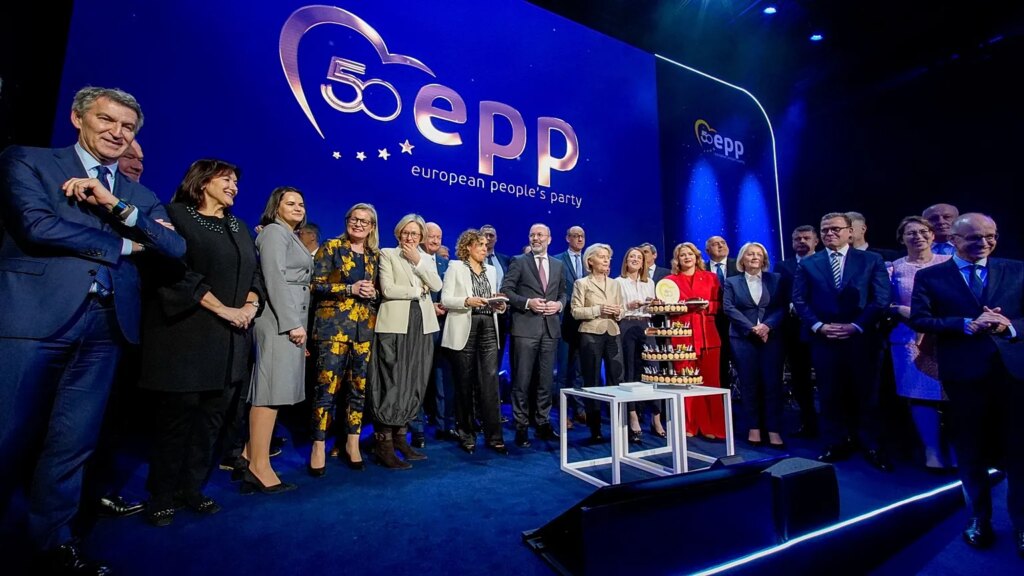
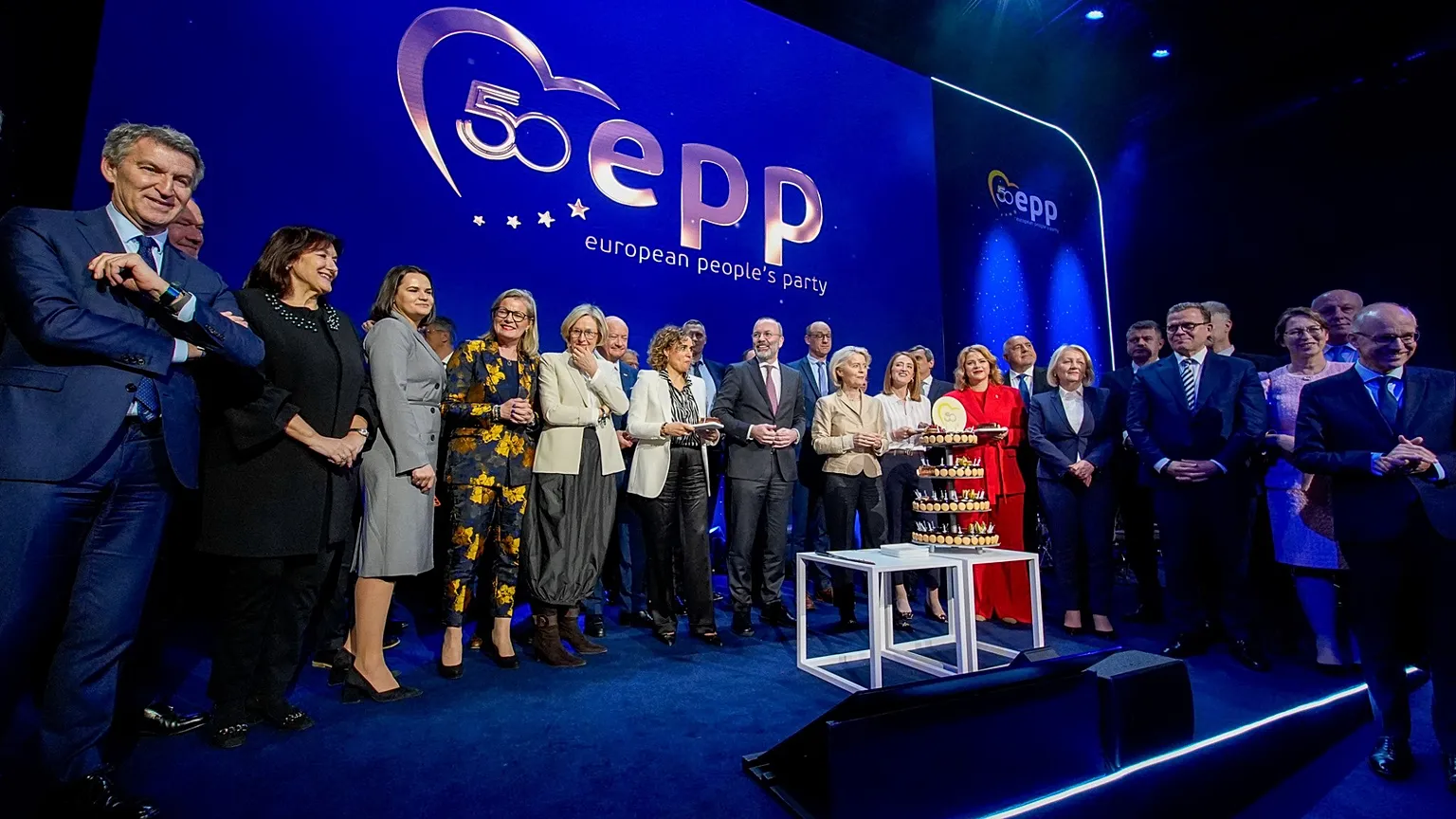
The European People’s Party marked its 50th anniversary in Brussels amid internal disputes sparked by accusations of collaboration with the far-right within the European Parliament.
At an elegant venue in Brussels, attendees raised champagne glasses to celebrate the European People’s Party’s 50-year milestone on Wednesday.
 ADVERTISEMENT
  ADVERTISEMENT
However, concerns about the far-right influence cast a shadow over the event as the EPP confronts one of its most pressing challenges in decades: defining the future path of Europe’s conservative movement.
Leadership within Europe’s oldest and most influential political force is troubled by accusations of coordinating activities in the European Parliament alongside anti-EU factions through a WhatsApp group.
This incident carries importance as it exposes an institutionalised form of cooperation and indicates a weakening of the barrier that traditionally forbade collaboration with parties once deemed unacceptable in national governments — a boundary now eroding in Brussels.
Such developments could drastically alter coalition-building strategies within a highly fragmented political arena, which is increasingly polarized, threatening the endurance of centrist alliances across Europe and major democracies.
«It was a serious error,» confided a senior party member to Euronews under anonymity. The WhatsApp group matter was a subject of quiet discussion during the event, with multiple party members expressing concern over its consequences and the signals it conveys.
«This represents a sensitive topic for us: in my country, voters outright reject this,» stated a former German MEP.
Open collaboration with the far-right Alternative for Germany is frequently cited as a clear boundary by Chancellor Friedrich Merz. He attended the event, seated in the front row with a reserved expression, flanked by other heads of government and past and present EU institutional leaders.
A few places to his left, Manfred Weber, the EPP leader, sat — regarded by Merz as bearing the «responsibility» to terminate any dealings with far-right groups.
«This must have been quite a moment for him,» said an EPP official, noting increased tensions between the two figures.
Accusations regarding the EPP’s proximity to the far-right are longstanding. However, the issue escalated dramatically this week when the German News Agency DPA revealed a chat indicating coordination between the EPP and far-right associates, including Alternative for Germany’s personnel, on drafting migration legislation.
«Merz strongly dislikes issues emerging from the European Parliament. For Germans, this is a major story,» explained another insider familiar with the case.
«We condemn what appears to have happened at the staff level last week. We categorically do not cooperate with the far-right in the European Parliament,» Merz declared on Monday.
Two days afterwards, his statement echoed throughout the anniversary’s polished halls and amid clinking Prosecco glasses, particularly when Weber himself identified «the main battle» ahead for the EPP as the fight against far-right populists.
«Those challenging European integration are not merely competitors; they are our political adversaries. As EPP president, I have established our firewall,» Weber announced, signaling directly to the German Chancellor.
Una formación política con un dilema
No todos los representantes del EPP coinciden en cuál debería ser la línea roja.
El término “Brandmauer” que prohíbe cualquier cooperación con la extrema derecha en Alemania no tiene el mismo impacto en el resto de Europa ni en Bruselas, pese a las afirmaciones de Weber.
El líder del EPP no ha evitado formar alianzas de facto con varios partidos situados a la derecha, comenzando por los Conservadores y Reformistas Europeos, que incluyen a Hermanos de Italia de Meloni y que ya no son considerados fuerzas anti-UE por la mayoría dentro del EPP.
Más allá de la colaboración práctica revelada por DPA, existe una alineación de facto entre las posiciones del EPP y las de grupos de extrema derecha como Patriotas por Europa (PfE) y Europa de Naciones Soberanas (ESN), el grupo al que pertenece AFD, en ciertos asuntos.
Oficialmente, el grupo sigue comprometido con una “mayoría centrista”, que apoya a la Comisión de Ursula von der Leyen y excluye a fuerzas nacionalistas. Análisis cuantitativos de votaciones en el Parlamento sugieren una convergencia con S&D y Renovar, aliados tradicionales del EPP, en nueve de cada diez ocasiones.
No obstante, las votaciones en el Parlamento Europeo son valoradas también desde una perspectiva política, dado que una iniciativa legislativa clave no tiene la misma importancia que una resolución no vinculante.
En temas migratorios y medioambientales, el EPP ha impulsado una mayoría de derecha, votando de manera similar a fuerzas antes consideradas demasiado tóxicas para la derecha moderada, como Rassemblement National, Fidesz de Viktor Orbán y Alternative for Germany. Mientras tanto, en Berlín, incluso la cooperación informal se considera inaceptable.
Las leyes controvertidas que permiten centros de deportación fuera de la UE y la posibilidad de enviar solicitantes de asilo a países sin vínculos previos son resultado de una alineación más dura hacia la derecha, así como un retroceso general en la legislación proambiental, como las normas contra la deforestación, bajo pretextos de simplificación y competitividad.
Prácticamente, el muro cortafuegos ya ha caído en casi todas partes. Los miembros del EPP deben decidir si intentan reconstruirlo o aceptan que simplemente no existe.