
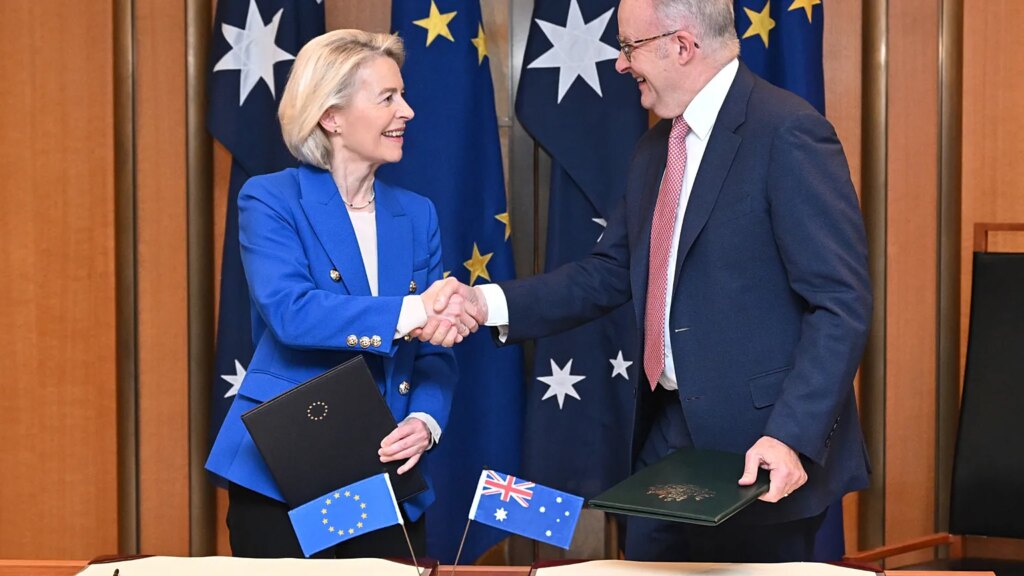
The European Commission secured a trade agreement with Canberra on Tuesday, easing restrictions on goods flows while maintaining quotas on select EU agricultural products and largely preserving Australia’s luxury car tax.
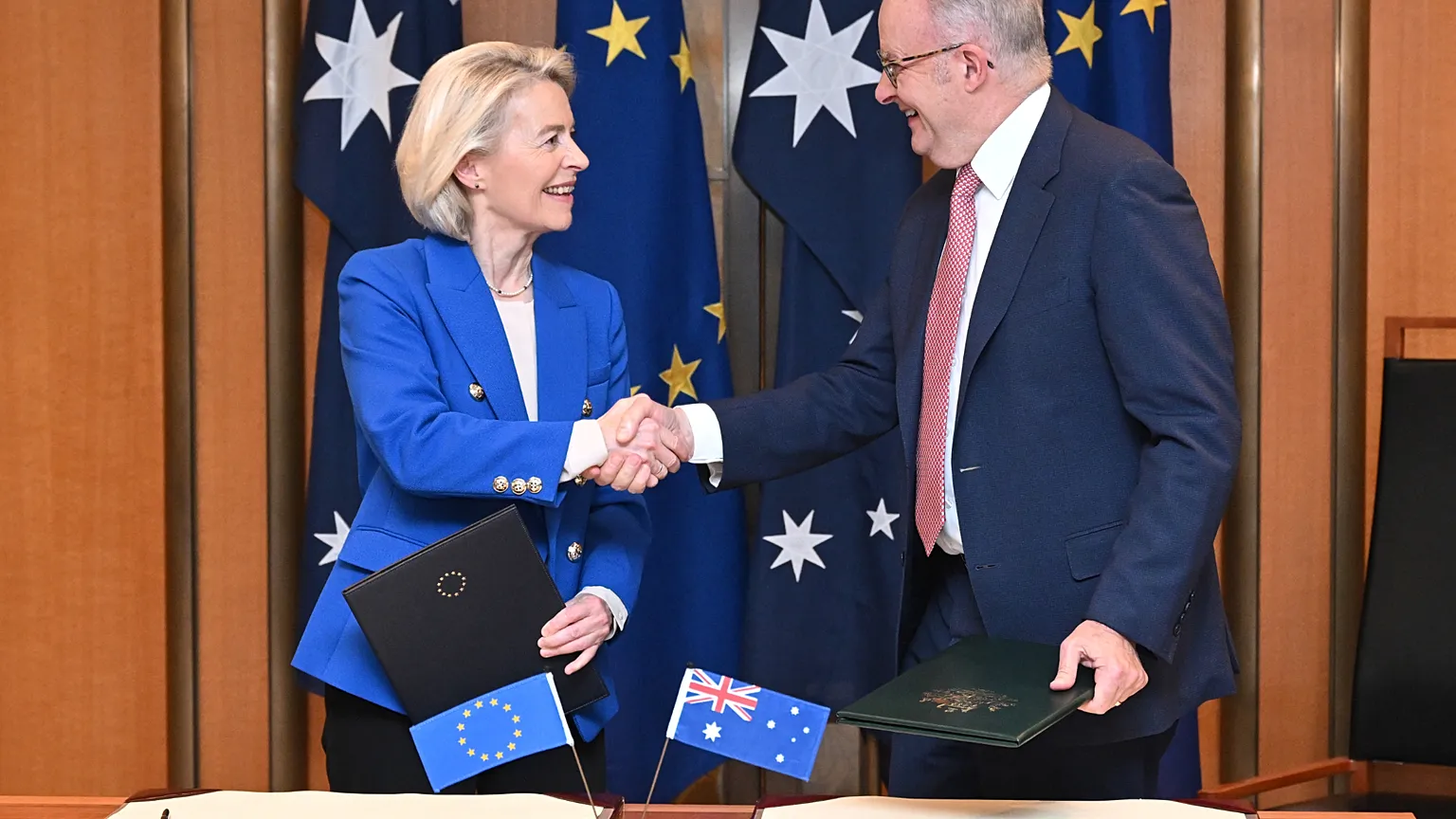
European Commission President Ursula von der Leyen formalized a free-trade pact with Australian Prime Minister Anthony Albanese, reducing tariffs on the majority of EU goods and agricultural exports.
 ADVERTISEMENT
  ADVERTISEMENT
This agreement represents another achievement for Brussels as it accelerates efforts to broaden trade relationships and secure strategic allies amid growing international uncertainties.
The Commission indicated that the deal will save the EU €1 billion annually in tariffs, with exports expected to increase by up to 33% within the next ten years.
Agriculture remained a contentious topic, as EU farmers had already voiced opposition to the Mercosur trade agreement, and a legal challenge from MEPs continues to threaten its ratification.
Tariffs will gradually be abolished on items such as cheese (phased out over three years), wine, certain fruits and vegetables, chocolate, and processed foods.
Regarding the most sensitive categories — beef and sheep, which halted talks in 2023 — Australia consented to annual quotas of 30,600 and 25,000 tonnes, respectively.
A safeguard clause enables the EU to protect sensitive sectors if there is a surge in Australian imports that negatively impacts the EU market.
Beyond the agricultural scope, the agreement opens access to essential Australian raw materials, including aluminium, lithium, and manganese.
However, Brussels did not succeed in eliminating Australia’s luxury car tax; instead, 75% of EU electric vehicles will qualify for exemption.
The agreement embodies a geostrategic initiative
The Commission anticipates significant export growth in vital industries, such as dairy (up to 48%), motor vehicles (52%), and chemicals (20%).
Brussels has emphasized this deal as part of its strategy to cultivate partnerships in the Indo-Pacific, where Chinese influence has become increasingly prominent. On Tuesday, a security and defense partnership with Canberra was also announced.
“Although the EU and Australia are separated by distance, they align closely in their worldview,” von der Leyen remarked, adding: “With these vibrant new collaborations in security, defense, and trade, our ties deepen significantly.”
Since Donald Trump’s return to power in 2025, trade agreements carry greater geostrategic significance for the EU as it pursues new markets.
In 2025, Brussels finalized agreements with Mexico, Switzerland, and Indonesia. The Mercosur pact was signed earlier this year and will be provisionally applied starting 1 May, despite an ongoing legal challenge from the European Parliament.
Additional negotiations are underway. Von der Leyen informed EU ambassadors on 9 March that talks continue with the Philippines, Thailand, Malaysia, the United Arab Emirates, and countries across Eastern and Southern Africa.