
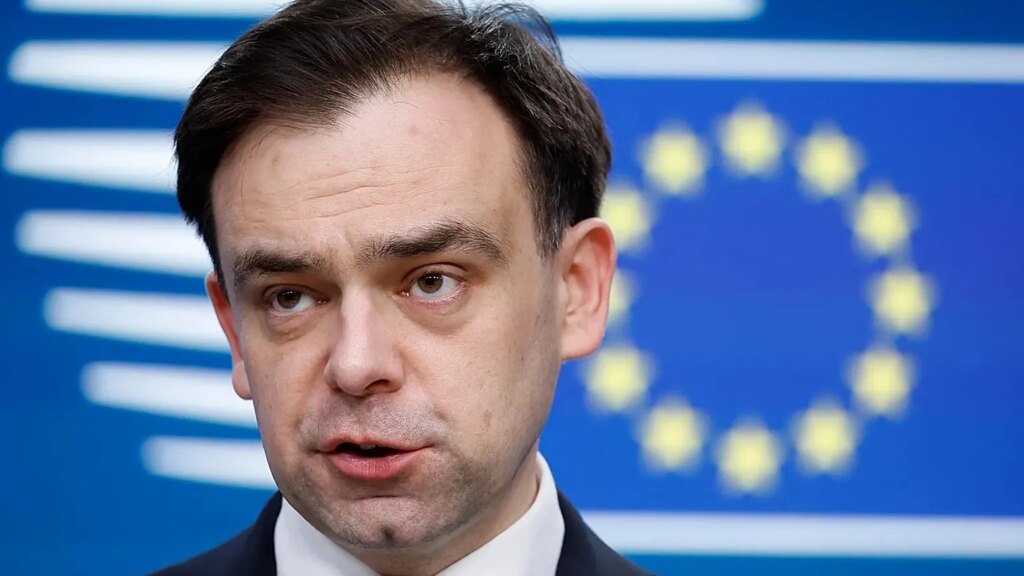
Andrzej Domanski highlighted that preserving the złoty as Poland’s national currency offers the economy greater adaptability amid global volatility, despite ongoing discussions about deeper eurozone integration.
During his interview with Euronews at the European Parliament, Domanski emphasized that the recently signed free trade agreement with India arrives at a pivotal moment for Europe, as international trade tensions increase and the EU seeks to broaden its economic alliances.
Although Poland has demonstrated solid economic results, it remains cautious about adopting the euro. Domanski argued that retaining the złoty ensures economic flexibility during external shocks.
“Having our own currency serves as a cushion in crises and aids the economic rebound,” he stated, while also acknowledging arguments supporting membership in the eurozone.
“At this point, I believe it is advantageous for Poland to maintain the złoty,” he added.
Significance of the EU-India agreement for Poland
EU officials praised the free trade deal with India, labeled the “mother of all deals,” as the most ambitious trade agreement the bloc has negotiated so far, granting access to a market of two billion consumers.
The European Commission expects the pact with New Delhi to significantly cut tariffs on EU goods—from automobiles to wine—providing alternatives following US President Donald Trump’s tariff measures.
For Poland, one of the EU’s rapidly expanding major economies, the agreement opens up new export possibilities.
“Polish companies are rapidly growing and require new markets,” Domanski noted.
“India represents a dynamic market with substantial potential, and this treaty creates opportunities for enhanced cooperation in sectors that previously had limited access.”
While Warsaw indicates the need for further detailed analysis, the government believes the agreement could markedly increase Polish exports and strengthen investment relations with India.
Challenges in the global economy
Domanski placed the agreement within the wider geopolitical landscape, marked by strained EU-US relations and escalating protectionist trends worldwide.
“Reduced tariffs are always preferable to higher ones,” he remarked. “They benefit businesses, consumers, and the overall economy. Diversification remains crucial, and India is a natural partner with high growth prospects.”
Still, Poland continues opposing the EU-Mercosur trade agreement with South American countries, citing risks to the Polish agricultural sector.
Consequently, Warsaw advocates for additional safeguards to protect domestic farming interests.
The agreement was signed on 17 January, and aims to establish a free trade zone encompassing over 700 million people.
However, the deal faces controversy across Europe, with several nations such as France and Hungary expressing firm opposition.
Poland’s pursuit of hosting the European Customs Agency
Poland is positioning itself as a candidate to host the upcoming European Customs Agency (EUCA), which is set to play a vital role in enhancing EU border controls and enforcement of customs regulations.
“Poland has successfully executed customs reforms, employs seasoned customs officials, and possesses excellent transport infrastructure,” Domanski highlighted, pointing out Warsaw’s central location and Chopin Airport’s proximity to the city centre.
He also emphasized Poland’s increasing economic influence and argued that EU agencies should be more evenly distributed geographically among member states.
“In this era of rising uncertainty, Europe requires a single entity overseeing its customs borders,” the minister asserted.
“This is essential for competitiveness, security, and safeguarding the single market.”
A final decision on EUCA’s location is anticipated later this year, with nine EU capitals competing, including Lille, Rome, and The Hague.