
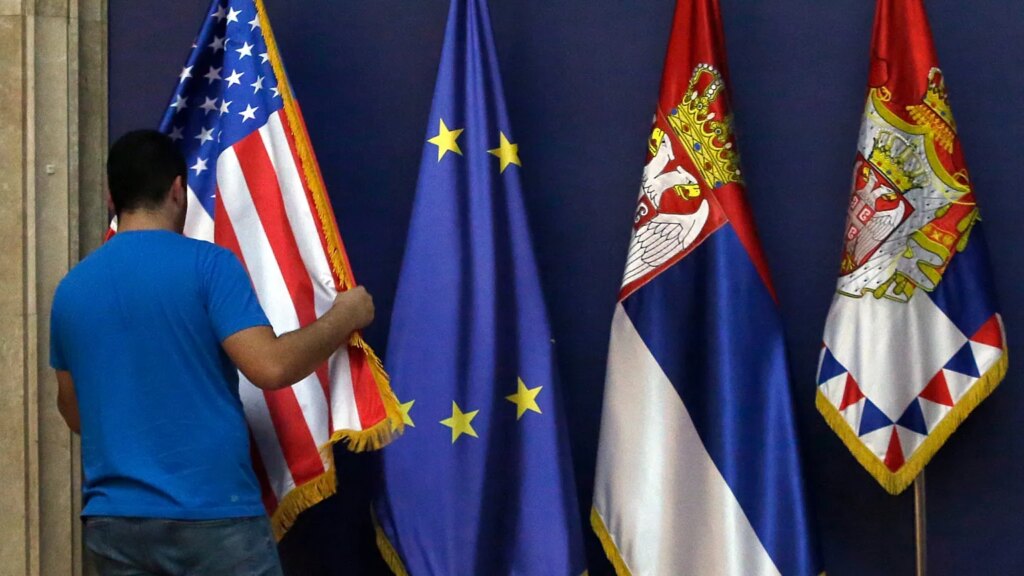
Washington traditionally endorsed the EU enlargement process, believing that adding more member states would boost commerce and influence. That stance has changed. Experts tell Euronews that Donald Trump shows indifference.
With EU enlargement returning to the political spotlight, the United States has taken a backseat in a process that could enhance democracy and prosperity for millions in the Western Balkans and beyond.
Whereas earlier US administrations actively supported efforts to integrate additional countries into the European Union, President Donald Trump has maintained a notably silent stance.
No formal policy has been publicly declared specifying his views on the accession of individual EU candidate countries or the enlargement strategy overall.
In response to Euronews’ inquiry, a State Department representative replied with a brief statement: “The United States believes EU accession is a decision for candidate countries and the existing member states.”
Essentially, this indicates Washington’s lack of a definitive position.
“Europe rarely features in Trump’s agenda except within trade matters,” explained Nicholas Lokker from the Center for a New American Security, a bipartisan think tank based in Washington, in an interview with Euronews.
“Moreover, he shows minimal interest in promoting democracy in Europe or elsewhere.”
This marks a clear departure from established US foreign policy customs.
Throughout the Cold War, both Republican and Democratic governments regarded America as a key European power committed unequivocally to creating a “whole and free” democratic Europe—from initiatives like the Marshall Plan and NATO to supporting German reunification and stabilizing the Western Balkans after the 1990s conflicts.
In regards to the EU, US endorsement was perceived in Washington as a means to bolster peace, security, and economic growth in Europe, which, in exchange, would serve US strategic and economic interests.
Expanding EU membership implied a more stable, integrated Europe, diminishing the need for a heavy US military footprint on the continent and expanding business prospects through broader trade and investment within a wealthier European single market.
This explains Washington’s approval of the EU’s decision to commence accession talks with Ukraine and Moldova in December 2023, calling it a “powerful affirmation of the EU candidates’ and prospective candidates’ European future.”
Furthermore, Joe Biden’s State Department described it as “a historic moment for Europe and for the transatlantic partnership.”
‘Europe is insignificant to Trump as a great power’
Today, such a decisive declaration from the US government seems lacking.
The Trump administration considers whether EU aspirants—from Montenegro to Moldova—achieve their full democratic and economic potential inside the EU a non-priority.
“His antagonism toward Europe leads him to view efforts that strengthen Europe as weakening the United States,” noted James Bindenagel, director of the Center for International Security and Governance at the University of Bonn and former US ambassador, in a discussion with Euronews.
“Trump prefers to obstruct rather than support deeper European integration,” he added.
Indeed, Trump has often perceived the EU more as an economic rival than as an ally.
His foreign policy framework emphasizes “America First,” embracing nationalist aims that favor bilateral ties above multilateral agreements required for EU enlargement.
According to Lokker, Trump approaches geopolitics as a contest among major powers like the US, Russia, and China—but excludes Europe.
“He envisions the world divided into spheres of influence, placing the Balkans under Russia’s domain,” he explained.
“Trump is notably favorable toward authoritarianism, admiring European ‘strongmen’ such as Orban or Slovak Prime Minister Robert Fico,” Bindenagel observed.
Though Trump recognizes that EU enlargement could bolster Europe and weaken Russian President Vladimir Putin, “he simply does not want to weaken Putin,” Bindenagel emphasized.
The only case where EU enlargement has attracted somewhat notable attention from the Trump administration is Ukraine.
Trump and Ukraine’s NATO accession
Ukraine, a candidate country against which Russia launched a full-scale invasion over three years ago, continues to struggle to preserve its independence.
While acknowledging Ukraine’s strategic role and European aspirations, Trump has not publicly stated whether he supports or opposes its EU membership.
Nonetheless, a Bloomberg report in August indicated that President Trump discussed Ukraine’s membership with Hungarian Prime Minister Viktor Orbán, questioning Orbán’s opposition to Kyiv’s candidacy.
What is evident from Trump’s remarks is his opposition to Ukraine joining NATO.
“You (Ukraine) can forget about NATO,” Trump said during a cabinet meeting in February. “I think that’s probably why the whole conflict started.”
With NATO access denied, Ukrainians may see EU membership as a significant “consolation prize” connected to security assurances.
By strengthening ties with EU members, Ukraine could enhance its capacity to resist Russian imperial ambitions, according to Lokker.
“The Kremlin would hesitate before attacking a country covered by the bloc’s mutual defense clause, particularly considering the substantial rearmament underway within the European Union,” he added.
Supporting Ukrainian EU integration could offer Washington a way to fulfill Kyiv’s ongoing requests for security guarantees while reducing America’s share of responsibility for European defense.
“From Trump’s standpoint, this would be logical,” Lokker remarked.
As the largest candidate for accession—and given the US’s growing economic interests in its mineral sector—Ukraine’s economic progress would yield considerable advantages for Washington.
However, achieving this potential necessitates a vast post-war reconstruction initiative.
Facilitating Ukraine’s EU accession would bolster that effort by unlocking substantial funds aimed at transforming its economy.
Does this persuade the US president? The answer remains uncertain.
According to Bindenagel, Trump views Ukraine as embroiled in a war with Russia that he wishes to end quickly—but only to claim credit as a peacemaker afterward.
“Therefore, he wants Russia to cease the fighting, but is unwilling to take active measures to make it happen.”
The abortive US-Russian summit in Alaska last summer, alongside the much-anticipated but eventually canceled Trump-Putin meeting in Budapest, illustrates this ambivalence.
“Trump’s stance is hard to interpret because he lacks a coherent strategy,” Lokker explained. “Look at all the inconsistencies regarding Ukraine since his inauguration.”