
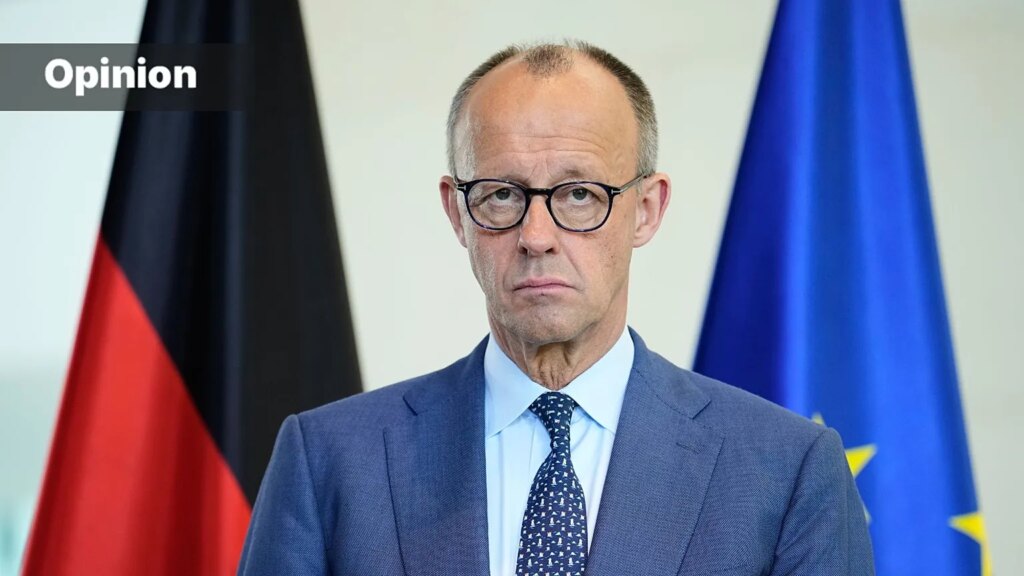
Following Germany’s decisive loss in the contest for a UN Security Council seat, one conclusion stands out: the nation is in critical condition. An opinion piece by Euronews’ Editorial Director, Claus Strunz.
After sixteen years under Angela Merkel, characterized by significant policy failures in energy, economic, and migration sectors, and three troubled years of a dysfunctional coalition led by Olaf Scholz, Friedrich Merz’s administration is currently heading toward an unprecedented low.
 ADVERTISEMENT
  ADVERTISEMENT
The German public might still attempt to rationalize why smaller nations like Portugal and Austria gained more support globally than Germany, the leading power in Europe. Portugal maintains numerous international friendships, receives substantial goodwill in Africa, and the UN Secretary-General is Portuguese. Nonetheless, Austria, a neighboring country, receiving significantly more votes is both humiliating and a wake-up call.
Germany has clearly lost credibility and trust. Politically, its influence has diminished, and economically, it is increasingly perceived as a declining power. Compliments now mostly reference its historical accomplishments, as “Made in Germany” is more and more linked with high expenses and low efficiency. Germany resembles an elderly care home and a museum preserving a world that no longer exists, despite being the intended driver of Europe’s future.
If Germany fails to recover, the European Union itself faces peril
Is this assessment justified?
As a devoted German and European, the following statement is difficult to express: yes, it is justified. Worse yet, Germany is responsible for this outcome itself.
For too long, policy has been steered by ideological ambitions that were either detrimental to future prosperity or irrelevant. Many conservatives transitioned into progressives, rendering themselves politically obsolete.
Europe already possesses a wide range of left-wing parties. As a consequence, the crucial balance between pragmatism and ambition, between preservation and reform — once a trait across the political landscape — has been lost.
Currently, the matter extends beyond parliamentary elections, politicians’ wage increases, bans on combustion engines, or gender identity debates. Germany’s destiny is now deeply intertwined with Europe’s.
Should Germany fail to stand firm, the European Union itself risks its stability. Brussels often hears, sometimes in jest and sometimes with genuine worry, that the EU subsists as long as Germany finances it.
Hence, a sweeping change is necessary.
Values influence only when backed by power
In an increasingly competitive world, economic strength, technological independence, and political efficiency are paramount. Values remain essential but exert influence only when supported by power. The key to this transformation is straightforward: prioritizing pragmatism over ideology.
This cannot be accomplished through speeches or moralizing — one of Western Europe’s less inviting customs. Leadership arises through economic vitality, political trustworthiness, and effective problem-solving.
Four major priorities stand out for this reconstruction mission:
Firstly, Germany needs to restore its economic competitiveness. High energy expenses, excessive bureaucracy, slow digital adoption, and lack of sufficient investment have weakened Europe’s largest economy.
A robust Europe requires a robust Germany.
Peace and stability are no longer guaranteed
Secondly, Germany must strengthen its defense capabilities and take on more responsibility for European security. Geopolitical conditions have evolved. Peace and stability cannot be assumed any longer. Europe demands credible deterrence and strategic strength.
Whether aiming for the German armed forces, the Bundeswehr, to become “the strongest conventional army in Europe” by 2039 — exactly a century after Nazi Germany’s invasion of Poland — is sensible remains debatable. Nonetheless, it at least represents a coherent strategy.
Migration must be better managed
Thirdly, Germany must optimize its management of migration. Humanity and order are not contradictory. A nation failing to secure its borders, seldom expelling illegal immigrants, and losing control over irregular migration will fail to command respect. Secure borders, efficient asylum processes, and successful integration are vital for social unity and trust in democratic law.
Fourthly, Germany needs to reclaim its position as an innovation hub. Artificial intelligence, digital infrastructure, advanced manufacturing, scientific research, and new energy technology will shape future generations’ prosperity.
Europe cannot afford to lag behind the United States and China. A country that once excelled in education and innovation but now lacks a world-class university, has dropped in global education rankings, seldom wins major scientific awards, no longer sets global norms, burdens research with regulations, overregulates AI, abandons nuclear research, distances from combustion-engine innovation, and dismisses advances in genetics will struggle to compete with the world’s most inventive nations.
Europe requires a strong and dependable Germany
To clarify: this is not advocacy for German hegemony.
Europe needs a Germany that is dependable, robust, and capable of decisive action. A partner committed to peace and prosperity. If Germany renews itself, it will once again be a driving force for Europe. Failure to do so will severely hinder the continent’s ability to maintain prosperity, security, and influence.
The encouraging news is: it is never too late — the important thing is to start now.
In 1648, the Peace of Westphalia ended the Thirty Years’ War, which devastated Central Europe, particularly Germany, with depopulation in many regions. This treaty concluded the conflict through a pan-European peace congress and became the foundation of modern European diplomacy.
In 1945, Germany and Europe lay in ruins. What followed was recovery, reconciliation, and the establishment of European cooperation. Prosperity and advancement ensued.
In 1990, the Cold War concluded. German reunification took place, the Iron Curtain dividing Europe vanished, and for most Europeans this signified further democratization, reconstruction, and European development benefiting all.
Now, a new beginning for Germany and Europe is imperative. Not someday, but now.
There are two possible paths out of intensive care: one leads to revival, the other to end-of-life care.
Chancellor Merz will have a pivotal role in deciding Germany’s — and Europe’s — future course. He may be recorded in history either as the physician who saved the patient or as the gravedigger.