
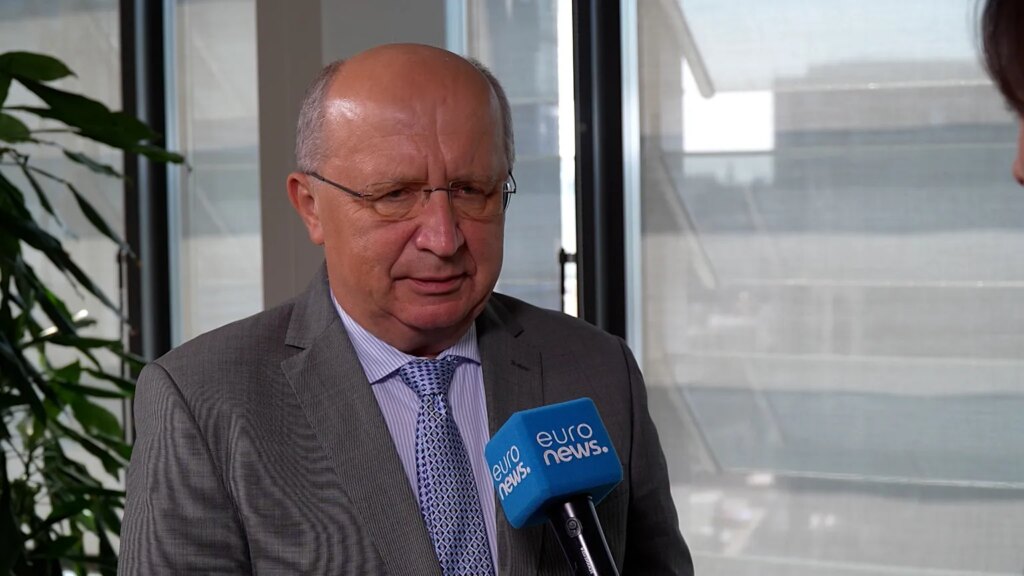
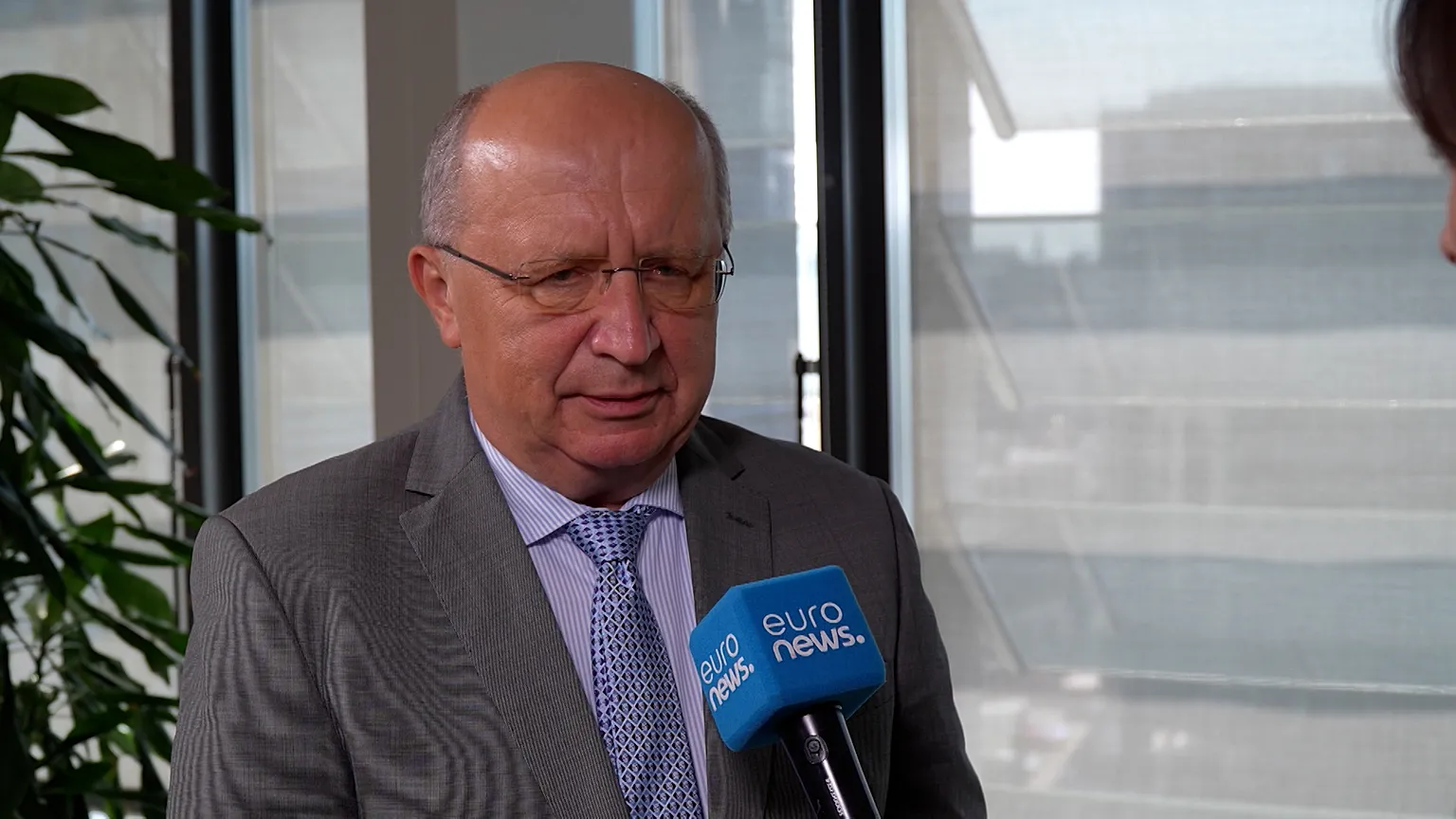
In an extensive discussion on Euronews’ flagship morning show Europe Today, European Commissioner for Defence Andrius Kubilius addressed Ukraine’s recent battlefield progress, Europe’s defence goals, and the interpretation of declarations coming from the White House.
Andrius Kubilius, the European Commissioner for Defence, noted that Ukraine’s successful strikes on Russian maritime vessels and energy infrastructure have strengthened Kyiv’s position — a development that could ideally compel Russian President Vladimir Putin to engage in peace talks.
 ADVERTISEMENT
  ADVERTISEMENT
“Ukraine’s achievements over the past six months through deep strike capabilities are remarkable,” he commented during the Europe Today programme.
“Such progress ought to be a strong message for Putin and his circle — demonstrating that he cannot secure any significant breakthrough in his war objectives. This should mark the point where genuine negotiations for a just peace commence.”
The European Union continues to back Ukraine against Russia’s ongoing full-scale invasion by providing a €90 billion loan, with €60 billion allocated for defence spending.
Additionally, European Commission President Ursula von der Leyen visited Kyiv this week and unveiled a new drone support agreement with Ukraine.
European defence
Regarding European defence, Kubilius expressed disappointment over some member states scaling back their initial ambitions for participation in the EU’s €150 billion defence loan initiative, known as Security Action for Europe (SAFE), attributing this caution to domestic fiscal constraints.
This initiative aligns with the EU’s drive to enhance its military capabilities by 2030 — a target year identified by numerous national security and defence bodies as critical, given potential threats like Russia.
Kubilius highlighted that 19 nations have had their loan applications approved by the European Commission, though some are now reassessing their original proposals.
“We observe that certain countries are somewhat lowering their original expectations,” he remarked.
“A few nations appear more hesitant about utilizing the funds, mainly due to budgetary or fiscal restrictions within their jurisdictions — that’s the trend we’re seeing.”
Poland received the largest SAFE loan, valued at around €43 billion.
Prior to formal approval, Poland’s president Karol Nawrocki, affiliated with the conservative Law and Justice (PiS) party, voiced concerns that the loan could undermine national sovereignty.
Comparable tensions have emerged elsewhere, including Romania, where the Commission and Bucharest finalized an approximately €16 billion loan following internal disputes about its distribution and drone operations in Romanian airspace.
Kubilius pointed out that Eastern Europe, regarded as bearing much of the EU’s security responsibility, has assumed the “greatest obligation in deploying SAFE loans.”
The Baltic states Latvia, Lithuania, and Estonia collectively hold loans amounting to €12 billion, with a focus on enhancing drone technology and counter-drone defenses.
American rhetoric
Kubilius also addressed US President Donald Trump’s renewed assertion at last week’s NATO summit in Ankara, Turkey, regarding control over Greenland, the autonomous Arctic region belonging to the Kingdom of Denmark.
Danish Prime Minister Mette Frederiksen responded firmly, stating that “Greenland is obviously not up for sale.”
Kubilius explained that Trump’s comments are familiar, and the EU’s stance is unequivocal. “Denmark has been assured full support from our side,” he confirmed.
He added that Trump’s public remarks are sometimes “emotional,” emphasizing the need for the EU to develop effective responses.
“During Trump’s presidency, we noticed a pattern of fluctuating, occasionally impassioned statements,” Kubilius observed.
“The EU must learn how to manage and moderate its reactions accordingly.”
After Trump repeated his annexation-themed rhetoric earlier this year, the Danish government announced in April its plan to acquire the SAMP/T NG ground-to-air missile defence system.
This is a French-Italian air defence platform, regarded as Europe’s counterpart to the US Patriot missile systems. Denmark, France, and Italy have all placed orders for the SAMP/T NG, with Ukraine joining as a new customer on Monday.
When asked if this procurement approach represents the right European response to Trump’s remarks, Kubilius stated that “each nation determines its own defence purchases.”
“When European Union funds, such as those from SAFE loans, are involved, we encourage member states to prioritize spending on European-manufactured products,” he added.