
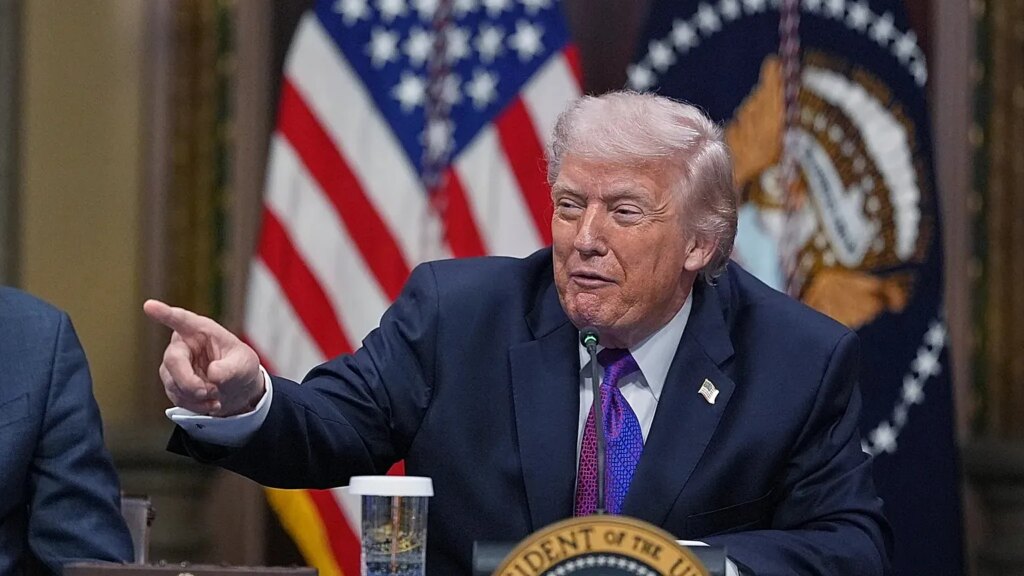
The US-Israeli offensive that triggered the war in Iran has created a split among European sovereigntist parties, torn between their habitual backing of Donald Trump and concerns voiced by their constituents.
The conflict initiated by the United States and Israel against Iran has caused division and uncertainty within Europe’s far-right factions.
 ADVERTISEMENT
  ADVERTISEMENT
The hostilities, starting with airstrikes by the US and Israel that eliminated Iran’s foremost leaders, have placed nationalist groups throughout Europe in a challenging position, as they strive to reconcile conflicting narratives.
Political forces that are strongly pro-MAGA, pro-Israel, and anti-Islamic struggle to openly endorse a conflict potentially harmful to European populations, including effects like rising energy costs. While openly condemning Iran’s regime remains straightforward, several parties find it difficult to balance their usual support for Donald Trump alongside demands to denounce the war’s repercussions.
During the conflict’s outset, Hungary’s governing party, Fidesz, was notably silent. Prime Minister Viktor Orbán, who has lauded Trump as a “peacemaker” in Gaza’s war, refrained from condemning or supporting the strikes against Iran.
Orbán, campaigning on a “pro-peace narrative” and accusing the EU of escalating the war in Ukraine by supplying Kyiv with funds and weaponry, later characterized the bombing of Iran in an ATV interview as not a new conflict but «the ultimate resolution and conclusion of a previous, unresolved hotspot.”
Italy’s League faces a similar predicament. Its leader Matteo Salvini has frequently advocated awarding Trump the Nobel Peace Prize and promoted non-interventionism as the optimal approach for global conflicts, including Ukraine.
“Diplomacy is always the preferred path,” said Paolo Borchia, the League’s head of delegation in the European Parliament, speaking to Euronews. He acknowledged the sensitivity of the topic amid heated domestic debates over the use of US bases in Italy for launching attacks on Iran.
‘Renewed destabilisation’
Some parties demonstrate greater willingness to recognize the dangers the war entails, while avoiding overt criticism of Trump.
“The fresh destabilisation of the Middle East contradicts Germany’s interests and must be halted,” stated Alice Weidel and Tino Chrupalla, leaders of Alternative für Deutschland (AfD).
“A collapse of Iran would be disastrous, triggering mass migration, steep energy price spikes, and a chain reaction of additional harms, directly impacting our own citizens,” AfD MEP Tomasz Fröhlich told Euronews. He called for urgent steps including renewed commitments to coal and nuclear energy and opposition to any deployment of German forces in the area.
Issues related to energy and migration are also priorities for the Flemish Interest party, which has raised concerns in the Belgian Parliament about the aftereffects of Western military interventions in Libya and Syria.
Czech Republic’s ruling ANO party shares comparable reservations. Insider reports reveal reluctance to criticize Trump directly, while also hesitating to follow US and Israeli leads uncritically, especially in a conflict likely to push up energy prices—an acute problem domestically.
The French National Rally (RN) offers the most vocal critique. Leaders Marine Le Pen and Jordan Bardella had previously challenged US strikes on Venezuela that led to Nicolás Maduro’s capture.
While firmly opposing Tehran’s regime, the RN aligns with France’s President Emmanuel Macron in asserting that the US intervention occurred “outside international law.”
“Change should come from the Iranian people themselves through government transition. External imposition—particularly through aerial bombardments alone—has no proven record of success,” RN MEP Pierre-Romain Thionnet explained to Euronews.
Nevertheless, other major nationalist groups, such as Spain’s Vox, Netherlands’ Freedom Party, and Nigel Farage’s Reform UK, remain more openly supportive of Trump, each tailoring messaging to their respective national audiences.
A European Parliament quagmire
This situation complicates efforts among far-right factions in the European Parliament to establish a unified stance on the conflict.
Both Patriots for Europe (PfE) and Europe of Sovereign Nations (ESN) assert that they leave the matter for each national delegation to decide, as per usual. However, multiple sources told Euronews that despite the official positions, the issue has been discussed internally and remains sensitive within the groups.
The Iran attack might represent yet another pivot in the bond between Trump’s MAGA movement and its firmest supporters in Europe.
The US raid on Venezuela in January and Trump’s previous threats to annex Greenland had already tarnished his image among many European sovereignty advocates, and his recent actions are intensifying unease among far-right politicians. Once emboldened by the resurgence of nationalist, anti-woke conservatism in Washington, they are now beginning to distance themselves from Trump.
“Trump seems increasingly toxic even to their voter base,” a senior MEP from a different political bloc told Euronews. “Behind the scenes, they are scrambling to find ways to disengage from him before it’s too late.”
Consequently, they seek minimal media exposure regarding their position on the war. Far-right and right-wing groups rejected a motion to debate Trump’s threats against Spain at next week’s European Parliament plenary session—a discussion potentially difficult for them. Meanwhile, a broader debate on the war’s consequences is planned for next Wednesday in Strasbourg.
“Aligning openly with Trump is quite complicated these days,” the MEP remarked. “Even for the Trumpists.”