
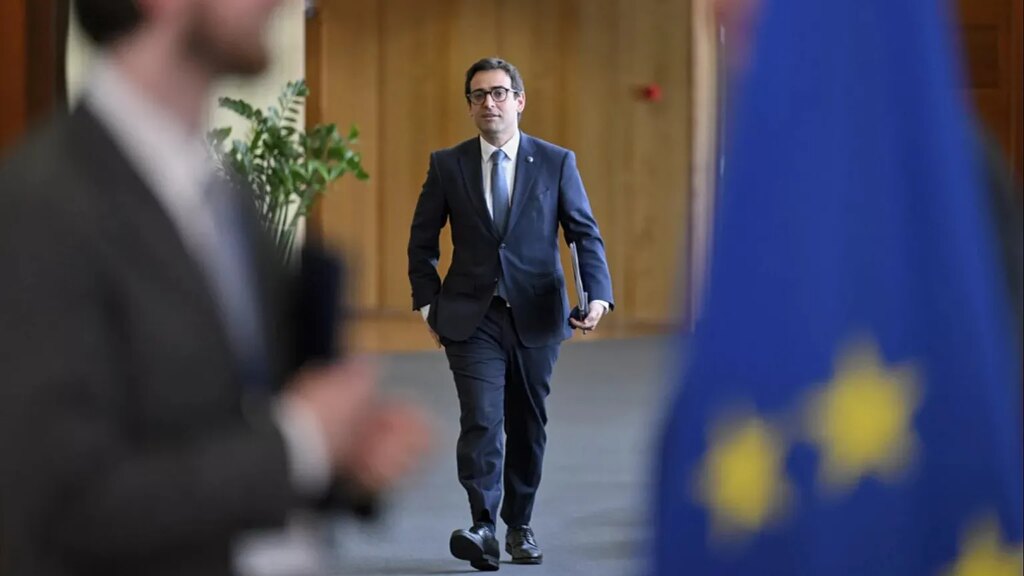
The EU industry commissioner, Stéphane Séjourné, advocated for a «European preference» to enhance the bloc’s competitiveness, though member states remain split regarding this approach.
On Monday, European Commission vice-president and industry commissioner Stéphane Séjourné called on the EU to implement a “European preference” within the single market as a response to increasing competition from China and the United States.
This initiative, which promotes products with components “made in Europe” in public procurement, has been under review for several months across the Commission and member states. Yet, it revealed growing divisions among the countries, with some expressing concern that it would mainly advantage the EU’s largest economies.
The «Made in Europe» initiative is expected to be a key topic at next week’s EU leaders’ summit focused on boosting competitiveness, where these disagreements are likely to become more apparent.
In an opinion piece signed by 1,141 business figures, Séjourné emphasized competitiveness as a fundamental element of Europe’s geopolitical strategy, asserting that establishing a European preference is essential to reinforce the continent’s industry against global competitors.
“A genuine European preference in our most strategic sectors must be established once and forever,” he stated. “The principle is straightforward: whenever European public funds are spent, they must support European production and stable jobs.”
Séjourné pointed out that other major economic powers already apply national preferences to safeguard strategic assets. His proposal requires firms receiving public procurement contracts, state aid, or other financial support to manufacture a significant portion of their products in the EU. The same requirement should extend to foreign direct investments, he added.
The discussion is poised to spark intense debates at the EU leaders’ retreat on 12 February in Alden Biesen, Belgium, convened by European Council President António Costa to define the EU’s competitiveness strategy.
Germany and Italy support the Commission’s push for broad regulatory simplification, while France and its allies advocate for joint borrowing and increased investment within the single market. France has been a longstanding proponent of the “Made in Europe” initiative, alongside Germany and Commission President Ursula von der Leyen.
However, smaller member states remain cautious, stressing that the single market must remain open and warning that a European preference could limit innovation and mainly benefit the larger economies.
EU countries divided
Disputes over “Made in Europe” add to the wider disagreements on how to revive the bloc’s economy.
Italian Prime Minister Giorgia Meloni and German Chancellor Friedrich Merz recently presented a joint plan advocating regulatory simplification, including challenging EU climate regulations under the Green Deal, which they consider overly burdensome for the automotive sector.
Conversely, last month, French President Emmanuel Macron renewed his call for increased investment in innovation using national and EU funds, bringing back France’s campaign for joint borrowing—a proposal supported by former Italian Prime Minister Mario Draghi in a significant 2024 report.
Macron noted that the report has become outdated following last year’s geopolitical shifts, especially due to China’s “aggressiveness” and American tariffs.
“The Draghi report, which has not been fully implemented, is already obsolete, partly because it failed to account for this acceleration in global developments,” Macron said at the annual French Ambassadors’ Conference.
Draghi and former Italian Prime Minister Enrico Letta, who also authored a critical report on reforming the EU single market, are expected to attend the February meeting.
A report from the European Policy Innovation Council released in September indicated that only 11% of the Draghi report’s recommendations were enacted during the Commission’s initial year.
“It is necessary to generate renewed momentum and give fresh impetus” to the reform agenda, Costa told Euronews in an exclusive interview.
“I anticipate leaders will provide clear political direction to the Commission and the Council, as they did last year on defence and security,” he added. “This time, the focus will be on the single market.”