
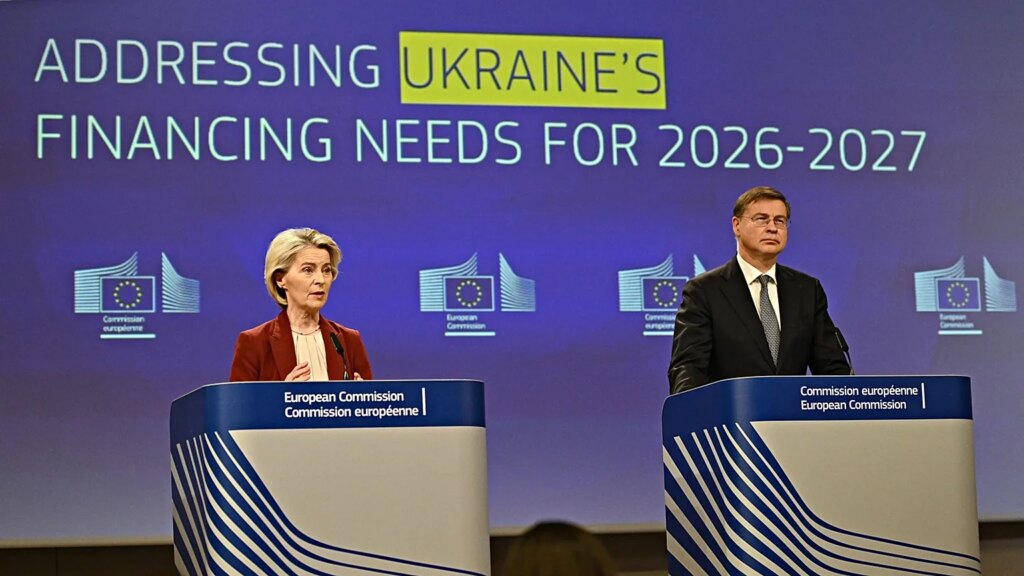
Euroclear, custodian of frozen Russian assets, has criticized Ukraine’s reparations loan as unstable, unpredictable, and risky. Meanwhile, the German chancellor convenes a crisis discussion with the Belgian prime minister in Brussels to seek a compromise and break the impasse on the proposal.
The European Union’s initiative to grant a reparations loan to Ukraine faced a new obstacle on Friday after Euroclear, the principal custodian of frozen Russian funds, described the proposal as «highly fragile», excessively uncertain, and potentially triggering a withdrawal of foreign investors from the eurozone.
This cautionary note arises as German Chancellor Friedrich Merz meets Belgian Prime Minister Bart De Wever and European Commission President Ursula von der Leyen in Brussels, aiming to resolve the deadlock before a pivotal summit on 18 December.
«The current proposal appears to involve significant legal innovation,» a Euroclear representative said to Euronews. «This level of innovation generates numerous questions. Our impression is that this framework is presently very fragile.»
Euroclear functions as the central securities depository holding the majority of Russian assets. Located in Brussels, Belgium thus holds a decisive vote in the often contentious discussions on financing Ukraine’s budget and military requirements for 2026 and 2027.
«Although we back the goal of aiding Ukraine, this initiative might expose Euroclear, Belgium, the European Union, and its financial markets to extensive legal, financial, and reputational risks,» the spokesperson added.
According to the plan, the European Commission would channel immobilized assets of the Russian Central Bank into a zero-interest credit line granted to Ukraine.
Repayment of this loan by Kyiv would only be required after Moscow consents to compensate for damages caused by its war of aggression. Analysts rate Russia’s willingness to pay reparations to Ukraine as nearly zero.
The EU aims to bridge €90 billion of Ukraine’s €135 billion financing gap over the next two years by utilizing these assets. For this, approval from Belgium is essential.
The proposal, unprecedented in modern times, has faced serious reservations from both the Belgian government and Euroclear since its presentation.
Euroclear also fears lacking sufficient liquidity to settle its claims with the Russian Central Bank if sanctions end early and member states fail to raise the €185 billion by the deadline.
Belgian authorities have expressed concerns that if Russia wins lawsuits demanding asset returns, it could leave Belgium with a treasury shortfall equivalent to the entire annual federal budget, a scenario that they claim might lead to the country’s bankruptcy.
To address these worries, the Commission has proposed a long-term asset immobilisation governed by a qualified majority vote, aiming to prevent abrupt halts or vetoes. It also pledged emergency funding for capitals that fall below their pledged guarantees.
Euroclear is additionally apprehensive about retaliatory measures, both inside Russia, where it holds roughly €17 billion in assets, and in jurisdictions sympathetic to Russia worldwide. The Kremlin might seize funds that Euroclear manages for its clients.
Should this occur, the Commission states Euroclear would be permitted to access assets held by its Russian counterpart, the National Settlement Depository, within the EU. Nevertheless, legal uncertainties persist in this area as well.
Euroclear raises concerns about the legal foundation of the plan
Furthermore, Euroclear warns that deploying Russia’s sovereign assets for issuing the reparations loan might trigger ripple effects across the eurozone and cause investors wary of unilateral government decisions to withdraw.
Von der Leyen acknowledged this possibility in a letter to EU leaders, admitting the bold move could be seen as illegal confiscation, though she insists the legal basis remains solid and the loan represents the best path forward for the bloc.
«If global investors interpret this mechanism as a seizure of Russian assets, confidence in Europe could deteriorate—impacting financial markets and raising borrowing costs for all EU member states,» stated the Euroclear spokesperson.
«Although the reparations loan might seem economically efficient, it risks escalated costs and could deter foreign investments.»
Euroclear’s critique is poised to influence Prime Minister Bart De Wever ahead of his meeting with Merz and von der Leyen on Friday evening.
De Wever has repeatedly highlighted the risks facing Euroclear and insisted he will not be pressured into approving the plan, placing him in the minority among European Council leaders, most of whom support the reparations loan.
Hungary and Slovakia also oppose the initiative for varying reasons.
«I can still determine my own stance, even if there are large, powerful neighbors whom I respect politically and esteem greatly, and who might request a different position from me,» De Wever stated prior to his meeting with Merz.
«I hold only one responsibility: representing the interests of Belgian taxpayers.»
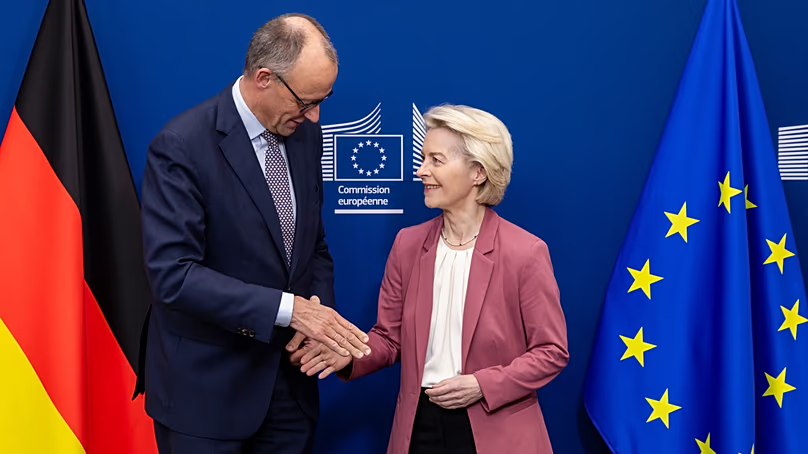
Merz and von der Leyen pledged to consider De Wever’s concerns carefully, maintain high-level discussions, and aim to secure his approval ahead of the decisive summit.
«It is legitimate to raise concerns, and equally legitimate to seek answers,» a Commission representative said on Friday.
The clock is running out: EU leaders will convene on 18 December for a crucial summit to decide on funding Ukraine’s financial and defense needs.
According to Ukrainian officials, the country will require new foreign aid as early as April.
At the same time, the White House—seeking a swift resolution to the war and engaged in direct negotiations with Moscow—is reportedly looking for ways to obstruct the plan.
Bloomberg reports that the US has lobbied «several» EU member states to block the reparations loan, arguing it could inadvertently «prolong the war».
Euroclear CEO Valerie Urbain reiterated similar views in a Belgian TV interview.
«At this stage, funds would be better allocated to peace talks rather than establishing a highly complex and risky legal framework, potentially losing leverage in negotiations,» Urbain stated.
Failing a breakthrough, the EU will likely need to turn to financial markets to raise €90 billion via joint debt issuance to support Ukraine—an approach favored by Belgium.