
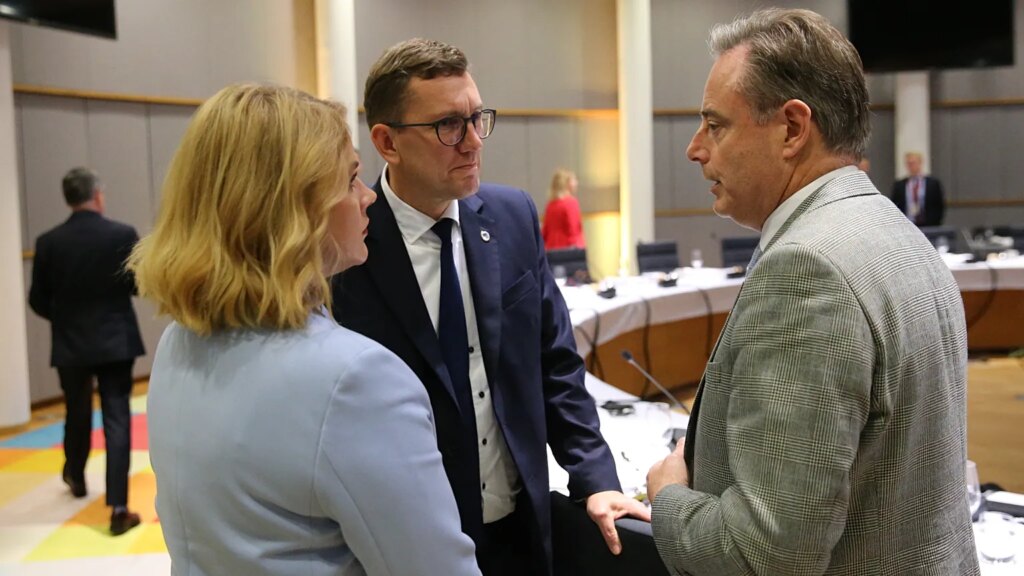
On Friday, both parties convened to address Belgian reservations regarding the unprecedented financial loan to fund Ukraine by utilizing frozen Russian assets. However, discussions concluded without progress as the December summit approaches.
EU representatives and the Belgian administration have been unable to resolve disagreements over the proposal to deploy immobilized Russian funds for Ukraine’s reconstruction over the upcoming two years.
A technical session was held on Friday involving the Commission and the offices of Prime Minister Bart de Wever and Foreign Minister Maxime Prévot.
Insiders familiar with the talks indicate escalating concern within the Belgian government about the European Commission’s lack of alternative solutions to employing frozen Russian assets for Ukraine’s financing.
The EU advocates a strategy to utilize €140 billion in Russian assets frozen at Belgium’s financial clearinghouse, Euroclear.
Ongoing Legal Ambiguity Surrounding Post-Conflict Arrangements
Nonetheless, the Belgian government highlights considerable risks tied to this unprecedented measure and is pressing for legal assurances ensuring it won’t bear liability for unforeseen repercussions. Concerns about possible Russian reprisals also persist.
Belgium expects it may face costly litigation if Russia or related parties pursue claims over the assets once the conflict concludes.
The Commission is exploring methods to secure steady financial support for Ukraine into 2026, as war-related expenditures increase amid waning support from the United States since President Donald Trump’s tenure commenced.
In October, EU leaders resolved to reevaluate the issue and deliver a definitive decision in December after considering alternatives, which have so far failed to satisfy Belgian authorities.
“Our expectation, agreed upon at the European Council, is that all feasible options will be thoroughly developed and presented at the upcoming Council meeting,” a source revealed to Euronews.
“Every potential approach should be on the table,” the source added.
Belgium Advocates for Collective Decision-Making
“For Belgium, it is critical to explore every option. Each approach requires rigorous and transparent examination to identify the optimal solution,” the source emphasized.
“Frankly, we remain awaiting the alternative proposals the European Commission committed to providing, as agreed at the October European Council,” the source told Euronews.
When questioned whether the government feels “frustrated” due to the limited options, the source responded, “Not yet frustrated, but time is pressing, and we continue to engage constructively.”
The EU must “jointly” determine the most suitable course of action, the source noted.
“One cannot select the best decision without having all options, along with their pros and cons,” the source stated.
Should this initiative falter, suggested alternatives include issuing collective debt, bilateral arrangements by member states, or a short-term bridging loan. Nonetheless, member states privately acknowledge that none would match the scale or stability of the reparations loan.
A European insider expects an agreement with Belgium to be reached but admits that time is running short before leaders assemble in Brussels for the year’s final European Council summit in December.