
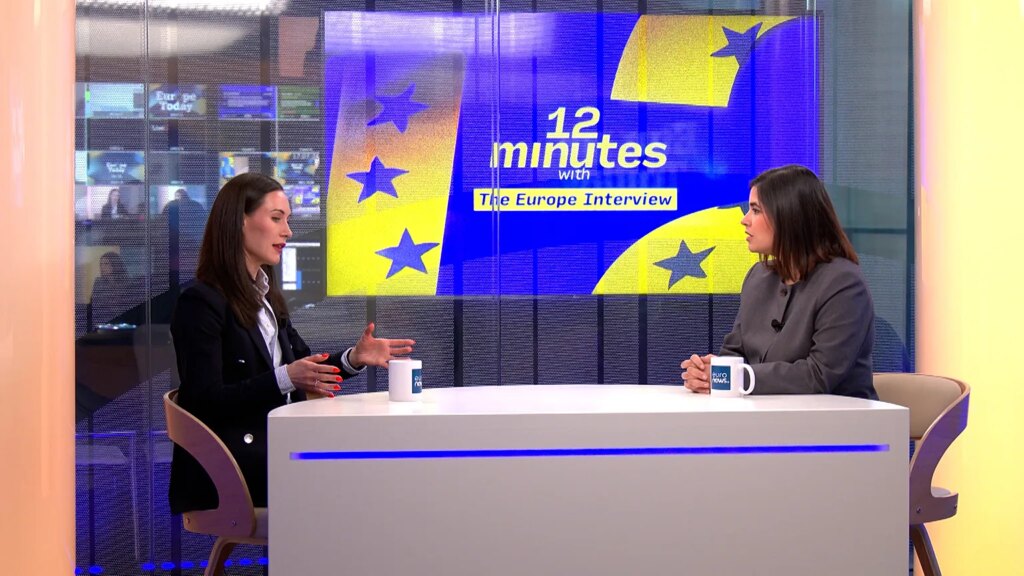
The former Finnish prime minister told Euronews that she "cannot exclude" that Russia is gearing up for a conflict with the rest of Europe, emphasizing that the bloc relies on Ukrainian assistance just as much as Ukraine depends on EU aid.
Ex-Finnish Prime Minister Sanna Marin stated to Euronews that the European Union must acknowledge its reliance on Ukraine and the strategic insights gained from the conflict imposed by Russia to strengthen its own security.
 ADVERTISEMENT
  ADVERTISEMENT
She maintained that without incorporating Ukraine’s practical experience, the EU’s amplified defence expenditures risk being squandered.
“While we develop our defence capacities and aim to achieve the 5% spending goal agreed within NATO, it is not only the amount invested that matters, but crucially, where these funds are deployed,” she explained during her appearance on Euronews’ 12 Minutes With program.
“Misallocating resources to expensive, outdated military models instead of those actively utilized in battlefields would mean wasting every euro spent,” she warned.
Last summer, NATO member states pledged to raise their defence budgets to 5% of GDP by 2035, more than double the current 2% target.
The EU is likewise ramping up investments, notably via the Security Action for Europe (SAFE) initiative, a €150 billion loan program aimed at boosting defence manufacturing and industrial capabilities.
Marin praised these initiatives but underlined that increased spending must be accompanied by frontline knowledge, which she contends only Ukraine holds.
“Ukraine possesses the largest, most operational, and modern military force with direct combat experience, and in its absence, we remain exposed,” she shared with Euronews’ Europe Editor Maria Tadeo.
Furthermore, she noted that the EU “must realise its dependence on Ukraine and Ukrainian capacities mirrors Ukraine’s reliance on EU support. The necessity of this relationship cannot be understated.”
Russian threats and warfare evolution
Marin stressed the critical need for heightened preparedness, acknowledging she “cannot dismiss” the likelihood that Russia, whom she described as an “adversary,” is actively equipping itself for potential conflict with Europe.
“Europe’s security is at risk because Russia is currently modernizing its forces and gearing up for broader confrontations,” said Marin, who now serves as an adviser to the Tony Blair Institute for Global Change.
Last year, German Defence Chief General Carsten Breuer warned of a possible Russian attack on NATO within four years. Similarly, Swedish Chief of Defence Michael Claesson stated towards the end of last year that Russia is expected to challenge NATO’s collective defence principle—where an assault on one member is an attack on all—soon.
Following Ukraine’s recent strikes against Russian oil and gas infrastructure, Moscow issued cautions to European nations and businesses about supporting Kyiv’s long-range drone manufacturing efforts.
The Kremlin asserted that “actions by European leaders are increasingly pulling these nations into the conflict with Russia.”
Marin also highlighted the importance of adapting to evolving military tactics, including drone use, cyber threats, and AI applications targeting critical infrastructure, which underscore the urgency of acquiring technical support from Ukraine.
“We require Ukrainian expertise in areas such as drone construction, military innovation, and technological transformation,” she stated.
This advancement in warfare reflects that threats from Russia transcend geographical borders and are not confined to NATO’s eastern front alone.
A report released earlier this year by the International Centre for Counter-Terrorism (ICCT) indicated that since the February 2022 invasion of Ukraine, Russia has conducted at least 151 hostile operations across Europe—including in Belgium, the Netherlands, and Denmark—encompassing drone deployments, airspace breaches, and cyberattacks.
“We face continuous pressure due to proximity to Russia, but it is crucial for countries like Portugal, Spain, and France to understand that distance from the border does not guarantee safety,” Marin warned.
“Drones can be deployed anywhere; AI can rapidly map critical infrastructure. Therefore, preparedness must extend beyond immediate borders, without illusions of security.”
‘Concentrate on own strategy’
When questioned about her views on US President Donald Trump’s NATO criticisms—such as labeling it a “useless, paper tiger”—Marin reaffirmed her support for Finland’s NATO accession in 2023.
“It is essential to recognize that NATO today differs significantly from when Finland and Sweden joined, largely due to the evolving dynamics between the US and Europe,” she remarked.
“This reality is unavoidable, prompting us to focus on our own approach,” Marin added, emphasizing that Europe can no longer depend solely on US military presence and abilities.
She asserted that Europe must engage more seriously in discussions about its nuclear deterrence. While France remains the EU’s only nuclear power, Europe has historically relied on the American nuclear umbrella as its ultimate safeguard.
France has proposed increased European involvement in deterrence; this week, French and Polish leaders discussed coordinated military exercises.
“Preparedness for various outcomes is necessary. Concerning US-Europe relations, one cannot simply pursue desired paths, but must anticipate possible developments,” she explained.
Marin stressed a preference for continued US engagement within NATO. “A sustained US presence in Europe and enduring US nuclear deterrence remain crucial. These are not mutually exclusive, but every scenario must be planned for.”