
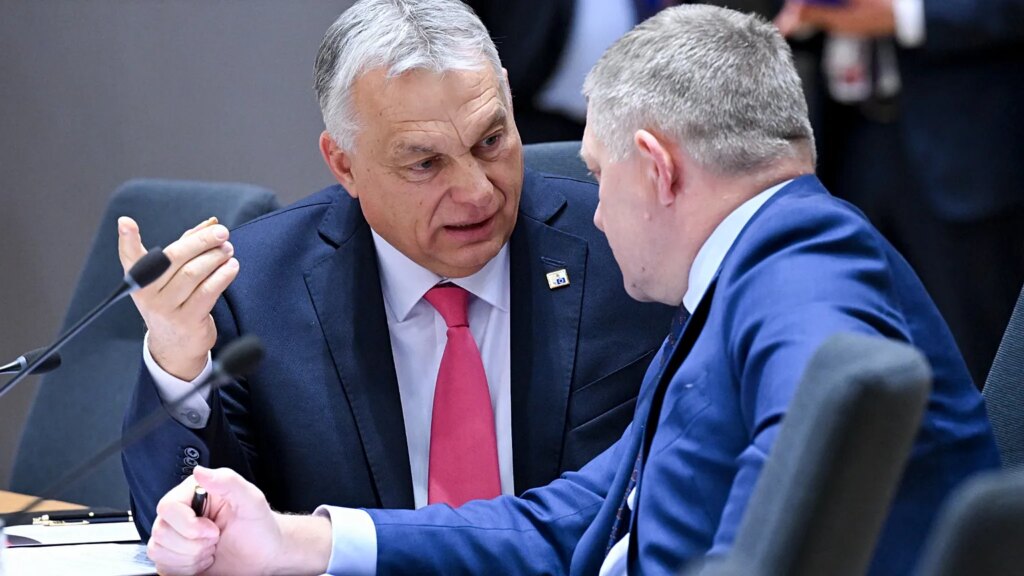
The clear defeat of Hungarian Prime Minister and primary EU veto-holder Viktor Orbán opens a window for the EU to progress on several critical foreign policy matters. Yet, was Orbán solely the obstacle? Or does the unanimity rule fundamentally hinder the EU’s ability to defend itself globally?
After a 16-year leadership span, Viktor Orbán’s role as Hungary’s prime minister and a disruptive figure on the world stage has concluded.
 ADVERTISEMENT
  ADVERTISEMENT
For many years, the Hungarian leader was a significant challenge to the EU, frequently deploying his country’s veto power to delay decisions on vital subjects.
Hungary holds the record for the most vetoes among member states: out of 48 total vetoes by EU countries, Budapest cast 21.
Most notably, in March, Orbán obstructed a €90 billion loan to Ukraine that had been previously approved, in the midst of a dispute regarding the Druzhba oil pipeline, which transports Russian oil to multiple European nations including Hungary.
The pressing question now is whether this governmental shift will suffice to unblock the EU or if more profound reforms are necessary to stop a single member state from immobilizing the bloc again.
The new administration under Péter Magyar, victorious by a large margin in the recent parliamentary elections, is anticipated to pursue a more cooperative and pragmatic stance.
At his initial press briefing following the election, Magyar announced that discussions with European Commission President Ursula von der Leyen had already started to mend relations.
His top priority, however, remains the unlocking of €17 billion in EU funds destined for Hungary but currently withheld by the Commission due to concerns over democratic regression. These funds’ release depends on implementing judicial reform by August.
In a development welcomed in Brussels, Magyar also voiced support for Ukraine and is expected to remove Hungary’s veto on the €90 billion EU financial aid to Kyiv, while endorsing additional sanctions on Russia.
Nevertheless, expectations should remain cautious. Magyar has pointed out that Hungary will continue importing Russian energy and stands against the EU’s migration agreement as well as any swift advancement of Ukraine’s EU membership.
What exactly is the veto and how does it operate?
The veto mechanism, originating during the establishment of the European Economic Community in the 1950s, was created to protect national sovereignty, especially for smaller countries.
It grants member states the power to block decisions on delicate matters such as foreign affairs, defense, and taxation, where unanimity is required by EU treaties instead of a majority vote.
This tool is most frequently used within the Council of the European Union — one of the bloc’s two legislative bodies — though it can also apply at the European Council level, which gathers national leaders to define the EU’s political course.
Approximately 80% of EU legislation is passed through qualified majority voting, leaving a smaller but critical set of policy fields subject to unanimous agreement.
In those areas, all 27 member states must give their consent. A single veto suffices to completely stop a decision, effectively bringing the process to a standstill.
Is reform on the horizon?
Signs suggest that EU leaders might be reconsidering this system. On Monday, von der Leyen told Euronews: “Transitioning to qualified majority voting in foreign policy is crucial to prevent systemic deadlocks as witnessed previously. We should capitalize on the current momentum to advance this.”
This debate is not recent. After the Conference on the Future of Europe in 2022, French President Emmanuel Macron advocated extending qualified majority voting to remaining policy domains. “Treaty reform is essential,” he argued, which would streamline decision-making and enhance EU effectiveness.
More recently, at a February leaders’ retreat, von der Leyen stated: “We cannot operate at the pace set by the slowest,” as discussions focused on enhancing the bloc’s competitiveness.
Nonetheless, concerns persist, notably among smaller member states. Dutch MEP Sander Smit warned that abandoning unanimity could expose nations to decisions contrary to their interests, emphasizing that “sustainable EU decision-making must not bypass national democracy.”
Conversely, some like German MEP Daniel Freund hold a different perspective. He considers unanimity unattainable, highlighting that the European Parliament—and all parliaments—function based on majority votes. He labeled unanimity as “a security threat for Europe,” urging instead for “greater democracy, stronger European security, and reduced leverage for autocratic blackmail.”
Should the European Parliament assume a larger role in foreign policy? Tune in tonight at 20:30 CET for the latest episode of The Ring, Euronews’ weekly debate programme featuring MEPs Daniel Freund and Sander Smit.