
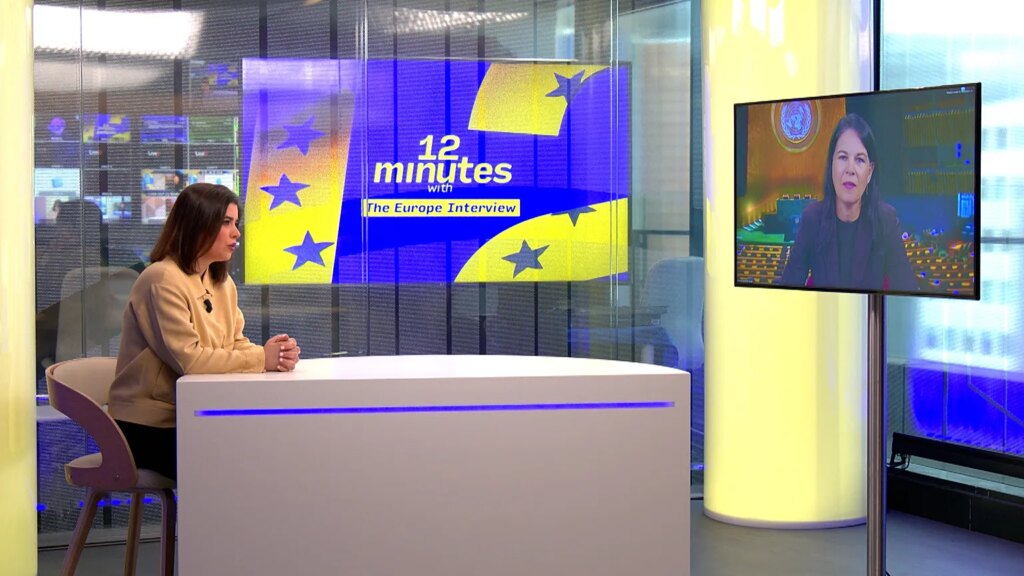
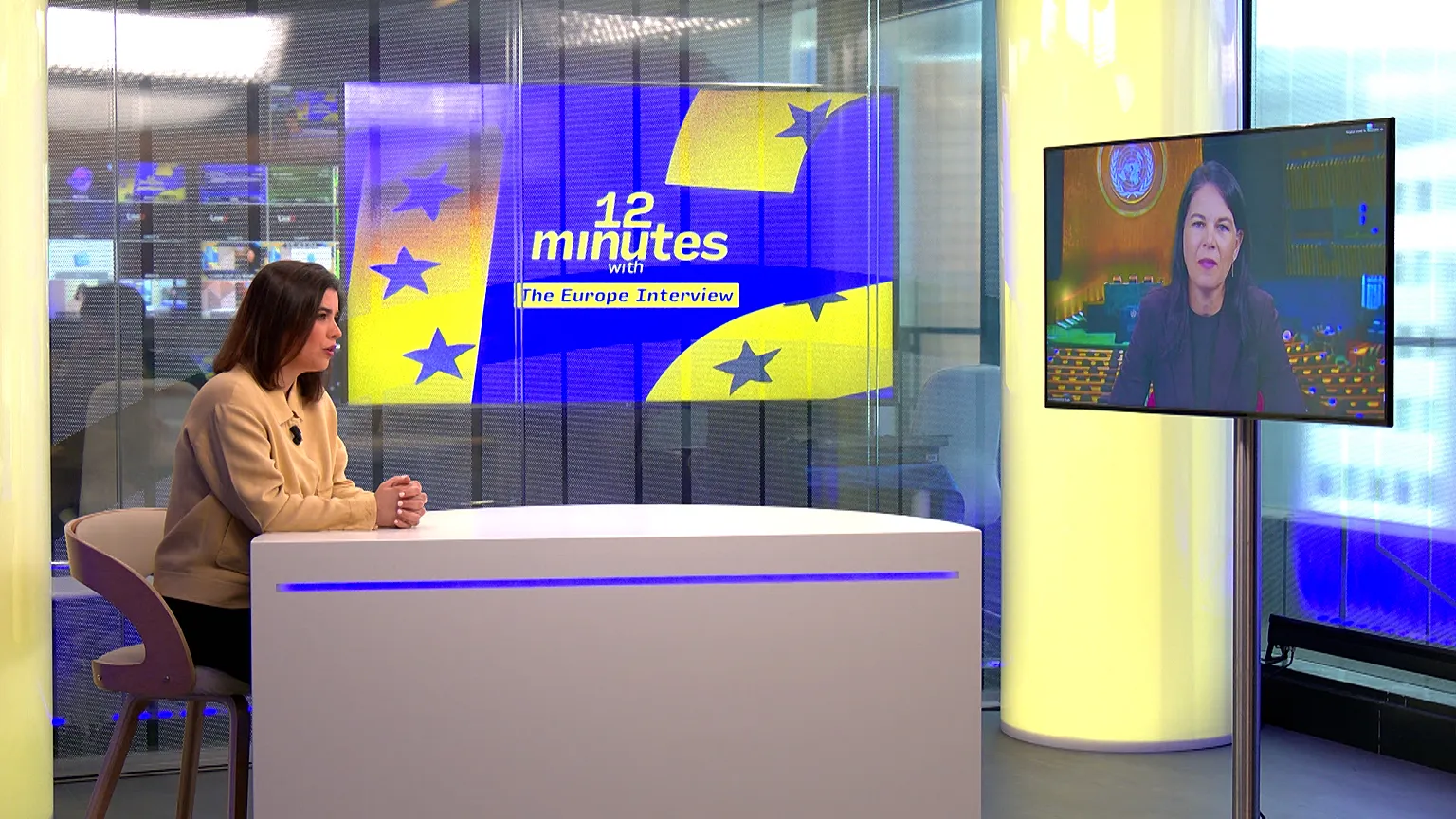
The leader of the United Nations’ principal decision-making body addressed growing criticisms of the organisation in a Euronews interview, emphasizing that the misuse of veto powers by key members obstructs progress.
The responsibility for ongoing wars cannot be attributed to the United Nations, stated Annalena Baerbock, President of the United Nations General Assembly (UNGA), in her discussion with Euronews.
 ADVERTISEMENT
  ADVERTISEMENT
She insisted that the fault lies with the member states themselves.
«When a member state initiates an aggressive war, it is not a failure of the UN or an ambiguity in the Charter that permits this, but rather the deliberate breach of the Charter by the member state advancing the conflict,» Baerbock explained on Euronews’ 12 Minutes With.
«Therefore, it is essential the UN receives pushback from other member states as well,» added the former German foreign minister.
Recently, the UN has been increasingly criticised, including by its own members, for what some perceive as its failure to carry out its fundamental mission to maintain global peace and security.
During her address to the UNGA last year, former US President Donald Trump accused the organisation of neglecting to address escalating conflicts, condemning what he called «empty words» that «don’t resolve war.»


Baerbock highlighted that the UN operates as a collective of 193 «highly diverse member states» rather than as a single entity. In that regard, she compared the UN’s functioning to national judicial systems, which also depend on numerous institutions.
«There are clear regulations forbidding killing. Yet, sadly, homicides still occur,» she remarked.
«No one suggests abolishing criminal laws because murders happen. Law enforcement and society respond, and similarly, the UN depends heavily on member states,» she concluded.
Veto problem
Baerbock identified the primary barrier for the UN in resolving current conflicts as the veto authority held by certain members of the Security Council, the body responsible for upholding international peace.
China, France, Russia, the United Kingdom, and the United States—referred to as the «Permanent Five» (P5)—occupy permanent seats and possess veto rights, enabling them to block any resolution.
This veto privilege granted to a select few has provoked considerable debate recently, as it greatly restricts the Council’s capacity to promote peace at the global level.
In recent times, Russia and the US have been key in this stalemate, vetoing measures concerning Ukraine and Gaza respectively. In 2024, permanent members exercised their veto power eight times over seven draft resolutions, the most since 1986. Last year saw two US vetoes on Gaza-related proposals and two Russian vetoes on Ukraine.
«Regrettably, currently not all member states shoulder their responsibilities, instead employing their veto rights to protect violations of international law,» Baerbock stated.
«Applying a veto to block decisions and then complaining about the lack of agreement clearly places responsibility on those using the veto.»
This deadlock in the Security Council has rekindled demands for comprehensive reform, including limiting veto powers and expanding permanent seats to Africa and Latin America.
Marking the UN’s 80th anniversary in March 2025, Secretary-General António Guterres launched the UN80 reform initiative, which seeks to streamline the UN’s structure, mandates, and finances while pursuing limitations on Security Council veto rights.
Still, the P5 show little willingness to support reforms that could reduce their influence. «And, unfortunately, any changes require unanimous approval from all Security Council members.»
A further potential challenge to the UN could come from the US-backed Board of Peace. Initially sanctioned by the Security Council to oversee the ceasefire in Gaza, former President Trump suggested the Board might evolve into a more substantial entity.
Nevertheless, Baerbock dismissed fears that the Board of Peace might rival the UN.
«There is a valid reason why every UN member state—regardless of size or power—has an equal voice. This unique responsibility defines the UN’s distinctive role,» she noted.
«Member states, including those on the Board of Peace, have made it clear this structure applies exclusively to Gaza. For all other peace and security issues, the United Nations will remain the rightful forum, primarily because it involves no participation fee.»
Unlike the UN, participation in the Board of Peace does not require payment for the initial three years, but afterwards, countries must contribute $1 billion (approximately €852.1 million) annually to continue their involvement.