
Although delays on departures are declining, aviation officials caution that a significant number of travellers continue to face flight postponements.
As summer nears, flight delays remain a persistent problem throughout Europe.
 ADVERTISEMENT
  ADVERTISEMENT
In its most recent annual review, the pan-European air traffic management body Eurocontrol called on airports and airlines to address congestion issues before the summer rush, as flight volumes keep rising, now reaching 100.2% compared to pre-pandemic figures.
During 2025, Lisbon, Zurich, and Nice led in delayed departures, while the Portuguese capital also ranked among the main airports with late arrivals, alongside Athens and Luxembourg.
What is the punctuality rate for departures at Europe’s 20 busiest airports?
Lisbon’s Humberto Delgado airport experienced a notably difficult year in 2025 with one of the steepest declines in on-time departures.
The proportion of flights leaving according to schedule dropped to 49%, marking the lowest rate not only among Europe’s top 20 busiest airports but across the entire continent.
Which airports in Europe maintain the best punctuality?
While many travellers tend to blame airport management, Eurocontrol’s analysis indicates multiple factors contribute to delays.
Reportedly, Lisbon’s departures were significantly affected by unfavorable weather, «en-route restrictions causing flight bunching at airports,» and several facilities operating near full capacity with minimal operational buffers.
Nonetheless, some European airports handle these challenges more effectively than others.
At the forefront of timely departures were the Norwegian airports Bergen and Oslo, Sweden’s Stockholm, Denmark’s Copenhagen, and Germany’s Lipsia, all showing punctuality rates exceeding 80%.
The most notable improvements were seen in Munich, Rome Fiumicino, and London Heathrow.
What factors cause flight departures to be delayed?
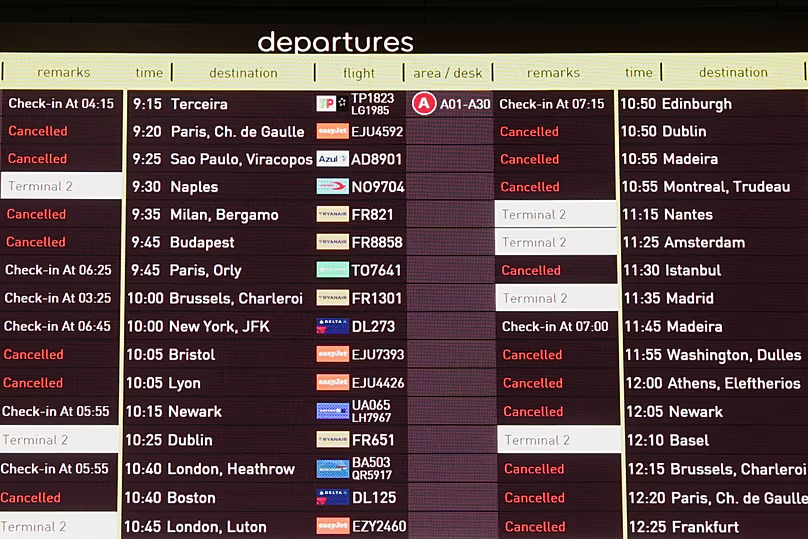
Reactionary delays, or knock-on effects caused by disruptions across the network, remained the leading source of delays, adding an average of 6.5 minutes per flight, which makes morning flights generally more reliable than those departing in the evening.
How widespread are these delays? According to Eurocontrol, approximately 30% of flights take off late, with a mean delay duration of 15 minutes.
Although punctuality improved by 4%, the organisation emphasized that managing increasing traffic will require resolving the shortage of air traffic controllers, revising airspace design and route planning, and speeding up technological advances.
Which airports and airlines are the busiest?
In 2025, Istanbul’s IGA Airport recorded the highest average daily flights within the Eurocontrol network, at 1,491, followed closely by Amsterdam Schiphol (1,351), London Heathrow (1,315), and Paris Charles de Gaulle (1,314).
Nearly all of Europe’s top 20 airports, apart from London Gatwick, reported air traffic increases from 2024 to 2025 — especially Istanbul Sabiha Gökçen, which saw 13.8% growth versus the European average of 4.3%.
The continent’s airspace managed roughly 30,000 flights per day, rising to 35,000 during the May–August peak period.
Among airlines, Ryanair led in daily operations with almost 3,192 flights, followed by EasyJet (1,611), Turkish Airlines (1,559), Lufthansa (1,083), and Air France (1,061).