
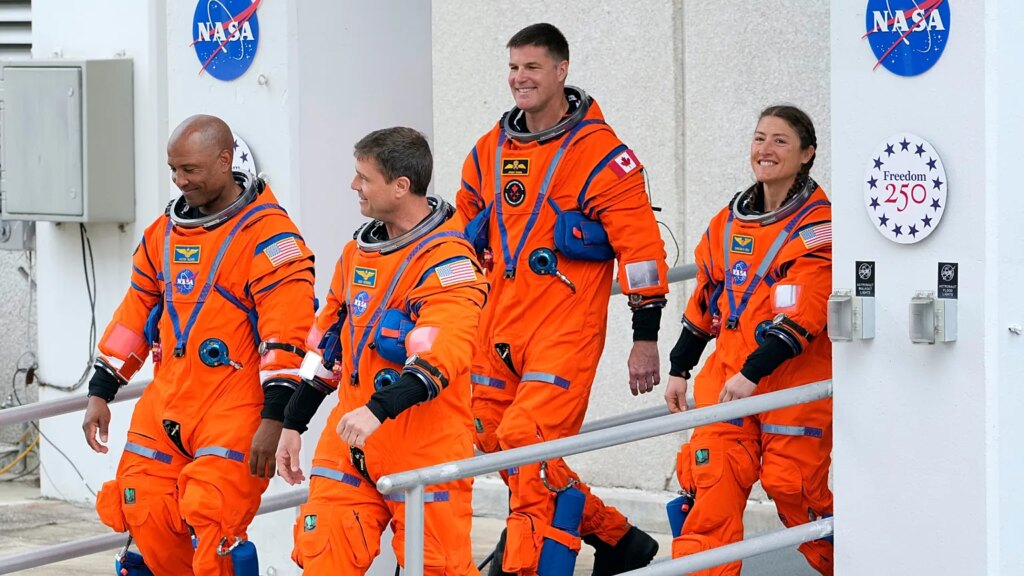
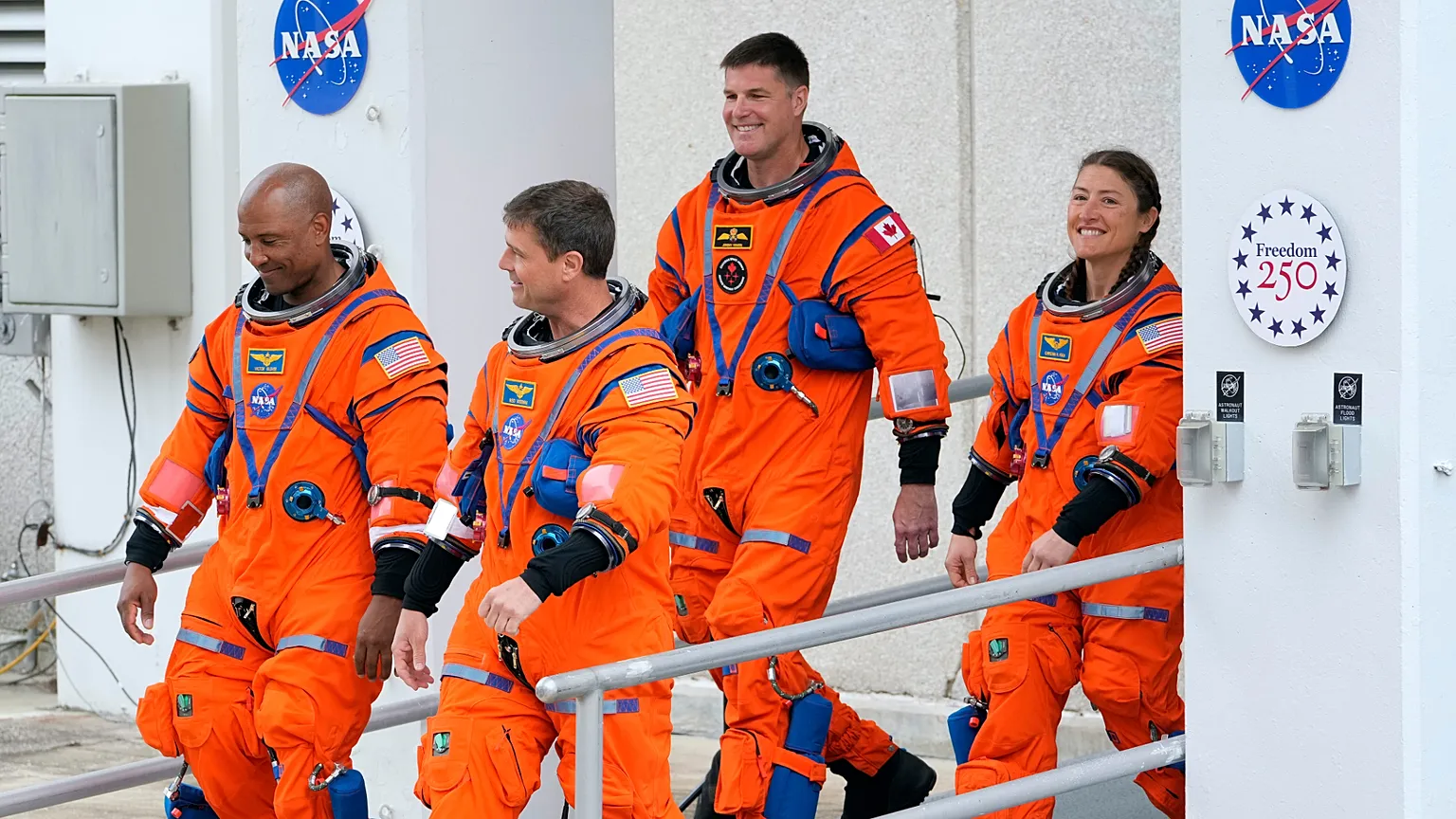
The Artemis II crew prepares for a landmark lunar flyby that will carry them farther from Earth than any humans before, capturing unprecedented views of the Moon’s far side.
The Artemis astronauts were preparing on Saturday for a highly anticipated lunar flyby, including studying the lunar surface features they need to analyse and photograph during their orbit around the Moon.
 ADVERTISEMENT
  ADVERTISEMENT
Upon waking at approximately 16:35 GMT on Saturday, the astronauts found themselves about 271,979 kilometres away from Earth, approaching the Moon at a distance of 178,154 kilometres, according to NASA.
The next key moment of the roughly 10-day mission is anticipated overnight from Sunday to Monday, when the crew will enter the «lunar sphere of influence» — the point at which the Moon’s gravitational pull overtakes that of Earth on the spacecraft.
If all goes according to plan, as Orion orbits the Moon, the astronauts might break the record for the greatest distance any human has traveled from Earth.
The astronauts began their day with a breakfast including scrambled eggs and coffee, as NASA reported, and rose to the pop hit «Pink Pony Club» by Chappell Roan.
«Morale remains high onboard,» Commander Reid Wiseman reported to Mission Control in Houston as the crew started their workday.
The father of two daughters was especially uplifted partly because he had the chance to communicate with his children from space.
«We’re so far away up here, and for a moment, I was reunited with my family,» he shared during a live press conference. «That was the most amazing moment of my life.»
Wiseman, alongside fellow Americans Christina Koch and Victor Glover, as well as Canadian Jeremy Hansen, are undertaking a historic journey around the Moon, soon preparing to perform a slingshot maneuver.
He described the mission as «Herculean» — a feat humanity has not achieved in over five decades.
Later on Saturday, Glover was scheduled to carry out a manual piloting test to provide NASA with additional insights into the spacecraft’s capabilities in deep space.
Following this, the team planned to review their checklist aimed at documenting their experience orbiting the Moon.
The astronauts have undergone geology training to enable them to identify and photograph lunar features such as ancient lava flows and impact craters.
This mission offers a unique vantage point compared to the Apollo flights of the 1960s and 70s.
While Apollo missions orbited roughly 70 miles above the lunar surface, Artemis 2’s closest approach will be over 4,000 miles away, granting a full circular view of the Moon, including areas near both poles.
Unseen Until Now
The Artemis 2 crew has already witnessed fresh perspectives.
«Last night, we had our first sight of the Moon’s far side, and it was absolutely stunning,» stated Koch, the mission specialist, during a live broadcast from space.
John Honeycutt, manager of NASA’s SLS (Space Launch System) programme, shared a new image sent by the astronauts during Saturday’s briefing.
«On the far left, lunar features appear that no human eyes have seen until yesterday,» Honeycutt explained, noting that until now only robotic imagers had observed that region.
The Artemis 2 team has taken many photos, including using smartphones—devices NASA recently approved for use on spaceflights.
NASA has previously released images from Orion featuring a full portrait of Earth, showcasing its vast blue oceans and swirling clouds.
However, the onboard space toilet continues to present challenges, with the crew occasionally resorting to backup urinal bags.
An attempted wastewater ejection designed to channel urine into space failed, likely caused by an ice blockage, NASA reported. Troubleshooting efforts are ongoing.
The Artemis 2 mission forms part of a wider strategy to return repeatedly to the Moon, aiming to establish a permanent lunar base that will support further space exploration.
This highly awaited journey requires precise execution but also allows the astronauts to experience the childhood dream of space travel.
«It really makes me feel like a kid again,» Hansen recently reflected, describing the joy of weightlessness.