
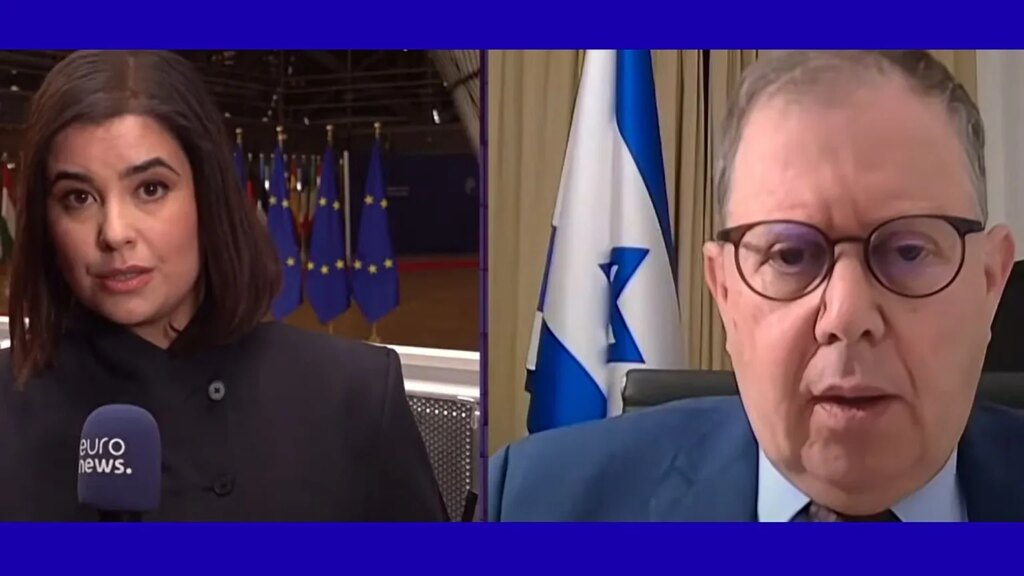
Israel has demanded an end to Europe’s diplomatic efforts with Iran, pressing for a tougher stance alongside the US to compel regime change in Tehran amid ongoing conflict.
The Israeli ambassador to the United Nations in Geneva has condemned Europe’s cautious approach regarding the Iran conflict, advocating for a stronger reaction as the hostilities extend across the Middle East.
 ADVERTISEMENT
  ADVERTISEMENT
During a discussion with Euronews on the sidelines of a pivotal EU summit on 19 March, Daniel Meron stated, “Europeans call repeatedly for diplomacy, but I believe the time for diplomacy has passed, and now there must be a decisive move to bring change in Iran.”
He also mentioned that Israel feels firmly backed by the US. “We certainly do not feel isolated; the United States and Israel are united in this conflict, and international support is substantial,” he affirmed.
Meron’s statements arrive as the US-Israeli military campaign against Iran, which has expanded regionally, nears its fourth week.
His position aligns with that of US President Donald Trump, a close ally and advocate for Israel, who has openly criticized European nations for what he perceives as their insufficient engagement in the war against Iran.
The offensive by the US and Israel began on 28 February and has so far targeted and eliminated roughly 40 senior Iranian figures, including Supreme Leader Ayatollah Ali Khamenei.
Separately, Israel has committed to eradicating the Iran-supported Shia militia Hezbollah, initiating a major operation in Lebanon. This conflict has displaced over one million individuals—about 20% of the population—and the death toll has exceeded 1,000.
Iran has responded by striking nearby Gulf states, which host US and European military installations. It is also deploying missiles and drones at Israel, most of which have been intercepted and neutralized. Up to now, 18 Israelis have died. On 2 March, an Iranian drone attacked a British military base in Cyprus, resulting in minor damage.
President Trump has described European and NATO allies as “one-way street” partners because they declined to deploy warships to safeguard the Strait of Hormuz, a critical maritime route south of Iran that facilitates 20% of global oil shipments. Tehran has recently blocked this passage, causing upheaval in international markets and driving energy prices higher.
In his interview, Meron further cautioned that Europe faces threats from Iran comparable to those confronting the Iranian population and the broader Middle East.
“What about the missile attacks toward Europe, Cyprus, and Türkiye?” he asked Euronews. “Why do people not demand Iran to cease terrorizing its citizens and the region, and to stop obstructing the oil flow through the Strait of Hormuz?”
“It is time to weaken this regime so that the people can determine their own future,” Meron continued. “Israel should not be the one deciding their future. This regime of terror must inevitably end.”
Meron’s remarks were part of a Euronews Special Report following a significant EU summit that addressed both the war in Ukraine and the ongoing Middle East conflict.
The full interview can be viewed using the video player above.