
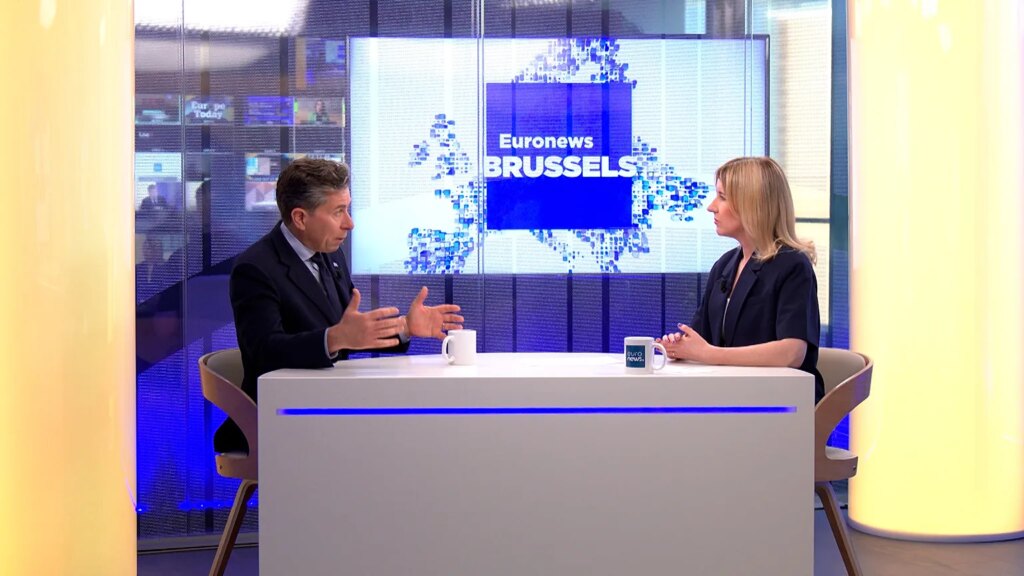

The head of humanitarian affairs at the United Nations told Euronews that delivering aid in Lebanon is becoming ever more perilous. The Israeli campaign, now expanded to include ground operations, has resulted in over 900 deaths and displaced upwards of one million people.
Tom Fletcher, the United Nations Under-Secretary-General for Humanitarian Affairs and Emergency Relief Coordinator, said in an interview with Euronews that the humanitarian emergency in Lebanon, triggered by ongoing Israeli attacks, risks evolving into a crisis similar to that experienced in Gaza.
 ADVERTISEMENT
  ADVERTISEMENT
«My concern is that Lebanon may become the next Gaza,» said the UN’s Humanitarian Chief on Euronews’ program 12 Minutes with.
«In reality, I am apprehensive because that is the message we are receiving from certain Israeli ministers who are adopting increasingly aggressive rhetoric concerning their plans for Lebanon.»
The majority of the Israeli strikes have been focused on southern Lebanon and the southern suburbs of Beirut.
Israel’s Defence Minister, Israel Katz, has warned that displaced Lebanese individuals will not be permitted to return home until the security of Israelis living in the north is ensured, drawing parallels with Gaza.
At the same time, Israeli Finance Minister Bezalel Smotrich suggested that the southern suburbs of Beirut might be reduced to conditions akin to Khan Yunis in Gaza, which satellite images last year showed was almost entirely destroyed during Israel’s conflict with Hamas.
Lebanon was drawn into the hostilities roughly two weeks ago after Iran-backed Hezbollah conducted attacks against Israel, retaliating for the killing of former Iranian Supreme Leader Ayatollah Ali Khamenei in an Israeli airstrike. Rockets launched at Israel have caused injuries among civilians and damaged residential areas.
Israel justified launching a fresh offensive against Hezbollah by citing these attacks, declaring that disarmament of the group is their objective. Prime Minister Benjamin Netanyahu has accused Lebanon of failing to meet its commitments to confiscate Hezbollah’s weapons, as stipulated in the ceasefire accord between the two nations set for November 2024.
On Monday, Israeli forces commenced «limited and targeted ground operations» against Hezbollah in southern Lebanon, following extensive air strikes and artillery bombardment in the region prior to troop deployment.
There are concerns about a possible Israeli occupation of southern Lebanon. Members of Israel’s far-right governing coalition have pushed for establishing a security buffer zone within southern Lebanon.



Authorities in Lebanon report that Israeli strikes have claimed the lives of over 900 individuals in the country, with displacement figures surpassing one million, representing approximately 20% of Lebanon’s population.
Many residents are evacuating areas as demanded by compulsory evacuation directives issued by the Israeli military. The Norwegian Refugee Council indicates these evacuation zones now cover more than 1,470 square kilometres, accounting for around 14% of Lebanon’s total land area.
The Israeli military insinuated that civilians remaining in these designated zones would be considered legitimate targets. Such declarations that mark areas for widespread indiscriminate attacks are prohibited under international laws of war. The IDF has employed similar approaches in Gaza.
«The fact is Israel has ordered civilians to vacate extensive portions of the country, severely limiting safe refuge options,» Fletcher stated.
He further noted that Israeli air raids have damaged critical civilian infrastructure. «We have witnessed significant harm to civilian zones, including substantial damage to medical facilities. On Monday, my colleagues on site briefed me regarding the number of hospitals and clinics struck in these operations.»
Israel maintains its attacks target Hezbollah-linked sites and that evacuation warnings precede military actions.
‘High risk to operate’
Fletcher indicated that conditions in Lebanon are becoming increasingly hazardous for UN personnel attempting to deliver aid to civilians.
«We attempted to dispatch a support convoy to southern Lebanon […], but had to turn back due to escalating dangers,» he explained. «Last week, we lost a colleague there. Our peacekeepers are present to literally maintain peace. De-escalation from all parties is urgently needed.»
Earlier this month, Lebanon’s president Joseph Aoun condemned Hezbollah’s assaults on Israel and proposed direct negotiations with Israel to resolve the mounting conflict, marking Lebanon’s first such overture since the 1982 Israeli invasion during its civil war.
Fletcher described this move as «a significant and intriguing development.»
«The Lebanese government itself is advocating for direct talks with Israel — a step not seen previously.» He considers this a potential route toward peace.
«There is a possibility to restart relations in the region, but it requires dialogue and diplomacy rather than intensified violence.»
Despite this, Lebanon insists hostilities cease prior to any negotiations with Israel, reducing the chances for immediate progress. Israel has yet to respond to Lebanon’s negotiation requests.
Meanwhile, Washington, under President Trump’s leadership, having positioned itself as a key mediator in numerous international conflicts, remains focused on the broader war and its global economic repercussions.
At the same time, Fletcher notes that the demand for humanitarian assistance is rising sharply while aid organizations encounter growing obstacles.
«Another crisis has emerged because we are unable to transport aid through the Strait of Hormuz.» The blockage of this vital shipping route also drives fertilizer prices higher, thus increasing food costs.
«People speak of the unpredictable consequences of this conflict, though these outcomes were foreseeable. We depend heavily on the Strait of Hormuz for both commercial and humanitarian shipments to many locations we serve,» he elaborated.
«Since the conflict’s resurgence across the Middle East, access to Gaza, for instance, has been curtailed with only one crossing remaining open. This limits the number of trucks bringing in aid, food, water, and shelter.»
Recent reductions in funding further undermine the UN’s capacity to respond. In the last months, the US declared it would allocate only $2 billion to United Nations humanitarian efforts, a significant decrease from the $17 billion provided in previous years. The US also withdrew from 31 UN agencies.
«The situation is extremely difficult. Efforts continue to save lives, but without funding stability or guarantees. I regularly visit Afghanistan, South Sudan, Ukraine, and Darfur, witnessing projects destined to shut down and meeting individuals whose lives are at risk.»