
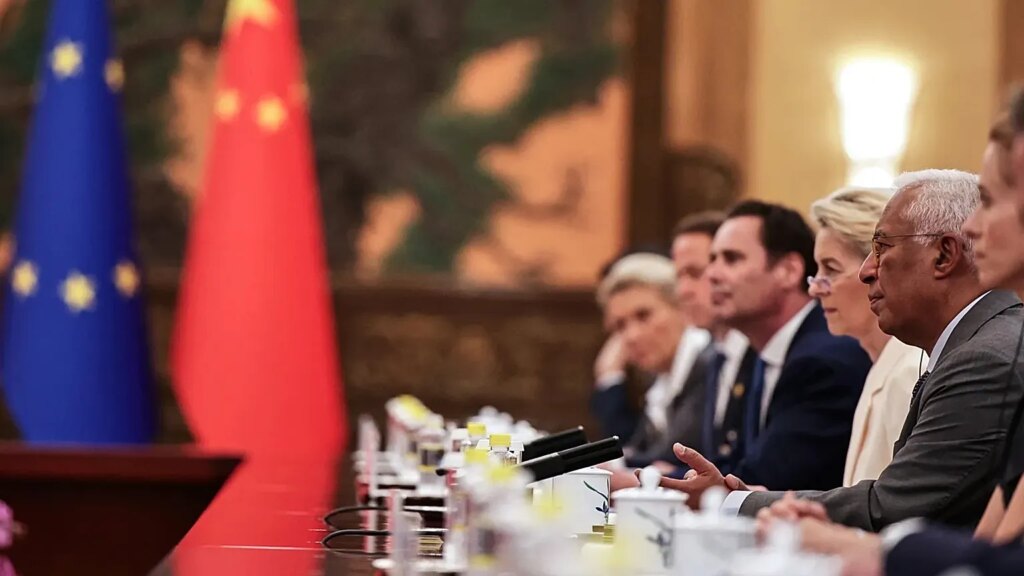
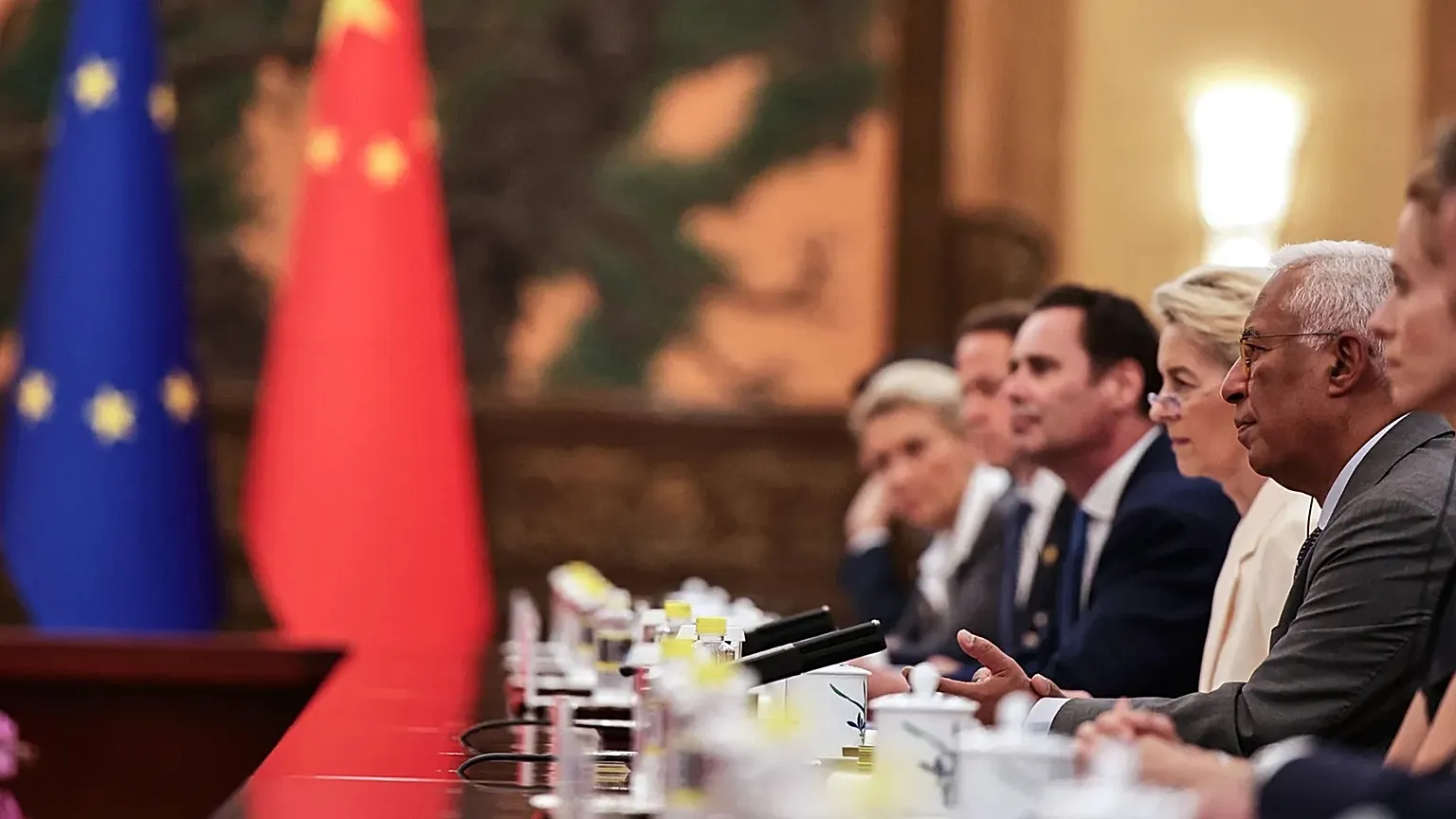
The European Union Institute for Security Studies has recommended that the bloc implement an “escalate to de-escalate” tactic concerning China, advocating for a speedier rollout of the EU’s so-called "trade bazooka”.
According to a report released Monday by the European Union’s foreign-policy think tank, the European Union Institute for Security Studies, the EU must not hesitate to engage in a trade war with China if it aims to prevent the decline of its industrial base.
 ADVERTISEMENT
  ADVERTISEMENT
The analysis contends that confrontation with Beijing appears largely unavoidable and calls on Brussels to facilitate the deployment of its most potent trade-defense tool — the Anti-Coercion Instrument (ACI).
This report comes after a year in which China intensified the use of export controls to weaponize Europe’s reliance on rare earths and semiconductors, while its trade surplus with the EU soared to €359.3 billion.
“The EU should implement an ‘escalate to de-escalate’ strategy akin to those applied by the US and China. It must be prepared to utilize its strongest instrument — the Anti-Coercion Instrument — to protect its vital interests,” the report states.
The authors argue the EU should not be deterred by potential retaliatory measures from Beijing, asserting that the expenses incurred would remain less severe than the consequences of inaction.
“Ultimately, a short-term trade conflict with China would be challenging, yet justified if it contributes to halting the EU’s industrial decline. EU institutions and Member States must communicate this truth transparently to their citizens.”
Reforming the trade bazooka
Although the ACI represents a robust defense against economic coercion, the EU refrained from using it during 2025.
Known frequently as the bloc’s «trade bazooka,» this mechanism authorizes Brussels to enforce actions such as export limitations, restrictions on licensing and intellectual property rights, or limiting access to public procurement when a non-EU state exerts economic pressure.
However, the activation process is cumbersome and politically vulnerable, allowing individual member countries to block its application easily.
The report advocates reforms permitting the European Commission to temporarily activate the tool during the required four-month investigative period. It also proposes altering the current voting norms, so a qualified majority would be needed to block the ACI, rather than to approve it.
Playing to China’s weaknesses
Distinct for its forthright approach, the report frames tougher trade measures as an unavoidable response to Beijing’s nationalist economic policies.
It points out vulnerabilities in China’s economy, including weak domestic consumption, heavy dependence on the EU market, and reliance on European technological expertise and research.
Brussels is advised to exploit these vulnerabilities by sustaining and establishing “technological chokepoints,” alongside “focused industrial policies, combined with export controls and monitoring of outbound investments,” the report recommends.
The authors also emphasize the necessity of diversifying supply chains and export destinations.
In combination with “credible escalation management” based on the Anti-Coercion Instrument, the EU could then engage in what the report defines as “leverage-based diplomacy” with Beijing.
“Having strengthened its negotiating stance, the EU could adjust its diplomatic approach toward Beijing and progress beyond perceiving diplomacy merely as an objective,” the text reads.
“The EU should establish pragmatic yet significant demands that reflect fundamental interests, accompanied by unilateral actions if negotiations fail to produce an agreement.”