
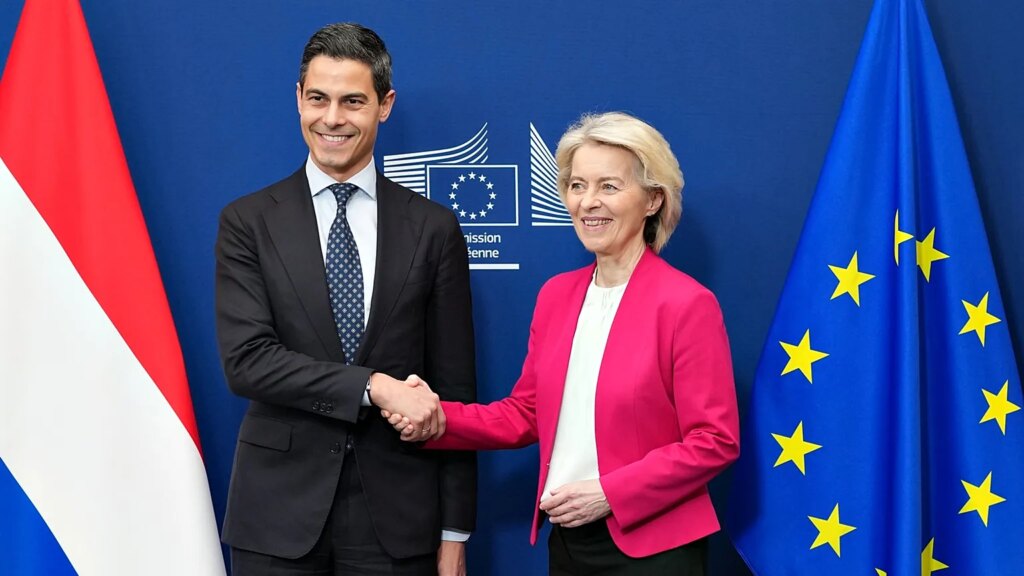
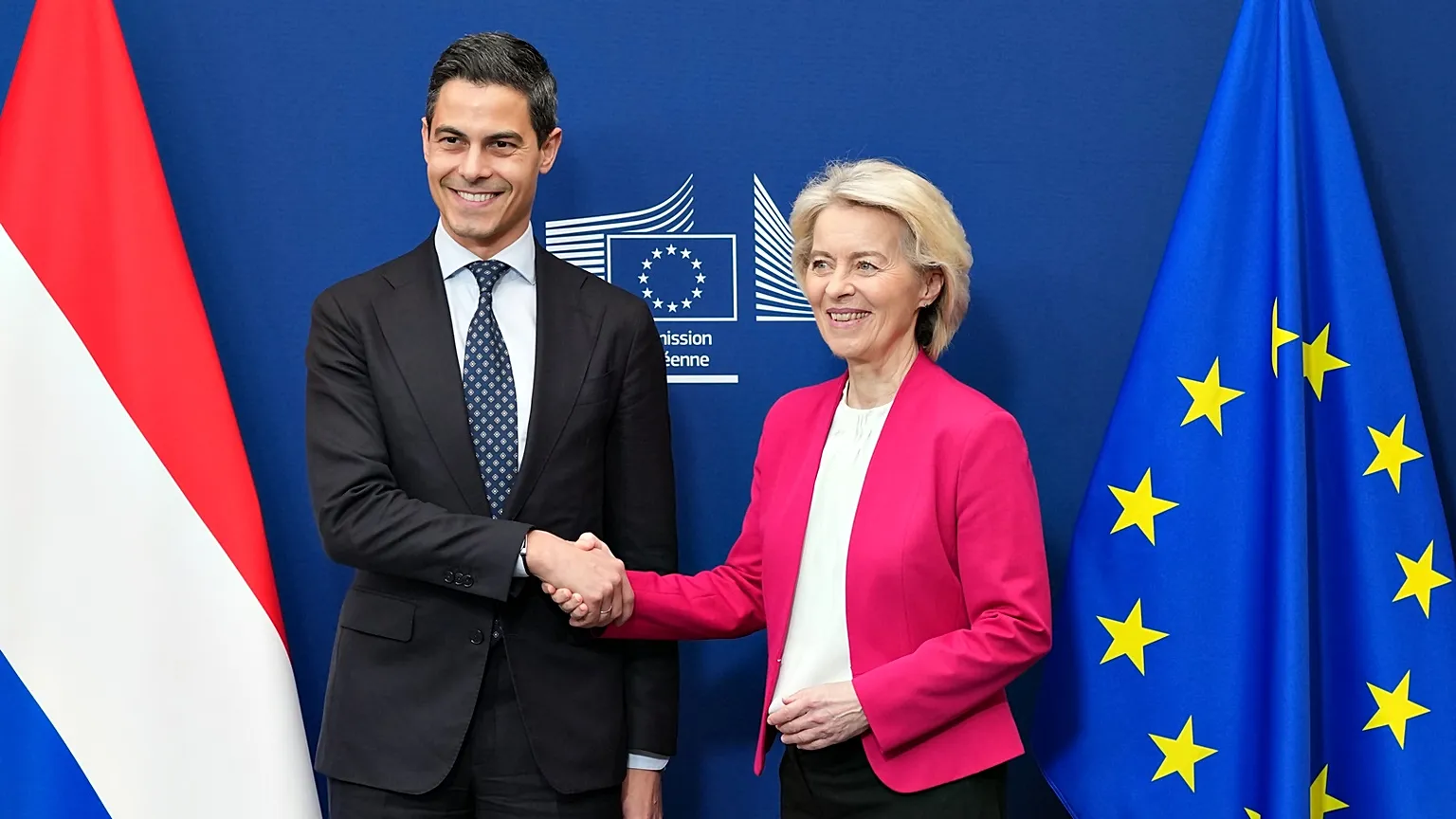
"The Netherlands has returned," announced Dutch Prime Minister Rob Jetten during his inaugural visit to Brussels after assuming office.
The last-minute veto by Hungary on the €90 billion loan to Ukraine underlines the urgent necessity for the European Union to reconsider its unanimity rule, stated Rob Jetten, the Netherlands’ new prime minister, on his initial trip to Brussels since his appointment.
 ADVERTISEMENT
  ADVERTISEMENT
«The current Dutch government supports decreasing the instances of unanimous decision-making on the European level,» Jetten explained to various media, including Euronews, on Tuesday.
«This situation clearly illustrates why such change is crucial, as it becomes difficult to justify to citizens that Europe reacts with undue delay to pressing issues impacting us all,» he added.
Jetten urged his Hungarian counterpart, Viktor Orbán, to honor the delicate agreement reached by the 27 EU leaders last December after intense negotiations. The deal involved Hungary, Slovakia, and the Czech Republic granting the necessary unanimity to amend the EU budget rules, while being exempt from collective borrowing.
Brussels officials and diplomats view Orbán’s last-minute veto of a vital loan element as a violation of the sincere cooperation principle that underpins the EU’s decision-making framework.
«When a political consensus is achieved at the Council level, all member states are expected to adhere to it. If this does not happen, the European Commission faces the challenging task of intervening,» Jetten commented.
The Dutch coalition program includes a call to «simplify» the Article 7 procedure, which can suspend voting rights of member states committing serious rule of law breaches. Hungary has been subject to Article 7 for years, yet there has been insufficient political momentum to escalate to strict enforcement.
«Supporting Ukraine in the upcoming months is absolutely essential to ensure they can persist in their resistance against Russian aggression,» Jetten continued.
«With diminishing American financial and military aid to Ukraine, the responsibility lies increasingly with Europeans to provide the necessary assistance.»
Orbán’s veto specifically concerns the halt of Russian oil supplies via the Druzhba pipeline, which Kyiv reports was damaged by Russian drone attacks on 27 January and remains out of service.
Conversely, Orbán alleges that Ukrainian President Volodymyr Zelenskyy intentionally shut down the pipeline for «political reasons,» aiming to sway the results of upcoming Hungarian elections. Orbán currently trails by a significant margin in polls.
Positioned between these opposing sides, the European Commission has requested both Zelenskyy to repair the Druzhba pipeline and Orbán to lift his veto. Simultaneously, Hungary and Slovakia have proposed a fact-finding mission to inspect the damaged pipeline section.
«We expect the European Commission to resolve this matter,» Jetten stated. «If a fact-finding mission on the pipeline assists in addressing this issue, I am open to it. Yet, everything should start with the principle that political agreements at the Council level must be respected.»
‘Premature’ to fix a date for Ukraine’s EU accession
One of the initial challenges for Jetten as prime minister concerns the future of EU enlargement, a topic on which the Netherlands has historically shown caution.
Zelenskyy calls for incorporating a concrete date for Ukraine’s accession within a forthcoming peace agreement, an approach that might mitigate the hardship of territorial concessions. Last week, he publicly proposed 2027 as an ambitious target year.
The European Commission has stated it cannot guarantee a specific date but is exploring legal mechanisms to streamline the notoriously complicated accession process, enhancing clarity for Ukrainians regarding their path to membership.
On the topic of possible reforms, Jetten emphasized that enlargement should be assessed from a «geopolitical standpoint» but urged prudence, warning that rushing forward may compromise the core objectives of the European project.
«We remain open to increasing support for candidate countries, yet advancing too swiftly is not advisable,» the prime minister remarked.
«Currently, setting a date for Ukraine’s accession is not feasible, but dialogue will continue, and I intend to discuss with President Zelenskyy how Europeans can aid Ukraine in executing vital reforms. At this stage, it is too soon to establish a timeline.»
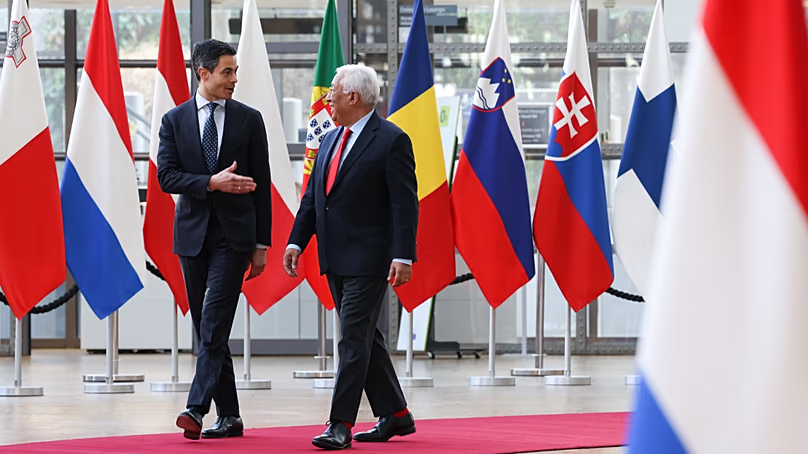
Jetten also addressed the US-Iran tensions in Iran, which have pushed the Middle East into unfamiliar territory. Wholesale gas prices have surged in response to the conflict, raising concerns that Europe might soon encounter exorbitant costs to replenish its underground gas reserves, which are depleted following the heating season.
«Clearly, the conflict in Iran could significantly affect strategic reserves not only in Europe but also in Asia. Therefore, preparations are needed should the war extend for several more weeks, impacting reserves within the Netherlands and beyond,» he noted, adding that additional measures would be implemented «if necessary.»
«The broader concern is how this conflict and developments in the Strait of Hormuz will influence pricing.»
‘The Netherlands has returned’
Jetten’s liberal D66 party has established a minority government with the centrist VVD and the conservative CDA, all proponents of European integration. His administration ends the fractious four-party coalition led by the right-wing, Eurosceptic Party for Freedom of Geert Wilders, which was characterized by persistent disputes.
The government promises to increase defense spending, streamline regulations, foster new technologies, and expand renewable energy sources.
«As a founding member and the fifth-largest economy in the EU, the Netherlands has returned to the table to collaborate closely with all here in Brussels and our EU allies,» Jetten affirmed.
«Numerous opportunities exist to boost the European economy and its competitiveness, while ensuring that substantial tax revenue is invested in European defense and the defense industry.»
Alongside the other 26 leaders, Jetten is preparing for a vigorous battle over the forthcoming Multiannual Financial Framework (MFF), the EU’s seven-year budget. Brussels has proposed a €2-trillion plan which some capitals regard as politically unacceptable.
The allocation of cuts will provoke major disagreements. Germany, the Nordic countries, and the Baltics seek enhanced prioritization of strategic areas, whereas Spain, Italy, and Eastern Europe wish to maintain significant funding for agriculture and cohesion policies.
The Dutch prime minister emphasized that the next budget must concentrate on the major transitions shaping Europe’s future: defense, technology, and climate.
«A modern MFF does not imply an inflated budget in sheer numbers,» he stated.
«The Netherlands will scrutinize the costs carefully and anticipates extensive debate on this issue in the coming months.»