
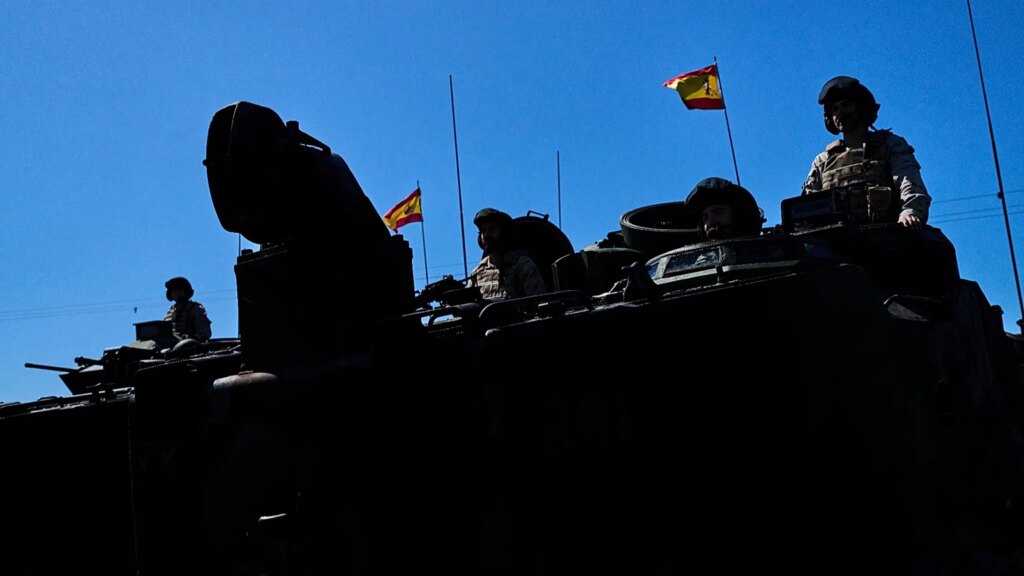
The mutual defence clause of the EU is formulated more strongly than NATO’s Article 5, yet it is often viewed as less robust because military alliance members have relied primarily on the deterrence guaranteed by the US.
The focus of efforts to implement the European Union’s mutual defence clause should be on situations that are considered «below the threshold» of NATO’s Article 5, according to the bloc’s highest military authority speaking to Euronews.
 ADVERTISEMENT
  ADVERTISEMENT
General Seán Clancy, Chair of the EU’s Military Committee, declared to Euronews over the weekend that his teams «are prepared» to assist with redefining the scope of European mutual defence.
During her address at the Munich Security Conference on Saturday, European Commission President Ursula von der Leyen advocated for the EU to achieve defence autonomy, emphasizing that the time had arrived for the bloc to activate its mutual defence clause as a part of this initiative.
She further noted that the pledge outlined in the clause, known as Article 42.7 of the Treaties, «carries significance only when founded on mutual trust and operational capability».
Von der Leyen’s statements come amid a defence restructuring within the EU triggered by Russia’s broad invasion of Ukraine, alongside concerns regarding a potential Russian attack on another European nation before 2030.
However, despite public assurances from European leaders and officials, there remains unease about the ongoing commitment of the US to European security, NATO, and its Article 5 collective defence principle.
‘Below Article 5’
Both NATO’s Article 5 and the EU’s Article 42.7 have been invoked just once: NATO’s after the 9/11 attacks in the US, and the EU’s following the November 2015 terror attacks in Paris.
The EU’s clause states that if an EU member is subject to armed aggression on its soil, other EU members are obliged to assist it by all means available.
When questioned about the necessity to further operationalise the EU’s mutual defence clause, given that 23 EU members are also NATO allies and trust Washington’s security commitment, General Clancy explained that the roles of these two entities are distinctly defined.
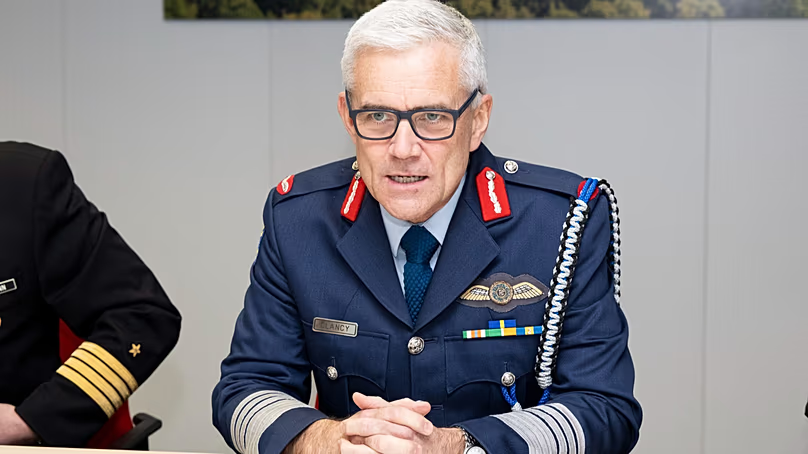
«NATO is fundamentally a military alliance, whereas the EU represents a fundamentally different entity. To put it simply, this is how we would put the operationalisation into practice—as something ‘below Article 5’,» he explained to Euronews.
«In other scenarios, including hybrid warfare or various crises—whether humanitarian or more severe, or even responses to hybrid threats—what is the EU’s approach and how should this be put into effect?»
«I believe this illustrates the complementarity needed, with the emphasis on complementarity, to strengthen the EU-NATO relationship and understanding,» he concluded.
Will the EU achieve self-defence capability by 2030?
A crucial component of the EU’s plan to enhance its defence readiness by 2030 involves a European Commission initiative encouraging joint defence procurement to address capability gaps more efficiently and cost-effectively.
Member states have access to a €150 billion loan facility provided by the Commission, aimed at collective acquisition in nine priority sectors, including ammunition, drones, air defence, ground combat, and strategic enablers.
General Clancy told Euronews that the EU is currently «in the implementation phase» with «active progress across all nine capability areas.»
He acknowledged that some sectors are advancing faster than others, primarily due to better-developed industrial infrastructures or accelerated innovation spurred by battlefield experiences in Ukraine. Drones and space systems, in particular, have seen rapid development.
The upcoming key deliverable will be a formal readiness report due in autumn, designed to offer political leaders—including Commission President Ursula von der Leyen—clear insights into existing gaps and timelines for their resolution.
Regarding whether the EU will be capable of autonomous defence by the end of the decade, as envisioned by the Commission’s Defence Readiness 2030 roadmap, General Clancy maintained a cautious perspective, viewing the goal as part of a gradual transformation rather than a final endpoint.
«The past four years have demonstrated that the global security landscape has fundamentally changed,» he remarked, referencing the Ukraine conflict as a vivid example of how warfare now blends conventional tactics—such as trench warfare—with advanced disruptive technologies.
This unpredictability, he explained, makes it difficult to foresee exactly how future European conflicts will unfold.
Nonetheless, he asserted that European readiness must encompass preparation for a spectrum of scenarios, from peaceful conditions to semi-peace, through crisis stages and possibly open armed conflict.
«The year 2030 represents a target we are actively striving toward, yet it is part of an ongoing progression,» said General Clancy. Europe, he indicated, cannot afford to relax its defence and security commitments after that point and must continue maintaining current momentum.