
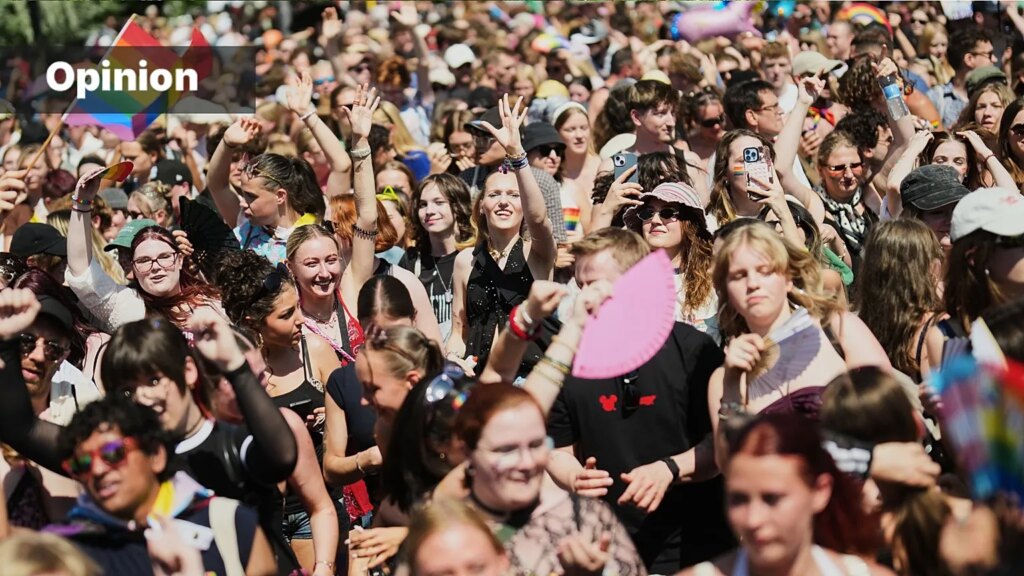
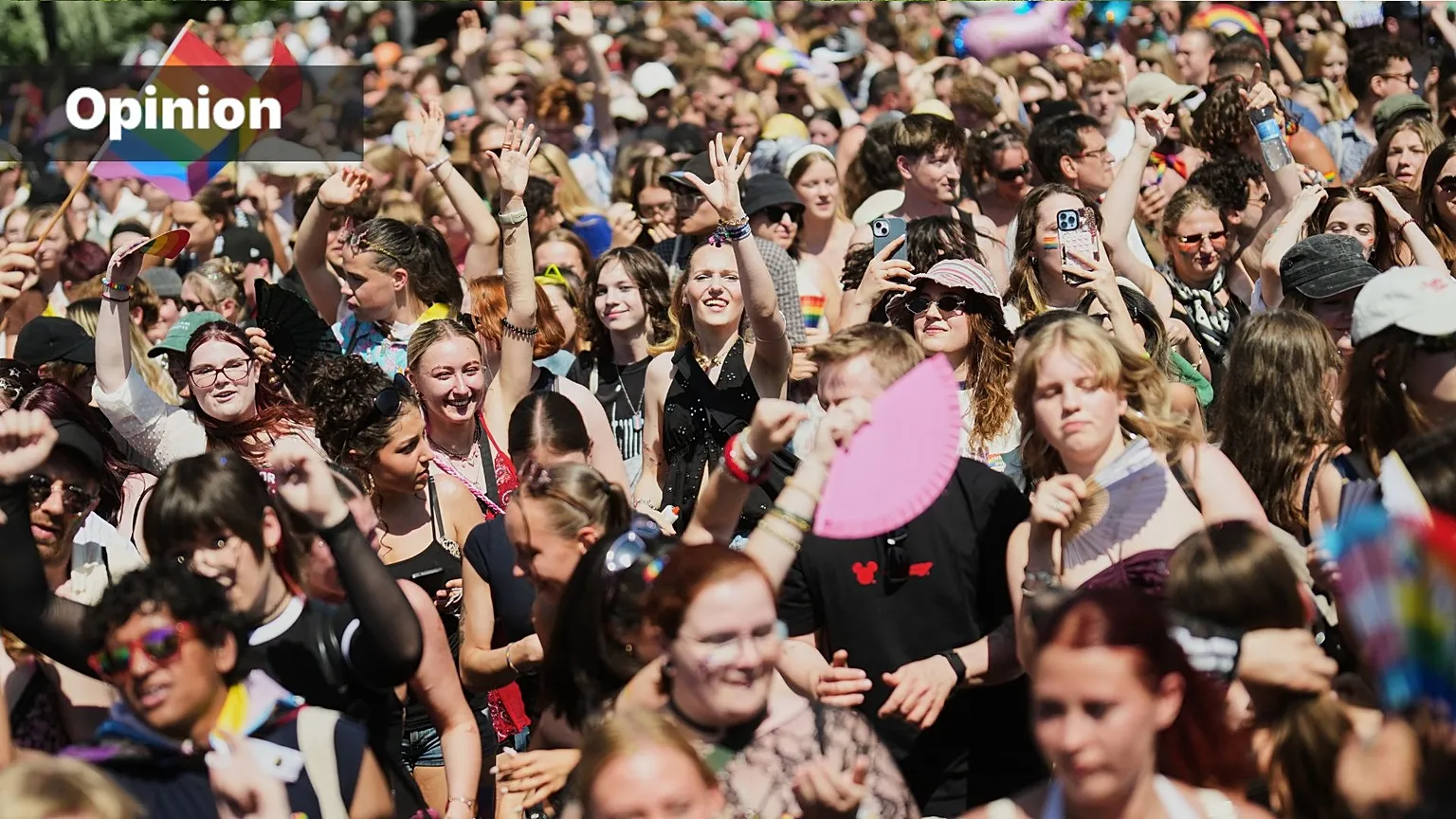
The Islamist assault during Berlin’s Christopher Street Day underscores the danger Islamism imposes on freedom, asserts Wolfgang Kubicki, leader of Germany’s liberal Free Democratic Party (FDP), in Euronews, emphasizing that this threat is escalating in Germany and demands confrontation.
Nearly a decade ago, on 12 June 2016, Orlando, Florida, witnessed the deadliest act of terrorism in the United States since 11 September 2001. A gunman opened fire at the Pulse nightclub, resulting in 49 deaths and 58 injuries. Almost six years ago, on 4 October 2020, a terrorist stabbed two men in Dresden, Germany, killing one and severely wounding the other. Yesterday, Berlin suffered yet another terrorist incident where one person was killed and several others seriously injured.
 ADVERTISEMENT
  ADVERTISEMENT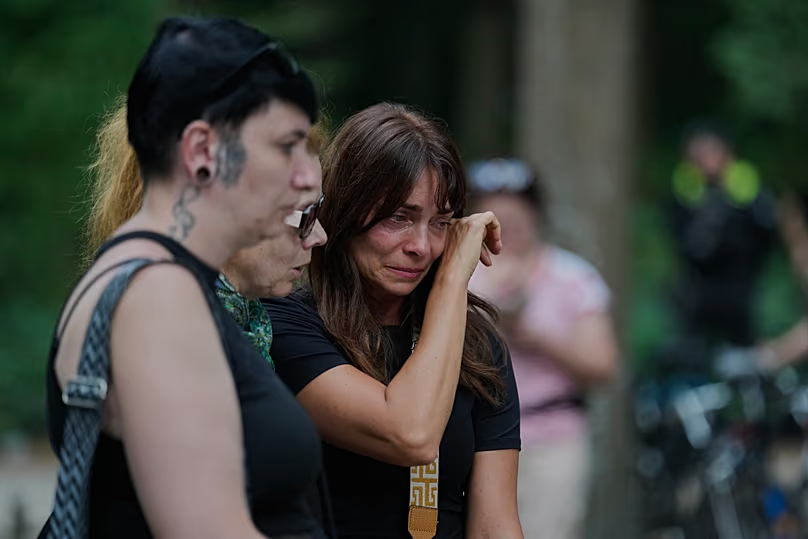
Islamist violence targeting LGBTQ+ individuals
The common factor among these three events is both the motive and the specific targets. In Orlando, the victims were attendees of a gay nightclub; in Dresden, the assaulted men were spouses; and in Berlin, those attacked were participants of Christopher Street Day. To the best of current knowledge, all three assaults were driven by Islamist motives and directed specifically against homosexual individuals.
The decline in a sense of safety among sexual minorities over recent years is no coincidence. Besides the initial attacks mentioned, there is a general escalation of such violent acts. In 2025, the Federal Criminal Police Office (BKA) documented 284 violent crimes motivated by the victim’s sexual orientation. This figure has consistently stayed at similarly elevated levels following a prior surge; for comparison, in 2015, only 54 such offenses were recorded.
Equality for same-sex couples signified a triumph of reason
Germany has little ground to claim moral superiority regarding its history with sexual minorities. Several decades ago, gay men were prosecuted under criminal statutes—with approval from the nation’s highest court in Karlsruhe. During the Nazi era, persecution escalated to a tragic extreme, resulting in thousands deported to concentration camps, many dying under horrific conditions.
Survivors were pushed into forced silence because their suffering was still considered criminal and socially stigmatized. Overcoming this legacy required a long, challenging process. The decriminalisation of homosexuality, followed by legal equality for same-sex couples, represented the victory of enlightened humanism over ingrained prejudice within the law.
Jews, women, Christmas markets — freedom is under threat
Nowadays, in 2026, the danger to gay and bisexual people no longer originates from the state. However, freedom is currently eroding in this country. This applies not only to sexual minorities but also to Jewish communities, whose schools and childcare centers require intensified security due to increasing violent attacks.
The same holds true for women, many of whom feel unsafe traveling alone at night. Moreover, anyone hesitating to attend Christmas markets, festivals, or other public gatherings out of safety concerns faces the same reality.
Segments of the left embrace a distorted worldview
Unfortunately, a growing trend rejects not only acknowledging the causes of this decline but also refuses to recognize them at all. Particularly within left-wing circles, a narrow worldview is nurtured that claims entire communities as its own. For instance, reports from this year’s Christopher Street Day in Kiel indicate that the far-left group «TurboKlimaKampfGruppe Kiel» (TKKG) disrupted the event against organizers’ wishes by chanting slogans hostile to the police.
This group justified their protest by accusing «the police as an institution» of promoting and accelerating «authoritarian and right-wing developments within the state,» which allegedly allow «racist violence to persist and grow.» Participants voiced well-known far-left anti-police chants, including «No Cops» and «All Cops Are Bastards.»
The main danger to a liberal society: Islamism
Yet such attitudes and the reluctance to explicitly identify the greatest threat to a liberal, open society—Islamism—also appear in more moderate left-wing factions. This stems from a flawed interpretation of tolerance. Still, there is no tolerance in allying with those who fundamentally reject and aim to dismantle all openness. From a cultural perspective, Islamists share more similarities with some of Germany’s darkest historical chapters.
They harbor hatred precisely because those dark times were overcome. Therefore, it would be a mistake to believe the Berlin attack targeted only a particular group. Instead, it was an assault on all of society. It challenges the achievements of liberal democracy and our lifestyle regardless of whom individuals love or where they choose to celebrate.
Unable to tolerate the freedoms of Western society, they seek to annihilate them. Attacks like those in Dresden, the Ansbach music festival, the Holocaust memorial in 2025, and the Nazi Documentation Centre in Munich all form part of this pattern.
Islamism is not merely imported—it is growing locally
The hope remains that this horrific attack will inspire more people to confront uncomfortable realities. This involves recognizing Islamism for the threat it poses. It also necessitates acceptance of the importance of regulating migration—deciding who may enter the country and who must be denied permission.
Furthermore, the harsh truth is that Islamism no longer solely represents a foreign menace but, as Berlin demonstrates, has rooted itself within local communities.
This development partly results from neglecting integration policies and permitting the formation of parallel societies, instead of leveraging existing legal measures to tackle them decisively.
Denmark as an example: political center solutions are crucial
Additionally, this problem arises because the facilitators of terrorism—Islamist hate preachers and supporting organizations—have operated unchecked for too long. The degradation of everyday freedoms has remained largely absent from political discourse, with those raising concerns often accused of «serving the far right.»
Nonetheless, nothing benefits right-wing extremists more than the political center’s incapacity to identify issues and address them effectively. This challenge can be overcome, as Denmark has exemplified.
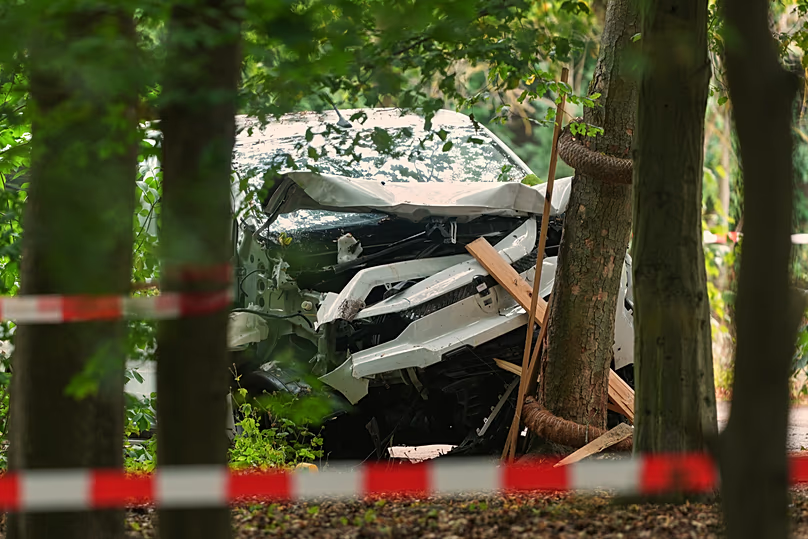
The assault on Christopher Street Day strikes a deep chord. Yet it was not merely an attack on that event. Rather, the incident in Berlin was an assault on freedom itself: the freedom to choose one’s faith—or to choose none at all. The freedom to love whoever one wishes. The freedom to attend concerts, fairs, or Christmas markets without fear.
The nation’s future will depend not on how shaken people feel after each attack, but on whether society embraces the courage to name problems candidly and address them decisively.