
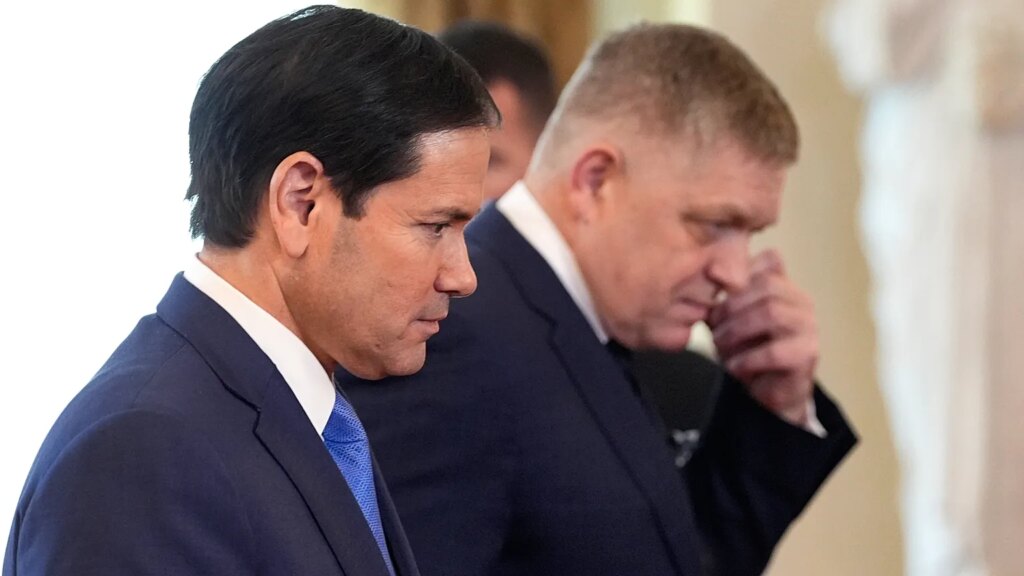
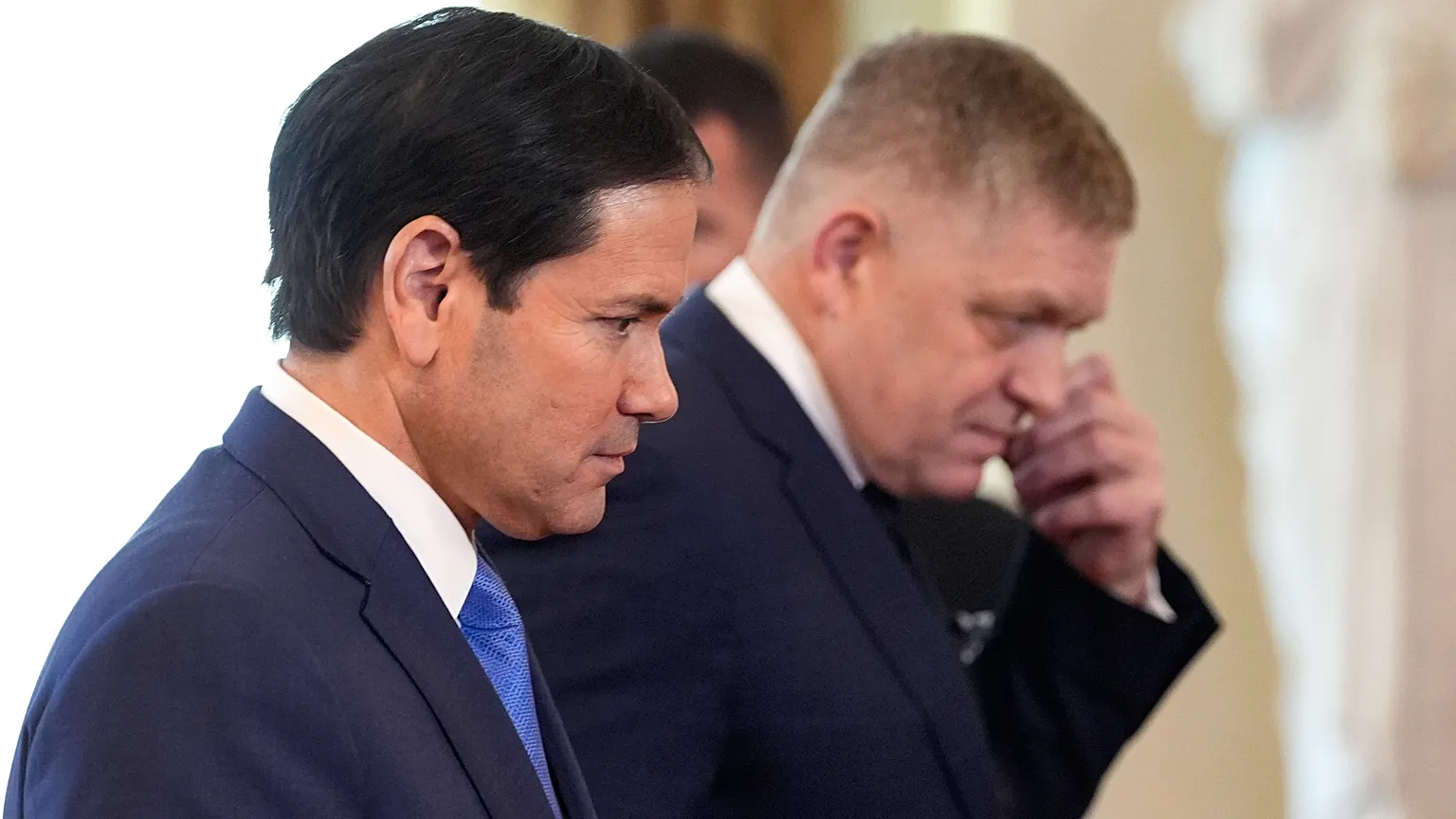
The leading US diplomat stated that Washington seeks stronger European allies who assume greater responsibility. He met Slovak Prime Minister Robert Fico in Bratislava on Sunday. Slovakia is the initial destination in his two-country tour of central Europe, which also includes a visit to Hungary.
US Secretary of State Marco Rubio emphasized that America does not request European partners to act as vassals but insists on their reduced reliance on Washington. These statements were made during a joint press conference in Bratislava following talks with Slovak Prime Minister Robert Fico.
 ADVERTISEMENT
  ADVERTISEMENT
Slovakia represents the first stop in Rubio’s central European tour, which commenced Sunday after his participation in the Munich Security Conference during recent days.
Following Slovakia, he plans to visit Hungary to meet with Prime Minister Viktor Orbán to discuss bilateral ties and strengthen connections with Trump supporters in the region.
Both Fico and Orbán stand as principal allies of the Trump administration within Europe, endorsing Washington’s anti-immigration stance and sharing Trump’s vision to conclude the conflict in Ukraine.
Rubio minimizes concerns about troop relocations
Responding to journalists’ inquiries, the top American diplomat downplayed the recent US move to reposition a limited contingent of troops stationed in Europe.
«The US is not abandoning NATO; a few thousand troops might be shifted between countries, but this situation is nothing new,» Rubio explained to reporters.
«Our goal is for Europe not to be dependent on us. We do not seek for Europe to be subservient to the United States. We aim to be partners and collaborate. The core idea is: the stronger European members are, the stronger NATO becomes.»
During Saturday’s speech at the Munich Security Conference, Rubio acknowledged shared US-European futures but cautioned that Europe’s cultural and economic decline must be reversed, with mass migration halted.
In January, numerous EU leaders voiced concerns that then-President Donald Trump’s plans to acquire Greenland could jeopardize NATO. Recently, the EU Defence Commissioner suggested that Brussels should prepare to substitute US troops stationed on the continent.
Rubio declined to elaborate on recent talks with Denmark concerning Greenland. He also minimized Slovak criticism regarding the US military operation in Venezuela that resulted in Nicolás Maduro’s arrest.
In January, Robert Fico labeled the raid a breach of sovereignty and international law.
«Many countries disapproved of our actions in Venezuela, which is acceptable. Those actions served our national interests. Surely, there will be actions by others in the future we may not agree with, but that doesn’t mean alliances will dissolve,» Rubio concluded.
He further emphasized that Central Europe will remain a strategic region for the current administration’s engagement with Europe during Trump’s second term.
Fico critiques EU’s backing of Ukraine
Fico and Rubio discussed nuclear and military cooperation as well as ongoing efforts aimed at ending the war in Ukraine, which marks its fourth year later this month.
The Slovak prime minister criticized the EU’s policy, which continues providing financial and military aid to Ukraine.
Fico reminded that during the December EU summit, Slovakia, Hungary, and the Czech Republic abstained when the EU approved a €90 billion support package for Ukraine.
«The EU grants a loan of €90 billion for Ukraine; €60 billion is allocated for weapons and €30 billion supports Ukraine’s operational expenses,» he explained.
«I take pride that we did not partake in this vote at the European Council,» Fico added, warning that ongoing financial support for Kyiv will only extend the conflict and increase casualties on both sides.
«What will follow? By December, the death toll for Russia and Ukraine could surpass another 100,000. Ultimately, this will only deepen Russia’s presence within Ukraine,» the Slovak leader stressed.
Fico also sharply criticized the EU’s decision to phase out Russian fossil fuel imports by 2027, arguing it will bring severe consequences for Slovakia and other countries.
«This decision will cause significant difficulties since we lack LNG terminals,» he noted.
The Slovak premier addressed Ukraine’s EU accession ambitions and commended Hungarian Prime Minister Viktor Orbán for openly rejecting those.
«We state that Ukraine may join the EU only upon fulfilling all the necessary criteria. We cannot mislead Serbia, Montenegro, or Albania, as they are far better prepared for accession than Ukraine,» Fico affirmed.
Additionally, he condemned Kyiv for using issues related to oil transfers to Hungary and Slovakia as instruments of political blackmail.
Rubio’s upcoming meeting with Orbán in Hungary
Marco Rubio continues his tour of central Europe in Hungary, where he is scheduled to meet Prime Minister Viktor Orbán.
The US State Department indicated that discussions will center on «the peace process to resolve global conflicts» alongside the US-Hungary energy partnership.
Orbán, a vocal critic of the European Union and fervent Trump supporter, was the first European leader to confirm Hungary’s participation in Trump’s Board of Peace initiative, viewed by many skeptics as an attempt to replace the UN’s role.
Last year, the US granted Hungary a one-year exemption from secondary tariffs imposed on countries importing Russian oil.
In December, Hungary signed an agreement with US energy company Chevron to import 2 billion cubic meters of liquefied natural gas (LNG) from the United States.
Trump is publicly endorsing Prime Minister Orbán for Hungary’s general elections, where Orbán faces a challenging re-election campaign in mid-April.
The opposition Tisza Party, led by center-right Péter Magyar, currently leads in the polls.