
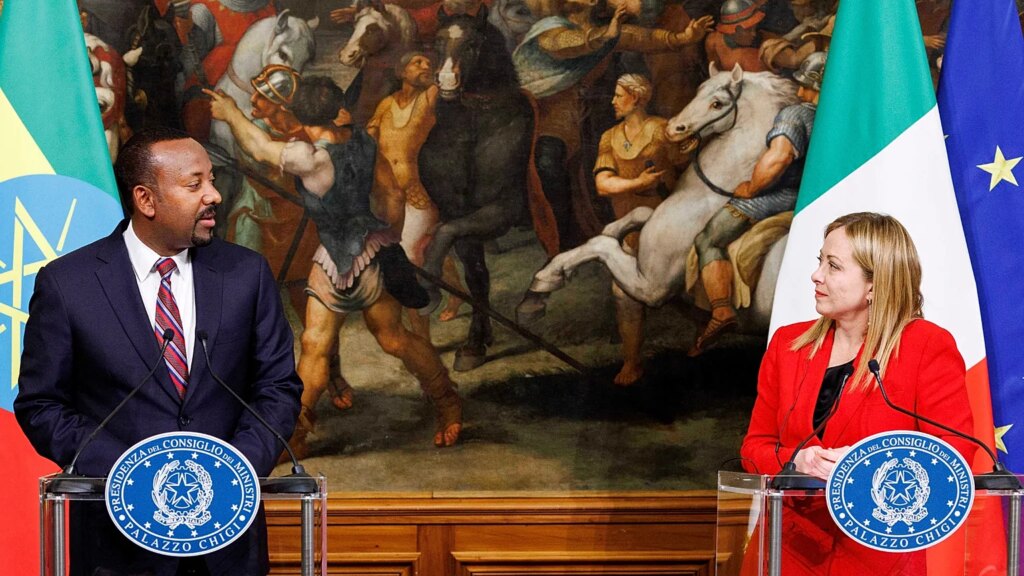
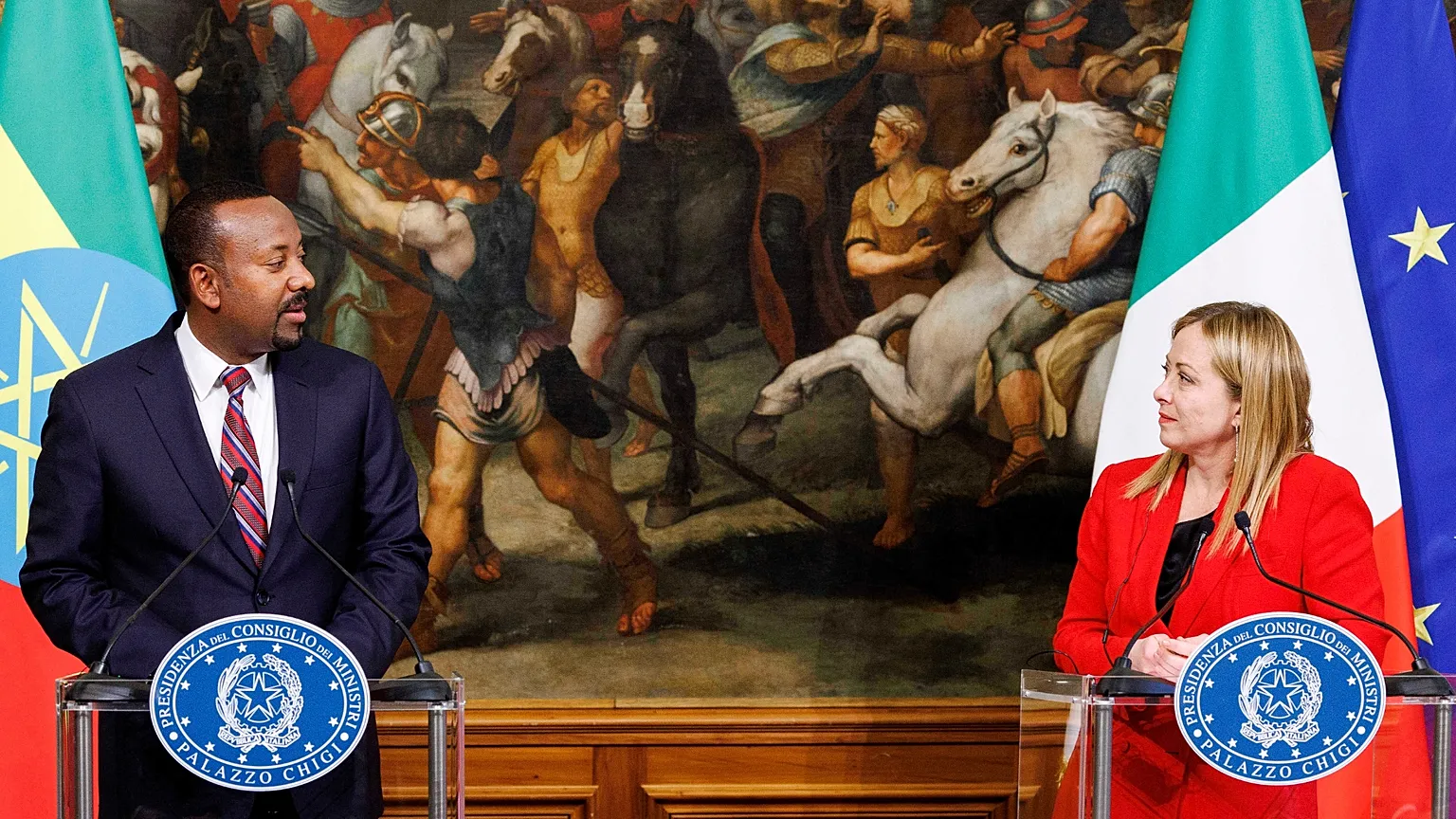
This summit represents the inaugural occasion the Italy-Africa biennial meeting has taken place on African soil since the Mattei Plan was introduced in Rome in January 2024.
On Thursday, Italian Prime Minister Giorgia Meloni hosted the second Italy-Africa summit in Addis Ababa, assessing the advances made under the Mattei Plan two years after its launch as a framework for collaboration with African countries.
 ADVERTISEMENT
  ADVERTISEMENT
Held at the Addis Ababa Convention Centre, the summit coincides with the African Union meeting and precedes the AU Assembly of Heads of State and Government, where Meloni is scheduled to deliver a speech on Friday as an invited guest of honour.
Raffaele Marchetti, director of the Study Centre for International and Strategic Affairs at Luiss University in Rome, described the Mattei Plan as Italy’s pursuit of a broader and more autonomous role on the global stage.
«Overall, this is the arena where Italy is most distinctly characterized,» he remarked. «There exists a strategic interest looking far into the future.»
Marchetti noted the United States shows limited engagement with Africa, while Italy sees the continent as integral to its broader Mediterranean outlook. He also cited projections estimating Africa’s population to reach five billion by the century’s close, with an expanding proportion of the global labor force.
He emphasized that although Italy has allocated some resources, public funding remains modest and must be supplemented by private investments in conjunction with Italian and European capital.
«Italy’s contribution lies in quality capacity building — specifically education and training,» Marchetti explained. «By educating individuals, multiplier effects are generated. Given that training is relatively inexpensive, it offers a cost-effective means to support African development.»
European dimension
Marchetti characterized the plan as «a significant acceleration, a formalization of a longer-term process,» and pointed out that «other European nations, particularly France, are struggling to safeguard their influence.»
He portrayed it as «an important opportunity for Italy to assume a degree of European leadership in Africa» with a project that «intends to evolve into a European initiative, backed by the Commission.»
Concerns about the viability of the project have been voiced. An investigation by IrpiMedia revealed worries regarding the transparency of infrastructure, the criteria for project selection, and the accessibility of funds.
Since the Mattei Plan’s launch in January 2024, this summit is the first to be held within Africa as part of the regular Italy-Africa biennial meetings.
Italian government sources indicate that projects planned for 2025 have valuations between €1.3 billion and €1.4 billion.
Funding was secured through the Africa Fund, the Italian Climate Fund, and partnerships with multilateral bodies such as the World Bank, the International Fund for Agricultural Development, and the African Development Bank.
The initiative has grown from its original nine participating countries to focus on fourteen nations, with Italy aiming for further expansion of this collaboration.
The plan targets five main sectors: energy, infrastructure, water and agriculture, education, and healthcare.
Significant milestones include water projects in regions severely affected by climate change, alongside the signing of the Framework Convention for International Health Cooperation.