
The European Commission’s announcement on Monday follows closely after France’s Emmanuel Macron and Italy’s Giorgia Meloni supported renewing dialogue with Moscow.
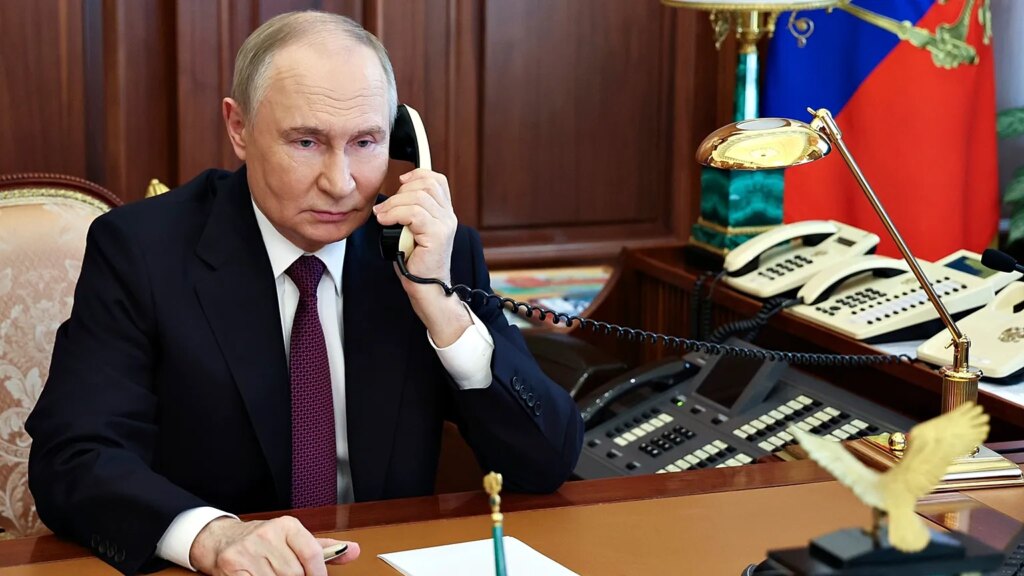
The European Commission has indicated the potential for direct negotiations with Russian President Vladimir Putin to resolve the conflict in Ukraine, while emphasizing that Moscow’s ongoing intensive bombing makes such discussions unfeasible at this moment.
«Great efforts are underway to achieve peace in Ukraine,» stated Paula Pinho, the European Commission’s chief spokesperson, on Monday afternoon.
«The resolution of the conflict in Ukraine hinges on one individual. That individual, as widely understood, is President Putin. Inevitably, direct talks with President Putin will be necessary eventually. Meanwhile, extensive efforts continue,» Pinho added.
«Regrettably, there is no indication from President Putin of willingness to engage in these discussions yet. While we have not reached this stage, we do hope that, eventually, talks will commence that result in peace in Ukraine.»
When asked if Commission President Ursula von der Leyen should initiate contact, Pinho refrained from speculating on the timing, conditions, or participants, instead urging Putin to consent to a direct meeting with Ukrainian President Volodymyr Zelenskyy, which the Russian leader has consistently declined.
«The readiness comes from President Zelenskyy, who has often expressed willingness,» Pinho explained. «However, we are not at that point yet,» she reiterated. «We wish that were the case.»
These remarks mark a notable shift in the Commission’s stance, which until now concentrated on diplomatically isolating and imposing economic sanctions on the Kremlin due to its extensive invasion of Ukraine and hybrid attacks targeting Europe.
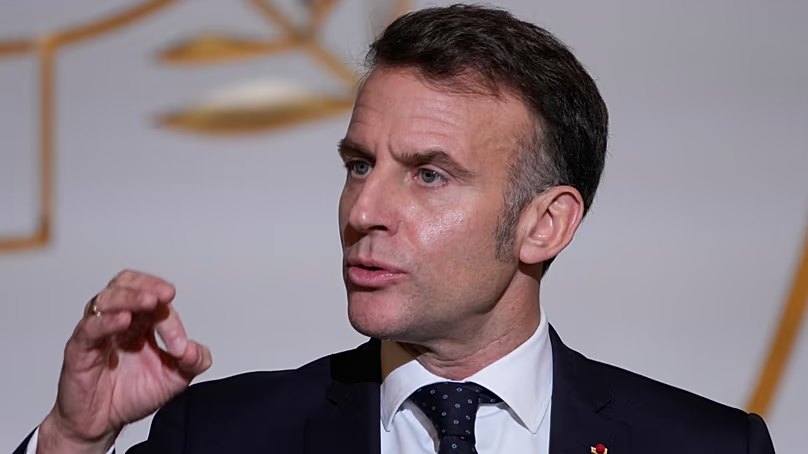
This altered tone arises shortly after French President Emmanuel Macron hosted a session of the «Coalition of the Willing» in Paris, advocating that restarting dialogue with Putin should happen «as soon as possible».
Previously, Macron argued that direct communication with Putin would be «useful» to reduce reliance on the United States, which currently stands as the sole intermediary.
On Friday, Italian Prime Minister Giorgia Meloni endorsed Macron’s initiative.
«Macron’s view is correct. The moment has arrived for Europe to engage directly with Russia,» Meloni said to reporters. «If Europe chooses to be involved in negotiations by addressing only one side, the potential positive impact could be constrained.»
The Italian Prime Minister proposed that the EU appoint a special envoy to represent all 27 member states in these discussions, though no specific candidate was suggested.
«Reopening dialogue with Russia without a coordinated approach would benefit Putin,» Meloni remarked during her customary New Year’s press briefing.
«This issue has persisted since the beginning. Too many voices and inconsistent formats have complicated the process.»
Although not a new proposal, the notion of direct talks with Putin has gained momentum amid US-led negotiations, which have at times marginalized European nations and left them vying for influence at the negotiation table.
Recently, European countries have intensified cooperation with Washington to develop a unified framework of security guarantees for Ukraine post-conflict. Still, it remains the White House that communicates with the Kremlin to secure its responses.
Renewing dialogue with Russia, which has been largely suspended since February 2022, remains highly contentious within the EU, given the ongoing severity of the war.
Last week, EU officials expressed collective condemnation of Moscow’s use of the Oreshnik intermediate-range hypersonic ballistic missile aimed at vital infrastructure in Lviv, western Ukraine, situated approximately 60 kilometers from the EU and NATO borders.
«Putin is unwilling to pursue peace,» stated High Representative Kaja Kallas. «Russia answers diplomatic efforts with additional missiles and devastation. This recurring pattern of major Russian attacks will persist until Ukraine is supported to halt it.»
Among EU leaders, only Hungary’s Viktor Orbán and Slovakia’s Robert Fico maintain direct contact with Putin; both have openly criticized European aid to Kyiv.