


The discussion over a reparations loan to Ukraine raises a crucial question: What is the exact whereabouts of Russia’s frozen assets?
When Belgian Prime Minister Bart De Wever firmly opposed the proposal at last month’s EU summit to grant a €140 billion reparations loan to Ukraine based on seized Russian Central Bank assets, he voiced concerns about being singled out.
Indeed, the bold initiative centers exclusively on funds held at Euroclear, a Brussels-based central securities depository, despite G7 members consistently mentioning roughly €300 billion in frozen sovereign assets spread across their territories.
«The largest share is in Belgium, but others exist elsewhere,» De Wever remarked. «Yet this rarely gets mentioned.»
In reality, few voices have addressed this issue in detail.
Following De Wever’s comments at the indecisive summit, Euronews contacted Western nations identified through media and independent sources as custodians of parts of the Russian Central Bank assets.
These include France, Luxembourg, Germany, Switzerland, the United Kingdom, the United States, Canada, Japan, and Australia — all aligned in the international effort to weaken the Kremlin’s war apparatus and halt the invasion of Ukraine.
Ironically, the clearest responses came from the two countries traditionally associated with financial confidentiality: Luxembourg and Switzerland.
A recent analysis from the European Parliament’s research service estimates that Luxembourg holds between €10 billion and €20 billion in Russian sovereign assets.
However, a joint statement by the nation’s finance and foreign affairs ministers presented a starkly contrasting figure: «The amount of Central Bank of Russia assets currently frozen in Luxembourg is under €10,000,» they asserted.
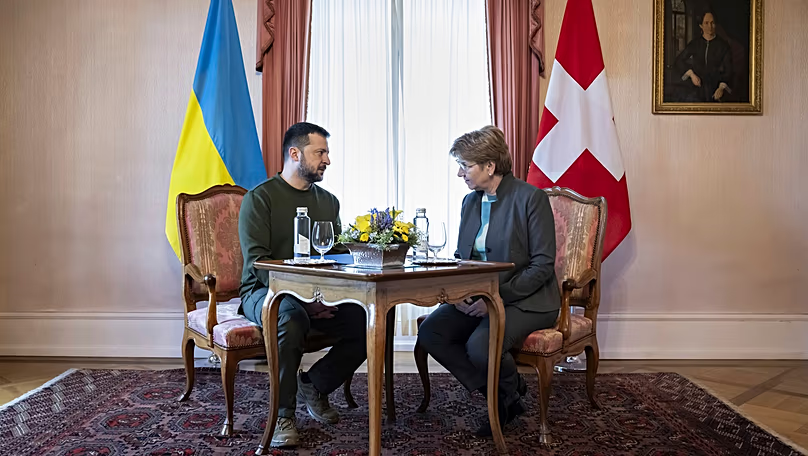
Switzerland confirmed holding 7.45 billion Swiss francs, approximately €8 billion, in Russian sovereign assets, which are stored in commercial banks.
Although Switzerland is neither part of the EU nor the G7, and thus not obliged to participate in the reparations loan plan, it remains closely monitoring developments.
«The Federal Council will shape its stance based on Swiss and international law, foreign policy priorities, and the need to maintain financial stability, aiming to prevent unintended effects on financial markets and future central bank dealings within the global financial system,» officials stated.
The remaining countries contacted by Euronews issued statements of varying detail but refrained from specifying the volume of Russian sovereign assets they hold.
Germany, believed to possess a modest share of frozen funds, stated it could not «reveal the size or location of Russian Central Bank assets» within its borders due to privacy regulations and EU sanctions legislation.
Japan responded similarly. The nation is thought to control between €25 billion and €30 billion in Russian sovereign assets, a figure not officially confirmed by Tokyo. (De Wever claimed Japan alone holds €50 billion.)
«The Government of Japan does not disclose information regarding the details of Russia’s sovereign assets in Japan, including amounts and locations. Therefore, it refrains from commenting,» the statement explained.
France declined to comment on the value of Russian assets hosted domestically, despite former Finance Minister Bruno Le Maire having acknowledged €22.8 billion in frozen funds linked to the Russian Central Bank.
The US Treasury Department did not respond to Euronews inquiries.
In September 2023, Axios reported that the international task force known as Russian Elites, Proxies and Oligarchs (REPO) identified approximately $5.06 billion (€4.41 billion) in Russian sovereign assets scattered through the U.S. banking system.
Wall of silence
The Western opacity over this issue contrasts sharply with Belgium’s transparency.
Euroclear regularly releases reports detailing Russian sovereign assets, their currency breakdowns, and updates on the profits generated from these holdings. These reports are accessible to policymakers, investors, journalists, and analysts alike.
It should be noted that, as a central securities depository, Euroclear adheres to stricter transparency standards and oversight than private banks, where secrecy and privacy are paramount to client protection.
Currently, G7 countries lack the ability to provide a precise breakdown of Russian sovereign assets under their control, a notable shortcoming in light of the reparations loan discussion.
The European Commission, author of the ambitious €140 billion loan proposal, has consistently avoided addressing whether it intends to investigate assets beyond Euroclear’s holdings.
Dr. Szymon Zaręba, senior researcher at the Polish Institute of International Affairs (PISM), endeavored to identify the exact location and valuation of Russian Central Bank assets. His attempt faced the same obstacles Euronews encountered.
«In informal talks with representatives of some EU and G7 states, no explanations were given regarding why exact data on asset sizes remains unavailable,» Zaręba noted.
The researcher questioned the reasoning that disclosing precise figures might expose Western firms still operating in Russia to retaliatory asset seizures by the Kremlin — a concern also raised by De Wever.
«Russia already knows exactly where its funds were deposited before the war and when they were frozen, as well as whom to target for private property confiscations,» he added.
Another common challenge is distinguishing between sovereign assets — the Russian Central Bank’s reserves — and the private holdings of sanctioned Russian individuals, such as oligarchs and business leaders.
The UK exemplifies this confusion.
On one hand, the country supports the reparations loan initiative.
«The moment calls for global action to utilize Russia’s frozen sovereign assets to assist Ukraine,» Foreign Secretary Yvette Cooper wrote in The Times. «Ultimately, Russia should bear the cost of the destruction it causes in Ukraine.»
But on the other, it has generated uncertainty about the exact amount of assets it holds.
As of May 2025, the UK’s Office of Financial Sanctions Implementation (OFSI) reported £28.7 billion (about €32.6 billion) in frozen assets due to sanctions enacted since February 2022. However, this headline figure, frequently cited in media, excludes sovereign assets.
The British government refused to provide a separate estimate regarding sovereign assets.
The Royal Canadian Mounted Police (RCMP) states Canada has effectively frozen CAD$185 million (€114 million) in Russian assets and blocked CAD$473 million (€291 million) in related transactions. Nonetheless, Euronews received no clarity on how much, if any, pertains to the Russian Central Bank, complicating efforts to differentiate.
Australia, with a smaller frozen amount, also declined to offer a detailed breakdown.
«Precise figures are unavailable. While individual states might have some idea — or should roughly know what lies within their jurisdictions — public transparency is minimal. That’s why the discussion happens in broad strokes,» explained Francis Bond, a senior associate at Macfarlanes law firm specializing in international sanctions.
«Such a proposal is unprecedented. It responds to an extraordinary and unusual situation. Consequently, legal, financial, and political risks remain significant because no clear framework exists to predict how this will unfold.»