
Albania places its hopes on an AI minister to fast-track the nation’s journey to European Union membership. While the bold political initiative has attracted global interest, specialists have expressed their reservations.
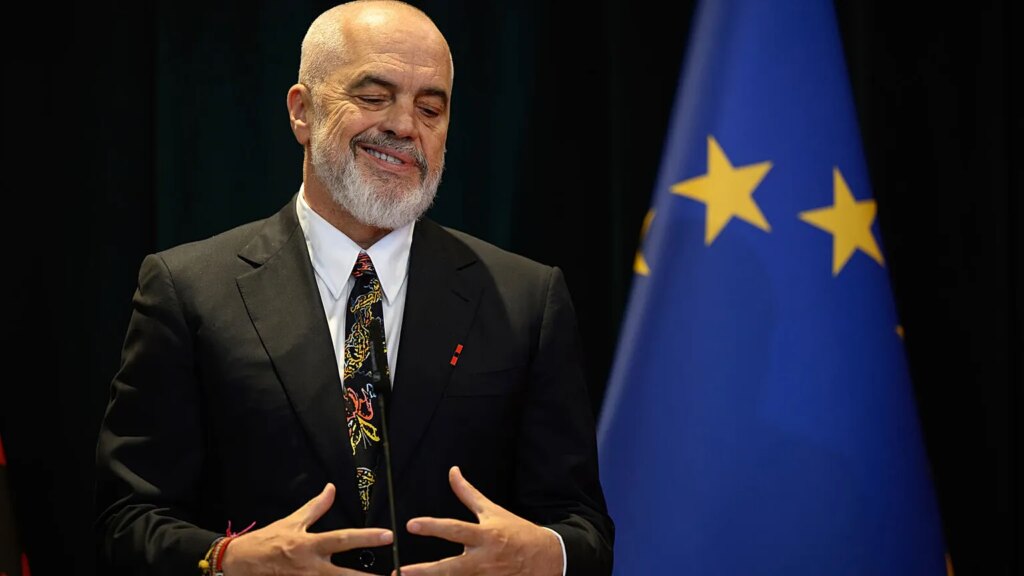
Albanian Prime Minister Edi Rama considers that he has discovered a key solution to hasten the country’s EU integration: Artificial intelligence.
Confronted with demands for reforms to quicken Albania’s accession to the European Union, Rama’s administration is implementing AI-driven technologies aimed at aligning national legislation with EU standards more swiftly and efficiently. Central to this strategy is an AI-created avatar named ‘Diella’, acting as a «virtual minister» responsible for enhancing transparency in public procurement and combating corruption. Although this initiative has garnered international spotlight due to its boldness, it also provokes numerous inquiries.
Diella, meaning ‘sun’ in Albanian, is portrayed as a woman in traditional Albanian dress and began her governmental service as a chatbot designed to assist citizens in navigating online government platforms. After winning a fourth consecutive term in May, Rama contends that this avatar can transform Albania into a nation with “completely corruption-free public tenders” and speed up its EU accession.
Andreas Schieder, the European Parliament rapporteur for Albania, informed Euronews that the country is advancing rapidly toward EU membership, including through digital transformation reforms, potentially concluding negotiations by mid-2027.
“Diella aims to alter the public administration and procurement landscape. It conveys a powerful message to international investors observing Albania’s push for transparent and accountable procedures,” Schieder told Euronews following his recent visit to Albania, noting the extensive discussions about Diella during talks on EU accession with Albanian officials.
The government affirmed that Diella will operate under human supervision. For some observers, this could revolutionize the way government bureaucracy functions.
“AI has been effectively tested by several international organizations to increase transparency in procurement and detect anomalies that may indicate corruption,” stated Andi Hoxhaj, a Balkan specialist at King’s College London, in an interview with Euronews.
“This initiative also signals that Albania is seriously addressing corruption and experimenting with new approaches. When traditional methods fail, innovation is necessary.”
Issues around legitimacy, security, and sovereignty
Nonetheless, numerous concerns have been voiced about Diella, with experts questioning the avatar’s legitimacy and impartiality.
“Algorithms inherently contain biases,” explained Clotilde Bômont, Senior Policy Analyst for cyber and digital technologies at the European Union Institute for Security Studies (EUISS), in comments to Euronews.
“The social, industrial, economic, and scientific context in which an AI model is developed influences the algorithm and thus affects the results.”
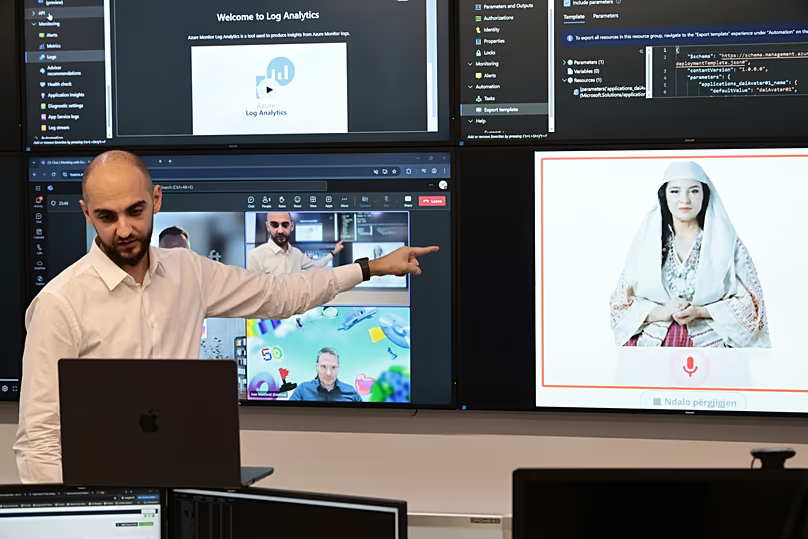
Though the government has not confirmed, many experts suspect Diella is derived from US firm OpenAI’s algorithm and hosted on Microsoft’s Azure cloud platform. Prime Minister Rama has a history of collaboration with Albanian-American tech executive Mira Murati, previously Chief Technology Officer at OpenAI and CEO at Thinking Machines Lab.
In response to US predominance in the digital arena and China’s swift growth, the European Union aims to bolster its digital sovereignty by minimizing dependence on non-European entities and foreign corporations, including those offering AI and cloud services.
The EU has also expressed apprehensions regarding the US CLOUD Act, which potentially enables US authorities to access European data held by American firms. Experts warn that relying on foreign AI models for ministerial functions might pose significant issues.
“Would this allow Microsoft or the US government to obtain access to the data? This question remains a major concern,” Clotilde Bômont remarked.
“Even with all technical protections in place by the US provider, some geopolitical and legal risks persist, since these two legal systems — European and American — operate in competition.”
Moreover, the attention garnered by Rama’s Diella project might increase vulnerability to cyberattacks and hacking attempts.
Albania’s firm stance on anti-corruption reforms
Despite these reservations, Rama has drawn international notice and commendation for his ambitious plan to enhance transparency, a critical EU requirement.
“Naturally, I have criticisms and doubts,” Andreas Schieder stated, “but the commitment to combat corruption overrides those concerns.”
Public procurement has been a core issue in corruption scandals within Albania previously. Eliminating irregularities in public administration remains a principal condition set by Brussels in Albania’s EU accession negotiations.
The European Commission’s latest report on Albania indicated that “corruption continues to be a significant challenge,” highlighting public procurement as among the most “susceptible sectors.”
The country has faced difficulties shaking off an international reputation often linked to organized crime. Prime Minister Rama has dismissed these links as “outdated stereotypes.”
Following comprehensive judicial and constitutional reforms in 2016, Rama’s government established a specialized anti-corruption agency named SPAK to address corruption and organized crime at the highest government levels.
Since its creation, SPAK has become the nation’s most trusted institution, with more than half of Albanians expressing confidence in it, according to a Euronews Albania poll. Before SPAK’s formation, very few corruption cases were prosecuted due to bribery and political interference.