
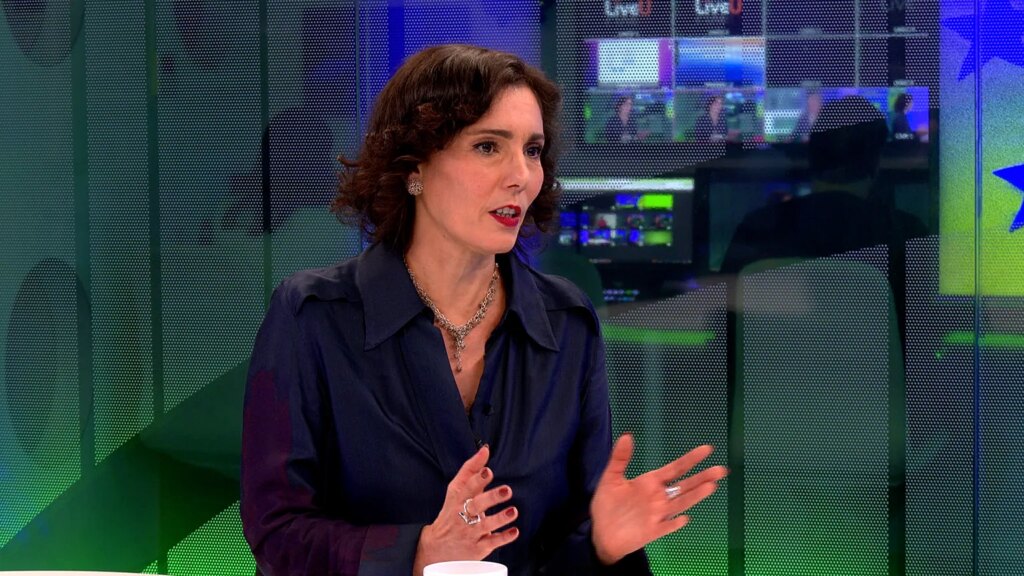
In an extensive exclusive interview with Euronews, EU Commissioner Hadja Lahbib discusses the bloc’s involvement in Middle East affairs, its role in Ukraine, and defends Belgium, her home country.
The European Union aims to take an active part in diplomatic efforts in the Middle East following the Gaza ceasefire, on the condition that Hamas is excluded from any future governance of the region.
“For us, Hamas does not qualify as a negotiation partner; it is recognized as a terrorist organization,” the EU Commissioner for Crisis Management and Preparedness stated in an exclusive interview with Euronews in Brussels.
“It is essential for Hamas to be disarmed and excluded from the framework of a two-state solution,” she emphasized.
The 20-point peace proposal mediated by US President Donald Trump has created a hopeful opening, yet the immediate focus must be on reducing suffering and delivering humanitarian assistance to Gaza’s civilian population, Lahbib explained.
The Commissioner called on Israel to promptly launch the second phase of the agreement, entailing the daily entry of 600 trucks into Gaza.
“This stage hasn’t been reached yet. Therefore, we urge Israeli authorities to fulfill their commitments,” Lahbib remarked during Euronews’ flagship programme The Europe Conversation.
Lahbib highlighted that the EU Foreign Affairs Council recently decided to maintain pressure on Israel by considering a partial suspension of the EU-Israel Association Agreement.
In September, just weeks before the ceasefire deal, the EU Commission formally proposed suspending specific parts of the bilateral agreement with Israel after a review suggested possible violations of human rights responsibilities.
The EU remains Israel’s top trading partner and the leading international donor to the Palestinian Authority.
“Balancing this approach requires ensuring that our principles and regulations are upheld,” Lahbib noted.
Belgium does not obstruct ‘a new mechanism for funding Ukraine’s war effort’
Turning to the conflict in Ukraine, Lahbib reaffirmed the EU’s steadfast support for the country and its citizens.
“During my tenure as foreign minister, it was constantly stated that Ukraine would receive support for as long as necessary, and this commitment continues,” she remarked.
Regarding Belgium’s reluctance to approve a €140 billion loan to Ukraine, utilizing frozen Russian assets held at the Brussels-based Euroclear depository, Lahbib expressed understanding of Belgium’s stance.
She clarified that Belgium is not blocking a novel financing mechanism for Ukraine’s war efforts.
“There is no precedent to model after, and legal safeguards must be established. That is the principal concern, and I think it is just a matter of time,” she explained.
Belgium’s primary worry involves potential Russian retaliation if Moscow demands the return of assets and sanctions are subsequently lifted.
“We must ensure the legal aspects are secure to prevent Belgium from facing legal challenges later,” Lahbib added.
Following intense dialogues at a European Council summit in Brussels on Thursday, EU leaders aspired to reach consensus on the plan.
However, the EU27 leaders departed without resolution, as Belgian concerns over the proposal remained unresolved.
The issue is expected to resurface at a summit scheduled for November or December.
When questioned about Europe’s preparedness for war, Lahbib pointed out the evolving character of conflict.
“Europe remains prepared daily for any scenario,” Lahbib said. “But war today isn’t simply a soldier knocking on the door.
“Contemporary threats include viruses, chemical attacks, or nuclear incidents potentially triggered by power outages. It is vital to understand the realities of today’s security challenges.”