
The US President can advocate for FIFA’s leader to become the United Nations Secretary General, but cannot impose him over other contenders — plus, support from other Security Council permanent members is essential.
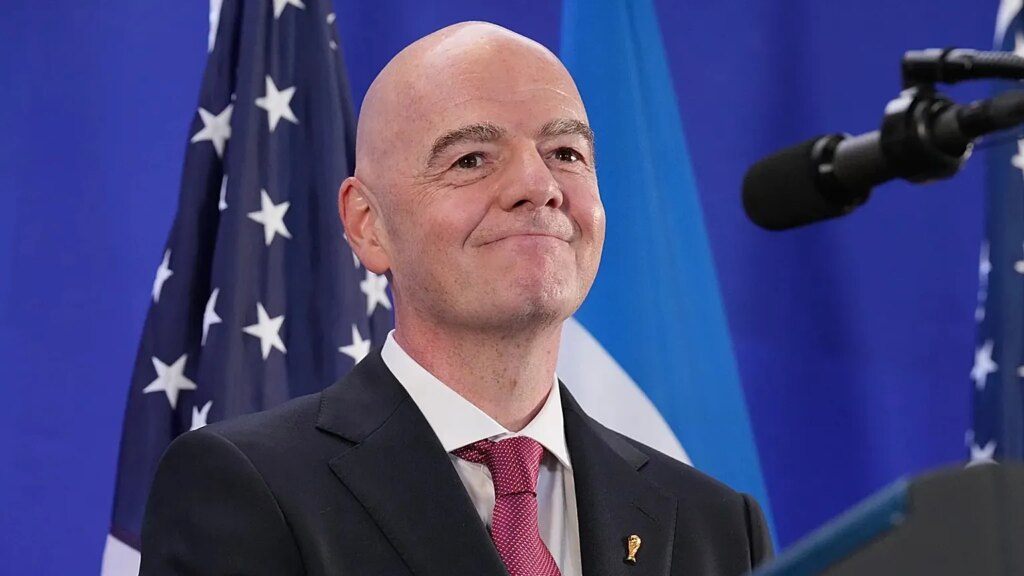
Gianni Infantino’s path to becoming the next UN Secretary General is far from certain, even if he has the endorsement of Donald Trump.
 ADVERTISEMENT
  ADVERTISEMENT
As reported by The New York Post, the US President views FIFA’s chief as a «respected» contender, highlighting his «special ability to unite people,» exemplified by the effective staging of the 2026 World Cup.
Nevertheless, his support alone would not suffice to secure the globe’s top diplomatic position for someone lacking a traditional diplomatic background.
Neither Trump nor Infantino have officially declared a candidacy, which, if undertaken, would entail navigating a complex and politically charged selection process.
To win, Infantino would need the backing of numerous nations and must avoid antagonizing Russia, China, France, and the United Kingdom—each able to veto due to their permanent seats on the Security Council.
How the UN selects its Secretary General
The UN Secretary General is appointed by the 193-member General Assembly following a Security Council recommendation.
Effectively, the choice is made by a limited council of 15 countries, which include ten rotating members and five permanent ones, through confidential deliberations.
All hopefuls must be nominated by one or more UN member states and present their vision during public hearings, answering queries from ambassadors and civil society representatives.
The Council conducts a series of secret straw polls before settling on a single candidate to recommend. Any of the five permanent members—the US, China, Russia, France, or the UK—can veto a candidacy, making geopolitical acceptability at least as critical as diplomatic qualifications.
The General Assembly’s subsequent approval is usually procedural; it could theoretically reject the recommended candidate, but this has never occurred in UN history.
With António Guterres finishing his term at the close of this year, the race is intensifying, and the Security Council is expected to begin evaluating candidates by late July. A public debate called “UN Town Hall: The Next Secretary-General” will be held Thursday afternoon in New York, featuring all current candidates.
However, no official deadline exists to submit candidates, so the US or another nation could put forward Infantino’s name while the process continues.
Six contenders currently in the race
So far, seven individuals have been proposed as the next UN Secretary General, though one has withdrawn: Virginia Gamba, former UN special representative for protecting children in armed conflict, was initially nominated by the Maldives but later withdrew her candidacy.
Among the most recognized candidates is Michelle Bachelet, the leftist former Chilean president and ex-UN High Commissioner for Human Rights. She is a seasoned politician with decades in diplomacy but may be polarizing due to her outspoken critiques of authoritarian regimes.
Chile’s conservative new government, led by José Antonio Kast, rescinded its backing, however, Bachelet maintains support from aligned leaders in Mexico and Brazil and remains a candidate.
Another notable contender is Rafael Grossi, current director general of the International Atomic Energy Agency, nominated by Argentina. His candidacy is largely supported due to his diplomatic role in safeguarding the Zaporizhzhia Nuclear Power Plant amid the Ukraine conflict.
Other nominees include former Senegalese president Macky Sall, proposed by Burundi; Rebeca Grynspan Mayufis, head of the UN Trade and Development department, nominated by Costa Rica; as well as ex-foreign ministers María Fernanda Espinosa Garcés of Ecuador and Carolyn Rodrigues Birkett of Guyana, each nominated by their governments.
A challenging campaign for Infantino
Based on an informal geographic rotation tradition, the UN Secretary General post tends to go to candidates from diverse continents—meaning that Infantino, a European Swiss-Italian, would have a slim chance to succeed Portuguese Guterres.
Additionally, numerous governments argue that the position should be held by a woman for the first time, as all ten prior UN Secretary Generals have been men.
Even though the UN Charter does not mandate diplomatic experience for the role, Infantino might face accusations regarding his suitability, especially due to controversies over his governance at FIFA and his close ties with Trump.
His critics frequently charge him with concentrating power within the football association and neglecting human rights issues connected to World Cup events in Russia and Qatar.
Supporters might contend that he expanded football’s global influence and has managed one of the world’s largest international organizations, with membership exceeding even that of the UN.
An official nomination from the US would launch a difficult but still open contest for him.
The United Nations, FIFA, and the European Commission declined to comment on the matter.