
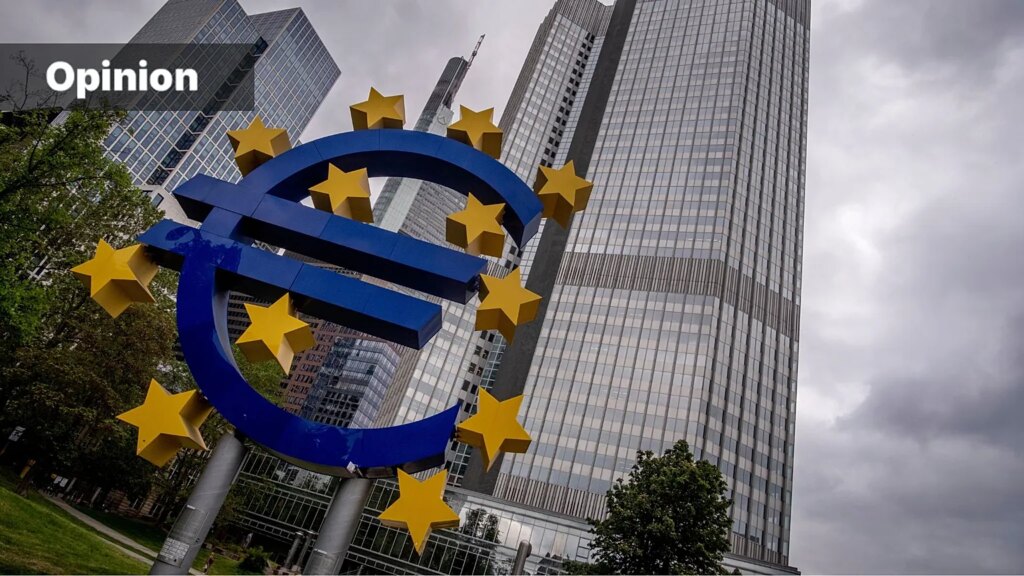
In an opinion piece for Euronews, Frédéric Oudéa, Chairman of Revolut Western Europe, argues that Europe must transcend divided banking markets to establish pan-European financial leaders capable of funding innovation, defence, and the green transition.
As Europe aims to solidify its role in a swiftly evolving geopolitical environment, one critical necessity emerges: while the financial resources to invest in our future exist, the systems to allocate these funds effectively do not.
 ADVERTISEMENT
  ADVERTISEMENT
To fund Europe’s digital and green transitions, enhance collective defence, and fuel innovation, enormous mobilised capital is essential.
Although a unified supervisory framework and largely standardized prudential regulations exist, the political constraints restrict the generation and distribution of this capital. Confined by national safety nets, segmented capital markets, and inconsistent local applications, the European banking sector remains territorially divided.
To address this, it is necessary to dispel a long-standing regulatory misconception that has influenced European policy since 2008: the belief that scale across borders inherently escalates systemic risk. This is inaccurate. Protecting Europe’s economic autonomy and ending reliance on foreign financial institutions for future funding requires cultivating its own global financial champions.
The foundation for this lies in creating a cohesive pan-European home market.
The price of division
Following the 2008 financial crisis, regulatory policies shifted significantly towards national protectionism. Concerned about «too big to fail,» governments encouraged banks to reduce risk by restricting operations to their home countries.
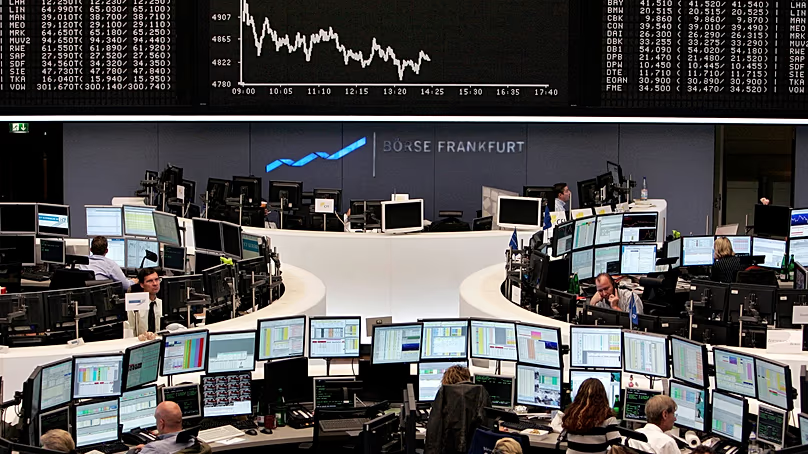
This approach has resulted in a European banking system too fragmented to compete internationally. The geopolitical consequences are clear when comparing pre-2008 figures: European and US banks were roughly equivalent in size. However, today, thanks to the US functioning as a true single market, an institution like JPMorgan Chase alone surpasses the combined valuation of Europe’s top ten banks. Though Europe’s prudence has merit, its extreme cautiousness risks excluding the continent from the future global economic arena.
Fragmentation also creates tangible financial vulnerability. Banks restricted to national borders heavily concentrate on their country’s sovereign debt, heightening exposure. This triggers the «doom loop»: an economic shock in a member state immediately weakens local banks’ lending ability, limiting credit access for domestic companies at critical times.
Furthermore, the opportunity cost is substantial. Europe faces an annual funding shortfall of €620 billion to support innovation and growth. However, with segmented capital markets, European scale-ups often have to seek late-stage investment across the Atlantic. Despite possessing abundant capital, the lack of efficient financial infrastructure leads to capital funding competitors abroad, while €33 trillion of European wealth stays underutilized within national borders.
Effective capital mobilisation is vital to finance energy transition, update ageing healthcare systems, and bolster collective defence.
In reality, fragmentation rather than integration constitutes Europe’s systemic risk. A shock to a fragmented system causes failure, whereas a pan-European system with cross-border liquidity disperses and absorbs shocks.
Advancing market integration
The private sector has demonstrated that technology to connect Europe’s divided markets is available. Yet, technology alone cannot remedy a regulatory framework that remains stagnant and struggles to keep pace with innovation.
For ten years, the EU Banking Union has remained incomplete—a structure combining centralized regulation with fragmented national safety nets. To progress, policymakers should pursue practical immediate measures: enhancing convergence among current national frameworks, backed by mutual guarantees and insurance systems. Such strategies build the protections necessary to encourage positive cross-border consolidation, enabling authentic pan-European institutions to arise organically.
Beyond the Banking Union, Europe’s financial markets remain hindered by slow development towards a genuine Savings and Investment Union. Uneven regulatory enforcement and national «gold-plating» keep investments trapped within borders, hampering capital flows needed to finance innovation.
A European blueprint for Europe
An integrated model across borders is the antidote to Europe’s financial fragility. Instead of a patchwork of local subsidiaries, unified technological infrastructure is necessary to enable smooth operations throughout all 27 EU member states. This arrangement naturally prevents the doom loop, as an economic slowdown in one market is offset by the stability of the other 26.
Importantly, this system supplies the financial channels Europe desperately requires, empowering citizens to effortlessly shift funds from passive local deposits to active pan-European investments, thus returning that dormant €33 trillion into the real economy.
As the only European firm among the world’s ten most valuable private tech companies, Revolut demonstrates that an institution founded in Europe for Europe can compete globally alongside US and Chinese giants. This proves that attaining pan-European scale is fundamental for global leadership.
The overly cautious approach of the past can no longer dictate Europe’s future. Equipped with talent, capital, and technology, Europe is poised to lead on a global scale. What is needed now is decisive action to complete market integration and regain economic sovereignty.
Frédéric Oudéa was appointed Chairman of the Board of Directors of Revolut Western Europe in July 2025.