
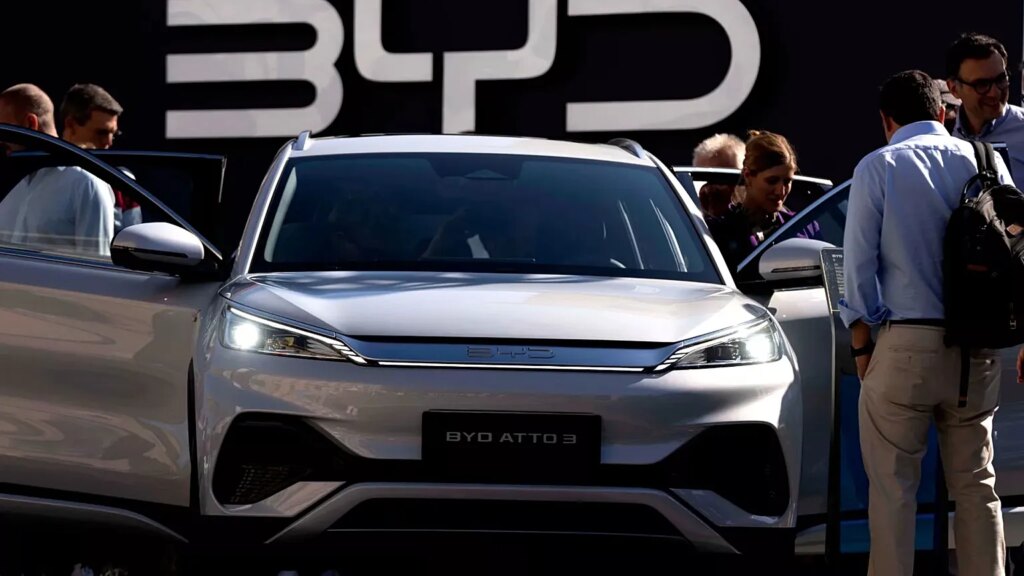
Bernd Lange, director of the European Parliament’s trade committee, told Euronews that the EU must strongly challenge China over unfair industrial subsidies and other urgent matters.
German MEP Bernd Lange (S&D), who heads the European Parliament’s trade committee, stated on Friday that the October deadline set by the European Commission to achieve «concrete outcomes» in trade negotiations with China is “completely unrealistic” if the EU aims for a binding treaty.
 ADVERTISEMENT
  ADVERTISEMENT
The European Union, facing pressure caused by a €1 billion daily trade deficit with China that endangers hundreds of thousands of jobs across member states, is pursuing a negotiated path to rebalance trade relations between the two parties.
Nevertheless, tensions remain elevated. Recently, China has frequently threatened Brussels with retaliation if protectionist actions are implemented to restrict access for Chinese products.
Talks between the European Commission and China started last Monday, aiming to ease these strains, with EU Trade Commissioner Maroš Šefčovič setting an October target for achieving “concrete results.”
Lange responded to this timeline with skepticism.
“Conversations are useful, but agreements carry more weight,” he told Euronews. “The deadline should result in a framework establishing agreement on key issues. Afterward, a detailed agreement with legal text must be negotiated, which is not achievable by October.”
Unfair subsidies prioritized
Faced with the EU market being saturated by inexpensive Chinese imports, the bloc’s leaders have empowered Commission President Ursula von der Leyen to tackle the problem through dialogue with Beijing while reassessing the EU’s trade defense mechanisms.
The objective is to exert pressure on China by using every available tool. Lange emphasizes that restoring fair competition is essential, given China’s heavy subsidies on goods exported to Europe.
“Approximately 4.5 percent of China’s GDP is directed toward mostly illicit subsidies. This creates an unfair competitive edge,” Lange noted.
“Investigations are ongoing, but a comprehensive solution must be found.”
European industries are increasingly reporting dumping or unfair subsidies, which are forbidden under EU regulations, to the Commission. For example, the steel industry has seen 80 protective measures implemented by the EU executive against low-cost Chinese imports.
However, the EU’s bargaining power remains limited due to its reliance on rare earth elements critical for green technology, automotive production, and defense. Europe faced shortages last year after China, holding a monopoly on these strategic metals, restricted exports during its trade conflict with the U.S.
Lange minimized the threat.
“The blockade was a US response. Although the licensing system for European companies isn’t perfect, it has improved significantly compared to several months ago.”
He furthermore remarked that the EU’s dependence on China for rare earths stems from European firms shutting down refining operations locally to take advantage of lower costs in China.
“These materials exist worldwide. The real challenge lies in their processing and refinement. We need to secure at least a secondary supplier promptly.”