
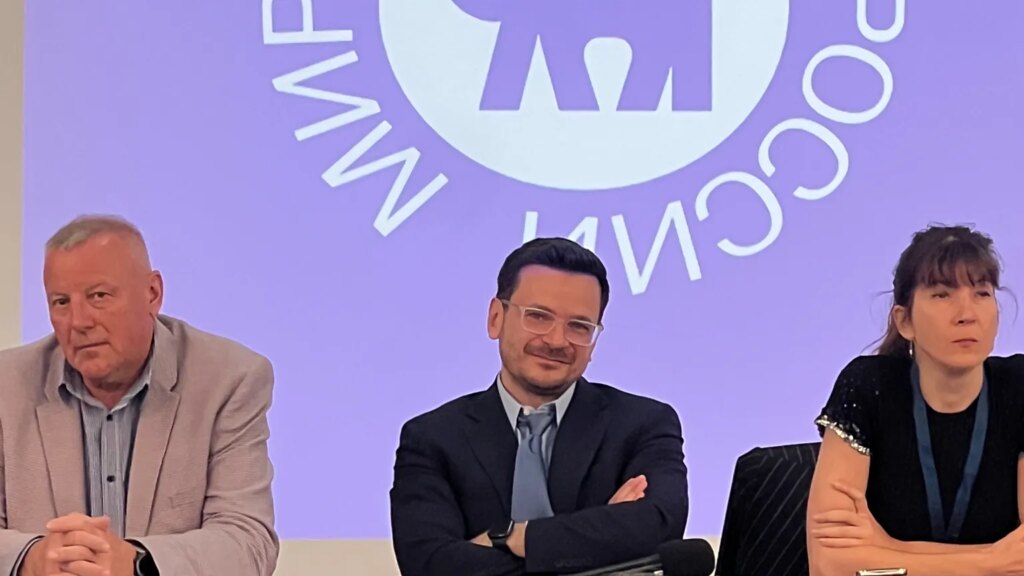
Ilya Yashin has officially become the head of the Russian opposition in exile – and internal conflicts have already started. A longtime associate shared with Euronews his concern that Yashin could turn into a ‘mini-Putin.’ Is the newly formed party already confronting its first major challenge?
The delegates of the newly established Russian opposition party Peaceful Russia convened in Berlin on June 12 and 13 to hold a congress where the party’s program was adopted. Invited to attend were 126 delegates in total.
 ADVERTISEMENT
  ADVERTISEMENT
The selection of the party leader sparked intense discussions. Ilya Yashin, a prominent Russian opposition figure and former political prisoner, was elected chairman with approximately 60 percent of the votes, according to Igor Kachetkov, a human rights defender and member of the organizing committee who spoke to Euronews.
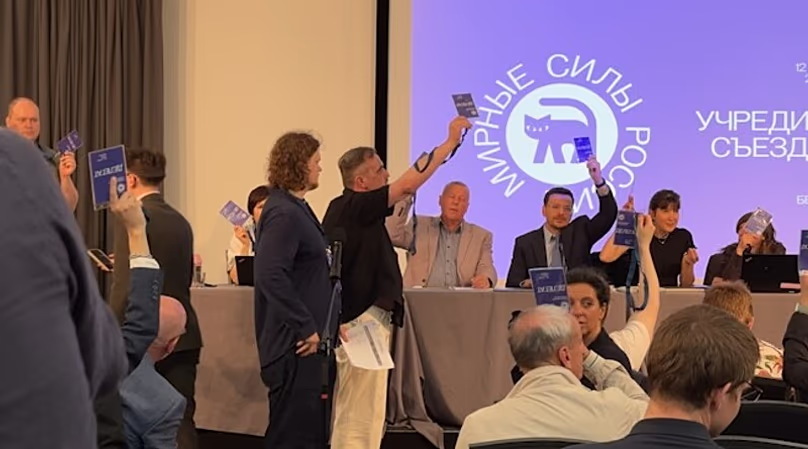
The congress spanned around twelve hours. During the session, the party officially renamed itself from Peaceful Forces of Russia to Peaceful Russia, explained Kachetkov. The term “Forces” was discarded to avoid links to repression in Russia and the ongoing war in Ukraine.
Delegate: «Inspiration is the key quality»
There are great expectations regarding Yashin’s capacity to unite his base.
“Ilya is a seasoned politician. He possesses remarkable oratory skills, which are crucial, as a politician unable to communicate effectively will struggle to collaborate,” said party delegate Alexander Archagov in an interview with Euronews.
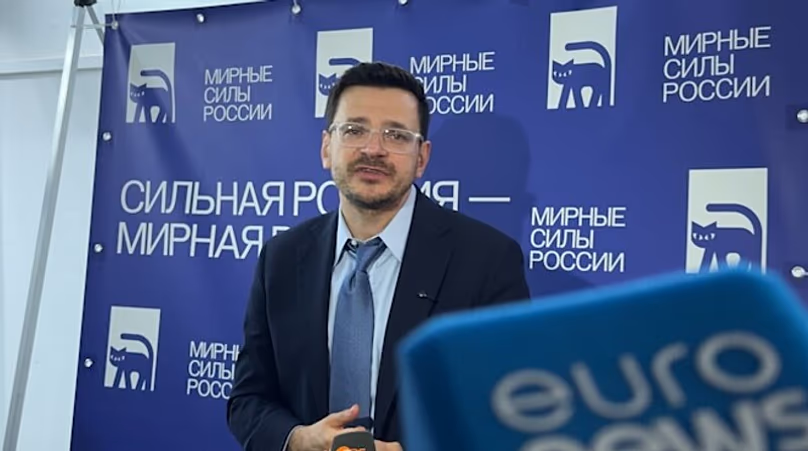
“He has a clear plan. I value his ideological foundations. Yet, the capacity to motivate people remains the most essential factor—both inside Russia and abroad,” Archagov added.
Yashin: «Our primary audience is within Russia»
“We have embraced this challenge,” Yashin told Euronews. “It is incredibly difficult given that we operate from Europe. However, we intend to engage with Russia eventually, despite the inherent risks.”
“We will reach out to Russian society and coordinate with individuals cautiously. It’s evident that cooperating openly with us inside Russia entails danger. We consider this reality. Nonetheless, our main audience resides in Russia. There are millions of supporters there,” he stated.
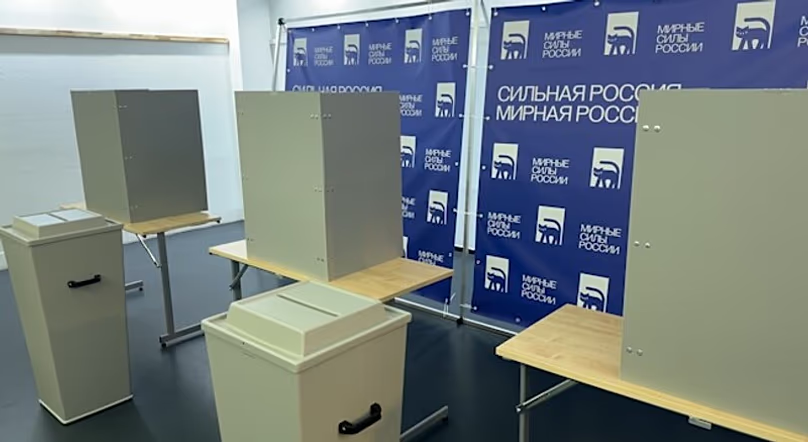
“Our party’s program and political message primarily target Russians who feel voiceless. We aim to become their voice.”
Yashin admitted that legally operating in Russia is impossible for the party. Nevertheless, he referenced historical instances where opposition groups formed abroad and later assumed control.
The most notable case is Vladimir Lenin’s Bolshevik Party. Prior to the 1917 Russian Revolution, its leaders largely lived abroad and orchestrated political work from exile.
Following the October Revolution, the Bolsheviks took power in the Soviet Union. Under Lenin’s and subsequently Joseph Stalin’s leadership, the country evolved into an authoritarian one-party regime.
Russian history shows no examples of democratic opposition parties returning from exile and governing the country thereafter.
Whether Yashin’s party will be the first to achieve this remains unclear. Internal discord has already surfaced, according to delegate Maxim Reznik.
Reznik is among Russia’s most prominent liberal opposition figures. Formerly a member of the St. Petersburg Legislative Assembly, he gained recognition for his strong criticism of the Kremlin. After the Russian invasion of Ukraine, Reznik left Russia and currently resides in exile.
Reznik: «I do not want Yashin to become a mini-Putin»
Having collaborated with Yashin for years and opposing Vladimir Putin with him, Reznik expressed concerns about repeating previous errors within the opposition.
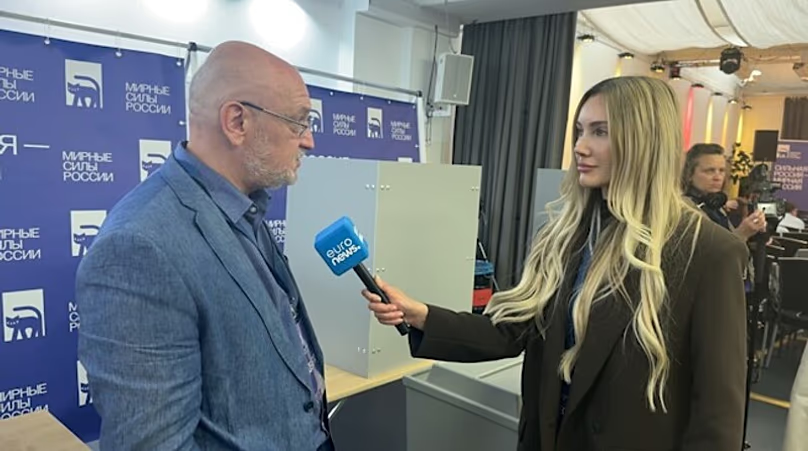
“I do not want Yashin to become a mini-Putin. Sadly, my hope that he won’t transform into a self-centered Moscow political leader is fading. The opposition already has too many like that,” Reznik told Euronews.
“We require someone who can unite diverse groups across different regions—someone who treats everyone as equals. Currently, I don’t perceive that quality in him.”
“I believe Ilya has adopted the wrong approach. He seems to be attempting to build a party akin to the Communist Party of the Soviet Union,” Reznik explained. “Repeating such mistakes is not advisable.”
The Russian opposition is often considered fragmented. Andreas Heinemann-Grüder, a Russia specialist from the University of Bonn, notes that its struggles with leadership have been longstanding. Rivalries and personal ambitions have consistently obstructed the opposition’s cohesion.
He indicates that the new party should learn from the experience of Yabloko, the liberal opposition party established in 1993.
To be effective, the party needs decentralization, a reflection of Russia’s ethnic diversity, and representation of the Russian diaspora throughout the EU. The capacity to impact developments within Russia while in exile remains highly restricted, Heinemann-Grüder told Euronews.