

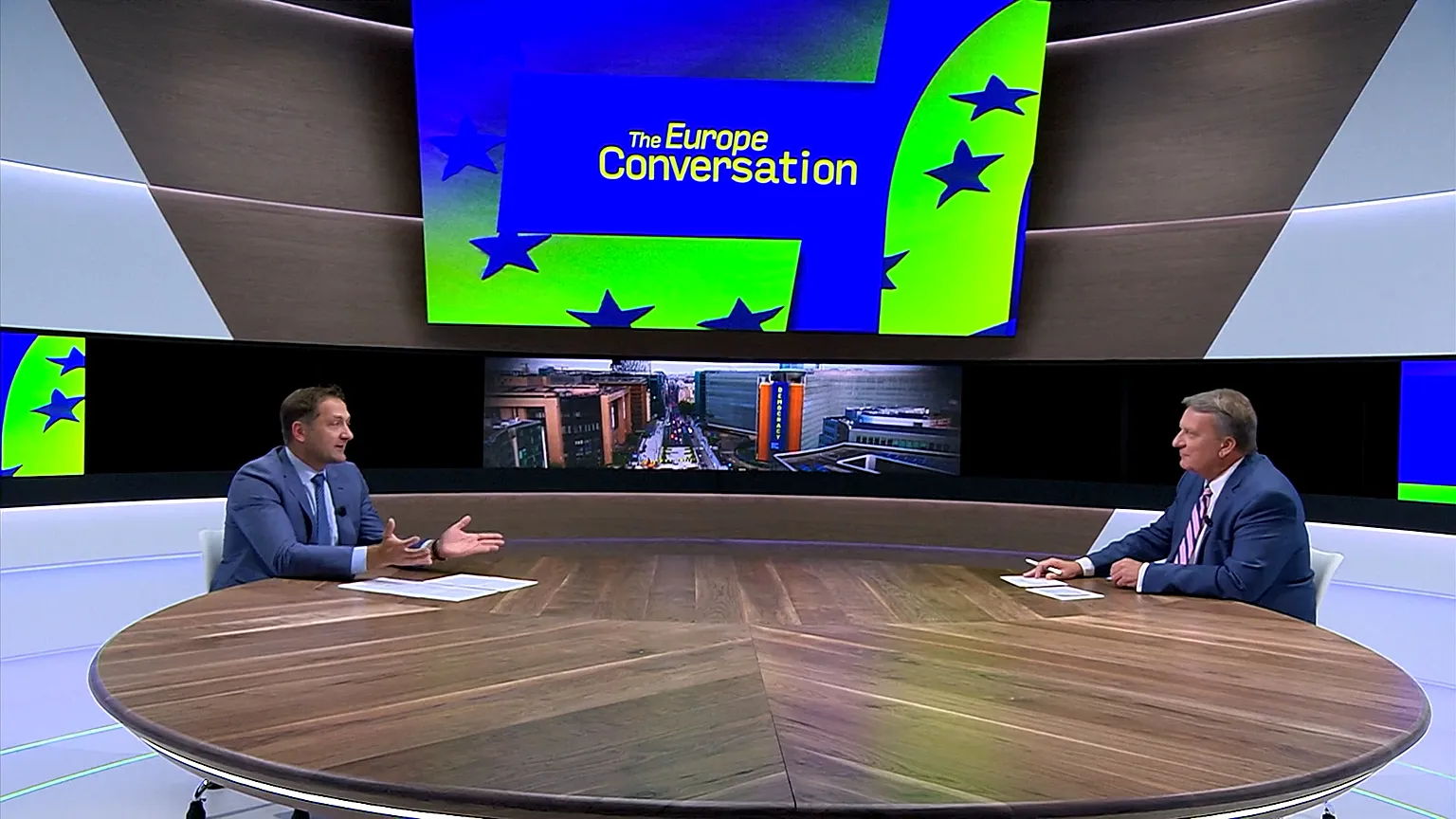
The Agriculture and Food Commissioner cautioned that to prevent imminent food shortages caused by rising fertiliser costs, the bloc must ensure sustainable fertiliser availability rather than rely solely on temporary financial interventions.
Without establishing durable strategies to guarantee fertiliser availability, the European Union is likely to face food scarcity, stated European Commissioner for Agriculture and Food, Christophe Hansen, in an interview with Euronews.
 ADVERTISEMENT
  ADVERTISEMENT
His statements follow the recent escalation of fertiliser prices triggered by the ongoing conflict in the Middle East. In reaction, the European Commission—concerned that elevated fertiliser costs might decrease crop yields and food production—rolled out the Fertiliser Action Plan, which offers financial assistance.
Yet, Hansen emphasizes that alongside this immediate support, the EU must address fundamental vulnerabilities in its fertiliser supply chain.
«We must also undertake thorough efforts to ensure fertilisers are not only accessible but reasonably priced; otherwise, food shortages will arise within the European Union,» the Commissioner expressed during Euronews’ The Europe Conversation programme.
He noted that a significant number of farmers across Europe are contemplating ceasing crop production, «because expenses have escalated beyond what they can easily pass on, especially given competitive pressures.»
The fertiliser plan, unveiled in May, is set to disclose the precise funding amount this Friday. Hansen informed Euronews that «over €500 million will be proposed to budget authorities to support farmers promptly.»
From this €500 million, €200 million originates from the Common Agricultural Policy (CAP) crisis reserve, the EU’s agricultural subsidy and programme system, supplemented by an extra €300 million.
He further mentioned that member states have the option to augment this funding by up to 200%, potentially increasing the total to €1.5 billion.
Hansen, whose family background includes farming, highlighted that recent geopolitical tensions exacerbate a fertiliser crisis that has been intensifying for years, underscoring the necessity for Europe to build lasting resilience.
«The fertiliser crisis began well before the Middle East conflict,» Hansen remarked, indicating that fertiliser prices surged by 60% between 2020 and 2024 due to the energy crisis stemming from Russia’s full-scale invasion of Ukraine.
«We are now facing two consecutive crises, which will recur if we don’t establish a steadier and more dependable production cycle and supply.»
Domestic initiatives and dependable alliances
Hansen explained that the core problem behind fertiliser shortages and inflated costs lies in Europe’s heavy reliance on imported energy and fertilisers. Fertiliser manufacturing, especially nitrogen-based types, depends largely on natural gas.
«Energy is the primary component in chemical fertilisers, and Europe continues to depend greatly on energy imports from beyond the EU borders.»
Additionally, between 40% and 45% of fertilisers used in member states are sourced from third countries, exposing farmers to risks from global market instability and geopolitical disruptions.
This dependence on external supplies impacts much more than just agriculture.
«Food is a daily necessity, consumed two to three times by individuals to maintain health and well-being. It cannot be left vulnerable to imports or unreliable partners who only offer slightly lower production costs.»
According to Hansen, reducing the EU’s reliance on external countries will require bolstering domestic fertiliser production.
The Commission intends to encourage increased usage of organic fertilisers, enhance nutrient recycling, and promote precision farming methods to lessen dependence on imported inputs.
«Significant benefits can be achieved through improved efficiency and optimized nutrient utilization,» he affirmed.
Nonetheless, dependable international partnerships remain critical, as certain raw materials essential for fertiliser production are not produced within Europe.
«This challenge isn’t confined to Europe; it is global, which is why fostering international alliances is crucial,» Hansen added, referencing a recent G7 agriculture ministers meeting focused on rising fertiliser costs.
He recognized that although these initiatives may entail upfront expenses, in the medium to long term, «they will be more cost-effective than maintaining over-dependence.»
Europe’s susceptibility
Hansen’s observations arise as European policymakers evaluate the bloc’s broader vulnerability to import reliance and supply disruptions, highlighted starkly by the consequences of the Iran conflict.
«Such dependencies manifest in various sectors, including semiconductors and medical supplies, rendering us susceptible—an issue we must address to avoid coercion,» the Commissioner stated.
«This scenario currently applies to food as well. Food diplomacy—whether fertiliser diplomacy or warfare, however one labels it—is unfolding now, requiring decisive action.»