
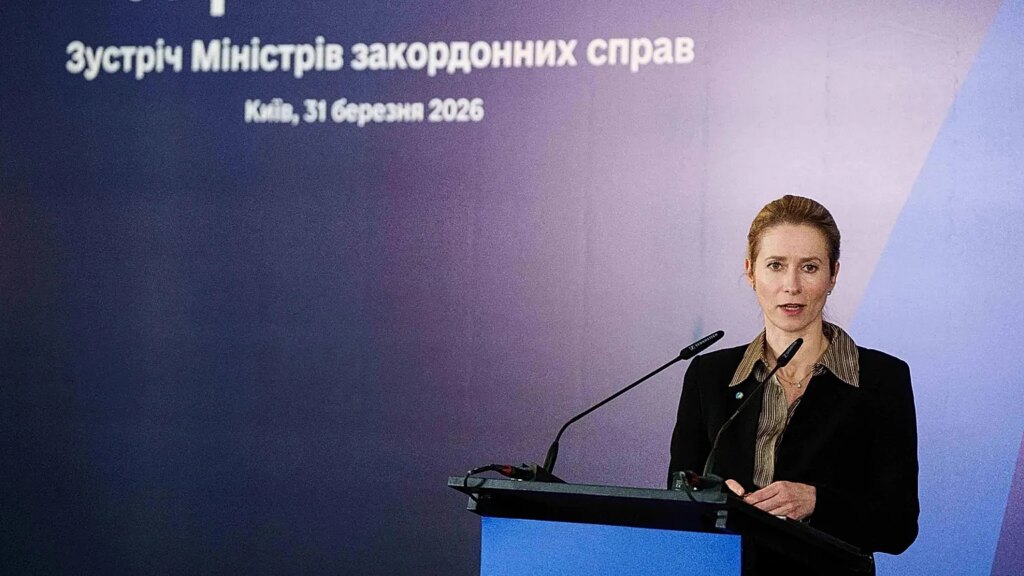
The European Union’s chief diplomat asserts that increasing female participation at peace negotiation tables enhances the prospects for better resolutions of global conflicts, including Russia’s war in Ukraine.
Kaja Kallas, the bloc’s foreign policy leader, has condemned the predominantly male composition of peace negotiation delegations, linking this to the current diplomatic approach’s focus on immediate, rather than lasting, outcomes.
 ADVERTISEMENT
  ADVERTISEMENT
During a press briefing in Tallinn, Estonia, on Sunday, she described this as a global issue seen in numerous peace efforts that fail to tackle long-term stability.
She pointed out that ceasefires often result merely in halting fighting temporarily without addressing the root causes that fuel ongoing violence.
Kallas highlighted insufficient female involvement as another challenge.
“Research indicates that peace agreements involving women tend to endure longer,» Kallas elaborated, noting the US-China negotiations displayed a dominance of masculinity in those discussions.
“Women have an essential role,” she asserted.
Several studies and international entities, including the UN Security Council, emphasize that women’s participation improves conflict resolution results, yet mediators and involved parties frequently exclude women from negotiation teams.
According to the Council on Foreign Relations’ data, women accounted for only 16 percent of negotiators engaged in active peace processes either led or co-led by the United Nations in 2022.
Iana Maisuradze, a security and defence analyst at the European Policy Centre, states that the EU strongly endorses the UN resolution promoting female involvement in conflict resolution and rejects claims that supporting women’s participation is sexist. She shared with Euronews that existing data substantiates this position.
“Women tend to address issues that male negotiators often overlook, such as education, healthcare, victims’ rights, social reconciliation, and community-building—areas that unify people rather than engage in zero-sum competition,” Maisuradze explained.
“Women’s presence at the negotiation table contributes diverse perspectives to both the conflict resolution process and the execution of peace agreements.”
A place at the table
Kallas’ statements have surfaced amid ongoing discussions in Brussels about whether the EU should participate in the negotiations between Russia and Ukraine — and if so, who would represent the bloc.
Russian President Vladimir Putin recently proposed appointing former German Chancellor Gerhard Schröder as the EU’s chief negotiator in prospective peace talks about Ukraine. European leaders largely dismissed this suggestion, and the debate over the EU’s official representative continues.
Diplomatic sources in Ukraine report that Russia would “never” approve a female lead negotiator.
A diplomatic official in Brussels confirmed this stance, indicating no women are being considered for the role. Nevertheless, another source in the Belgian capital emphasized that “equality remains a significant factor.”
Despite diverging views on gender, most EU officials argue that naming any envoy before the major European Council (EUCO) summit in June would be unrealistic.
Responding to Euronews on Monday, European Commission foreign affairs spokesperson Anitta Hipper described Kallas as a “feminist” with extensive experience in leadership, noting her tenure as Estonia’s first female prime minister from 2021 to 2024.
Hipper stated that while the Commission cannot speculate whether Russia would accept a woman at the negotiation table, European leaders are set to convene in Limassol, Cyprus, in the coming weeks to discuss the format of potential talks involving Ukraine, Russia, and Europe ahead of the June EUCO summit.
“The discussions will focus on our demands, the positions we hold, and the unity in presenting these demands to Russia,” Hipper explained.
“The emphasis is on the content of our stance, not on who represents us.”