
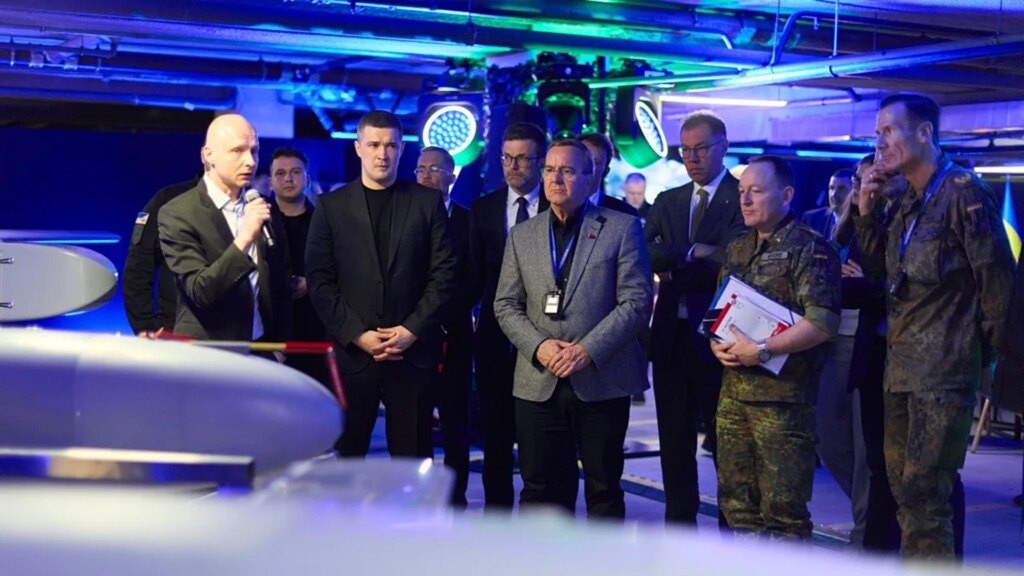
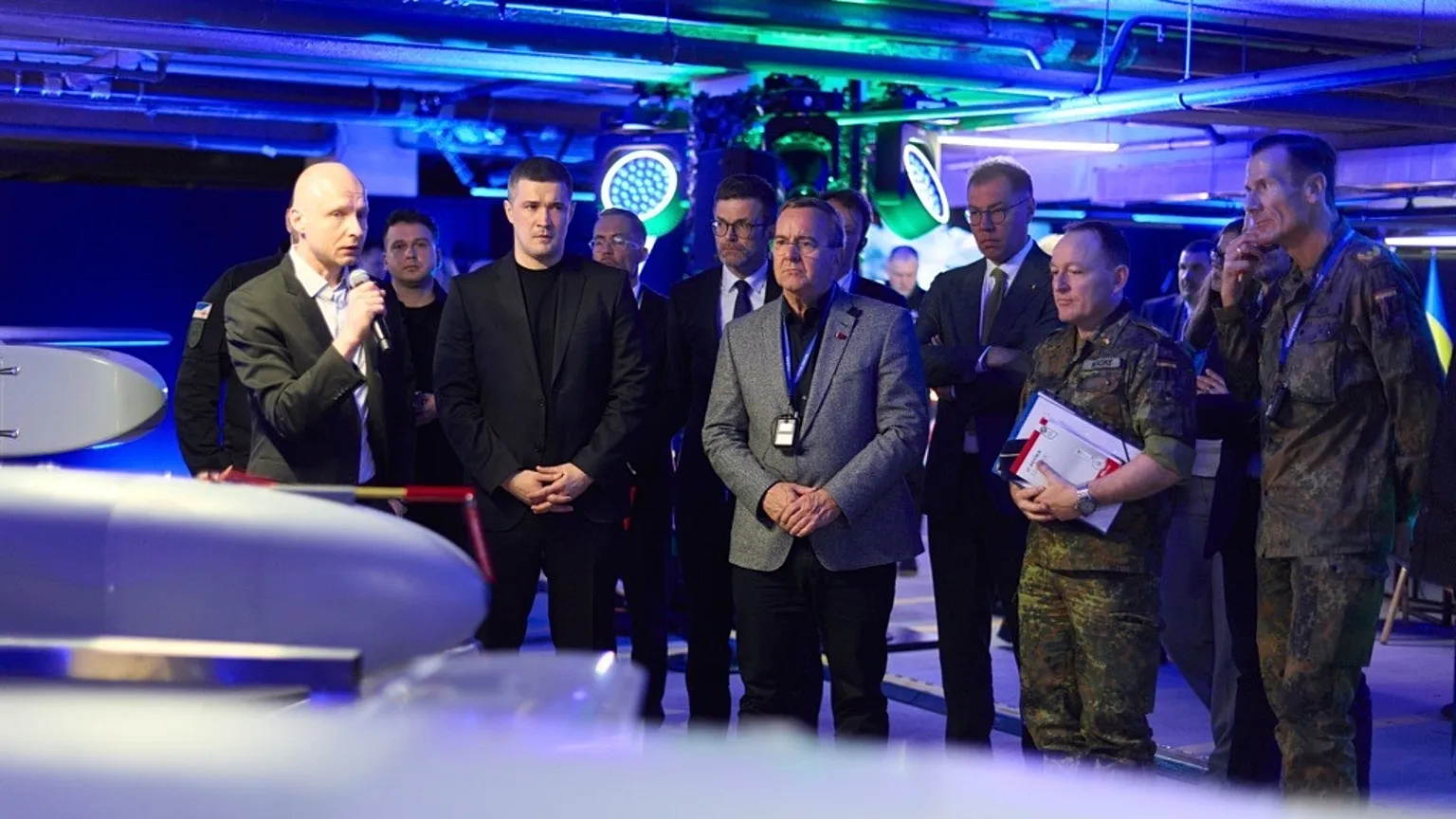
With "Brave Germany," Berlin and Kyiv seek to collaboratively create new defence technologies, AI-powered weapons, and deep-strike capabilities.
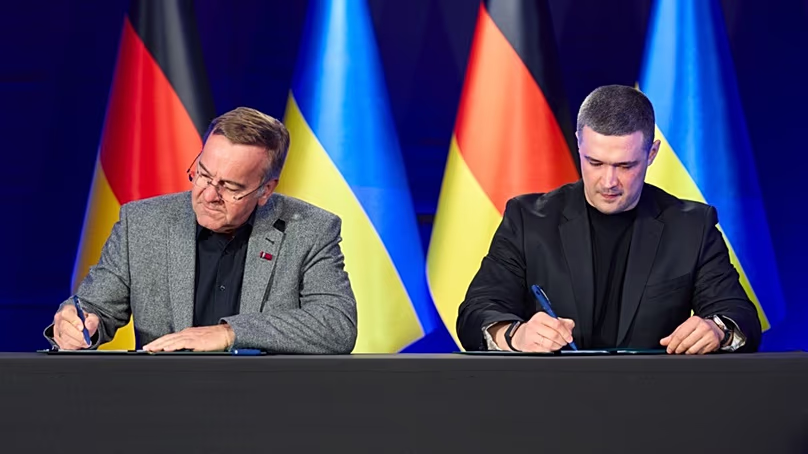
On Monday in Kyiv, German Defence Minister Boris Pistorius and his Ukrainian counterpart Mykhailo Fedorov signed a pact to initiate «Brave Germany,» a collaborative programme aimed at advancing defence technology and fostering innovative startups.
 ADVERTISEMENT
  ADVERTISEMENT
As reported by the Ukrainian news agency Ukrinform, Fedorov highlighted that Germany is now «the world’s primary provider of security assistance to Ukraine.»
He further noted that Berlin contributes to about one-third of all aid delivered to the country.
Pistorius made an unexpected visit to Kyiv on Monday with the aim of reinforcing defence collaboration between Germany and Ukraine. In remarks to the German news agency dpa, he explained that the visit would prioritize expanding joint arms initiatives and co-developing new weapons within the framework of the strategic partnership between both nations.
«Germany and Ukraine maintain a strategic partnership from which both parties benefit. Several new projects are expected to emerge from this cooperation,» the minister stated.
«The core emphasis is on the collaborative development of advanced unmanned systems across all operational ranges, especially in deep-strike technology. Through this, we are enhancing the security of both nations.»

Following his visit to Berlin last month, Mykhailo Fedorov announced on Telegram that Germany and Ukraine had agreed on a new €4 billion defence package.
This package comprises funding for several hundred Patriot missiles and 36 IRIS-T launchers aimed at boosting Ukraine’s air defence, along with an investment of €300 million for enhancing Ukrainian deep-strike capabilities.
Furthermore, the agreement includes joint manufacturing of AI-powered medium-range strike drones, with an initial allocation of 5,000 units planned for the Ukrainian armed forces.
During Monday’s signing event in Kyiv, Fedorov mentioned that Germany has started financing «mid-strike and deep-strike capabilities, which hold significant importance for us.»
“As our president puts it, these represent our ‘long-range sanctions,’” Fedorov stated, according to Ukrinform.
“Mid-strike capabilities enable disruption of enemy logistics and demonstrate the focus and quality of support and financing aimed at the most critical areas today.”
Germany continues to face challenges with deep-strike capability
Despite Germany’s extensive military expenditure, the Bundeswehr still lacks a vital capability: deep strike. This term refers to the precision targeting of high-value military or infrastructure assets located hundreds or even thousands of kilometers behind front lines.
Former Chancellor Olaf Scholz agreed with then-US President Joe Biden to deploy American Tomahawk cruise missiles in Germany as part of NATO’s deterrence measures against Russia.
However, following US President Donald Trump’s announcement of plans to withdraw approximately 5,000 troops from Europe, the planned deployment of Tomahawk missiles has become uncertain. Initially scheduled for 2026, their arrival now appears increasingly doubtful.
The Financial Times reported that Pistorius intends to visit Washington to persuade the Trump administration to approve the sale of Tomahawk cruise missiles and Typhon launch systems necessary for their deployment to Germany. The publication noted that this trip depends on securing a meeting with US Defence Secretary Pete Hegseth.
Due to tensions following Chancellor Friedrich Merz’s remarks on Trump’s Iran war policies, this meeting is reportedly “far from guaranteed.” Currently, the Bundeswehr’s only weapon approaching the lower threshold of deep-strike capability is the Taurus cruise missile, with an operational range exceeding 500 kilometers.
Could Ukraine contribute to closing Germany’s deep-strike shortfall?
The exact weaponry Germany and Ukraine plan to develop within the new investment and collaboration agreements remains unclear. However, Kyiv revealed a possible long-range system last year that might address Germany’s gap in deep-strike capacity: the FP-5 «Flamingo.»
This ground-launched missile has a wingspan near six meters, a total weight of about 6,000 kilograms, and can carry a warhead weighing up to 1,150 kilograms. Ukrainian officials have described it as the country’s first domestically produced «heavy missile system.»
Military expert Fabian Hoffmann, writing on his blog Missile Matters, reports that the warhead contains over 1,000 kilograms in total, which translates to roughly 450-550 kilograms of explosives. This would render it considerably more powerful than the drones and smaller cruise missiles Ukraine has previously utilized.
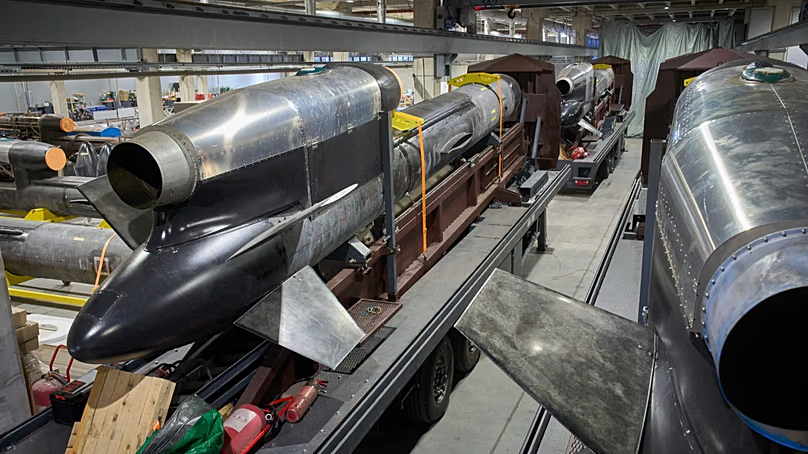
The Flamingo’s high terminal velocity paired with its substantial mass enables the warhead to penetrate deeper within targets prior to detonation, substantially boosting its destructive effect. Its sizable explosive payload also increases its lethal radius considerably.
Hoffmann estimates the explosion radius reaches about 21 meters when targeting fortified structures such as reinforced concrete, and up to 38 meters against softer assets like refineries.
Reports indicate the Ukrainian military has used the «Flamingo» to strike targets deep inside Russian territory, including a factory in Votkinsk over 1,300 kilometers from Ukraine in February 2026. This facility near Izhevsk is believed to produce Iskander missiles.