
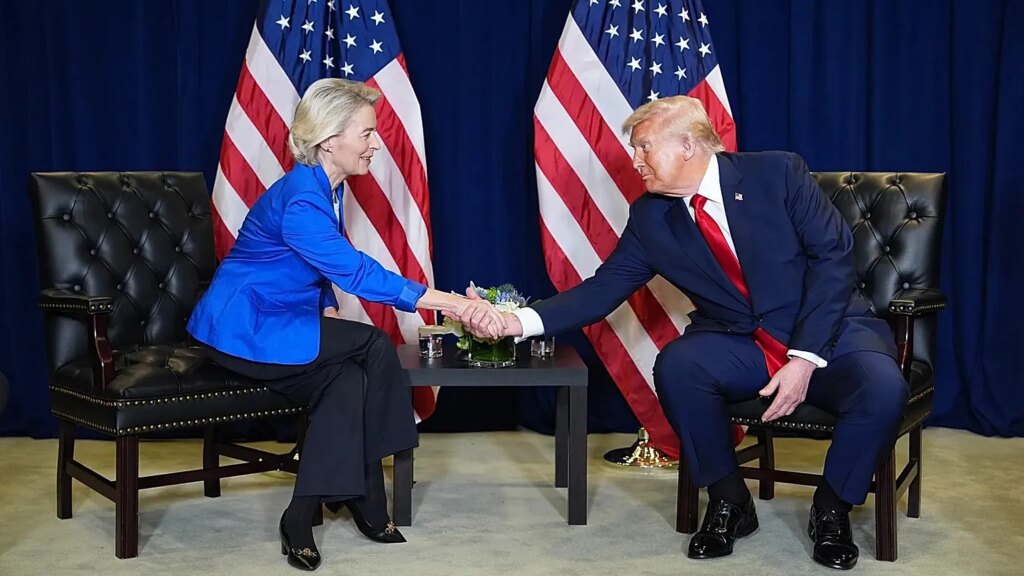
As the EU-US trade agreement reaches its first year anniversary, new threats from US President Donald Trump have placed it under fresh strain. How significant are these threats, and what options does the EU have if they become reality? Euronews investigates.
The EU-US trade deal faces a mixed milestone. One year after European Commission President Ursula von der Leyen and US President Donald Trump finalized the critical agreement in Turnberry, Scotland, transatlantic trade relations face renewed tension due to recent threats from the US.
 ADVERTISEMENT
  ADVERTISEMENT
The €890 million penalty levied by the Commission against US tech giant Google last week provoked a strong reaction from the Trump administration. Through Truth Social, the president declared that the US would initiate investigations into unfair trade practices, indicating readiness to respond when the EU enforces its digital regulations on US companies.
Nonetheless, Trump might need to brace for repercussions himself. After extensive talks to implement the Turnberry agreement—which sets 15 percent US tariffs on EU products and eliminates EU duties on US industrial goods—the Europeans introduced protective measures enabling them to reapply tariffs on US imports under certain conditions.
Euronews examines the gravity of the US threats and the likelihood of the agreement being suspended.
What unfolded after the EU imposed fines on Google?
Following the announcement of the EU’s fine on Google due to its predominant position in the EU digital market, Washington responded with two clear warnings.
On Thursday night, US Trade Representative Jamieson Greer stated that the EU fine generated “uncertainty” regarding the Turnberry deal, putting the EU-US dialogue on digital regulation at risk.
The next day, the threat intensified when Trump posted on Truth Social: “The United States of America is not a ‘PIGGYBANK’ for Europe, nor will we allow it to be!”
He further added that his administration would initiate a Section 301 probe under the US Trade Act of 1974, permitting the federal government to counteract unfair trade actions by foreign nations.
“The European Union will face severe consequences for this unlawful and highly unethical behavior, which I have persistently warned them about,” he declared. “Stay tuned!”
How credible are Trump’s threats?
Since the Turnberry agreement’s conclusion, Europeans have become accustomed to repeated threats from Trump on social media, often no longer responding.
In December 2025, Washington warned several EU tech firms—including Accenture, Siemens, and Spotify—about possible restrictions or fees should the EU continue regulating US Big Tech through its digital regulations.
The Digital Services Act (DSA) and the Digital Markets Act (DMA)—two significant pieces of EU digital legislation—have been consistently criticized by the Trump administration as non-tariff barriers disproportionately affecting US companies.
“Time will tell,” remarked German Socialist MEP Bernd Lange, the European Parliament’s trade coordinator, to Euronews. He noted that talks with the US regarding EU digital rules are ongoing but could not confirm whether these would yield “concrete” results.
Yet, Lange believes that if Trump’s threats prove genuine, the US might impose restrictions on EU digital services.
What actions can the EU take if Trump enforces his threats?
On 19 May, following lengthy negotiations, EU member states and the European Parliament reached an agreement to lift EU tariffs on US goods starting 1 July.
To safeguard European businesses, lawmakers insisted on including protective clauses to shield the agreement from potential future threats.
The Commission now has the authority to suspend the deal if the US fails to abide by the 15 percent tariff ceiling or if it “undermines access of Union economic operators to the United States’ market, discriminates against or targets Union economic operators aiming to operate, or already operating, in the United States”.
The regulation removing EU duties also stipulates that suspension can occur if the US “disrupts the trade and investment relationship between the Union and the United States.”
Croatian conservative MEP Željana Zovko informed Euronews that the responsibility for suspending the deal “has been appropriately delegated to the Commission.”
“I trust that it will act timely and based on factual evidence,” she added.
Who in the EU supports suspending the agreement?
In recent weeks, the Commission seemed to consider accepting new US tariffs provided they respect the 15 percent threshold.
This was evident on Friday when the US introduced a new tariff regime replacing one imposed after a February ruling by the US Supreme Court. The EU welcomed the new US tariffs capped at 10 percent, even though they resulted from alleged failures to prohibit imports produced with forced labor—an accusation the EU denies, emphasizing its strict regulations to block such products.
But what if EU services come under attack?
Lange mentioned that there is an agreement with the Commission that Parliament’s position would be considered if suspension of the deal becomes necessary.
“So, if Parliament advocates suspension, I expect the Commission to follow suit,” he commented, adding that political determination within Parliament favors such a move.
“Confidence has grown significantly compared to a year ago.”