
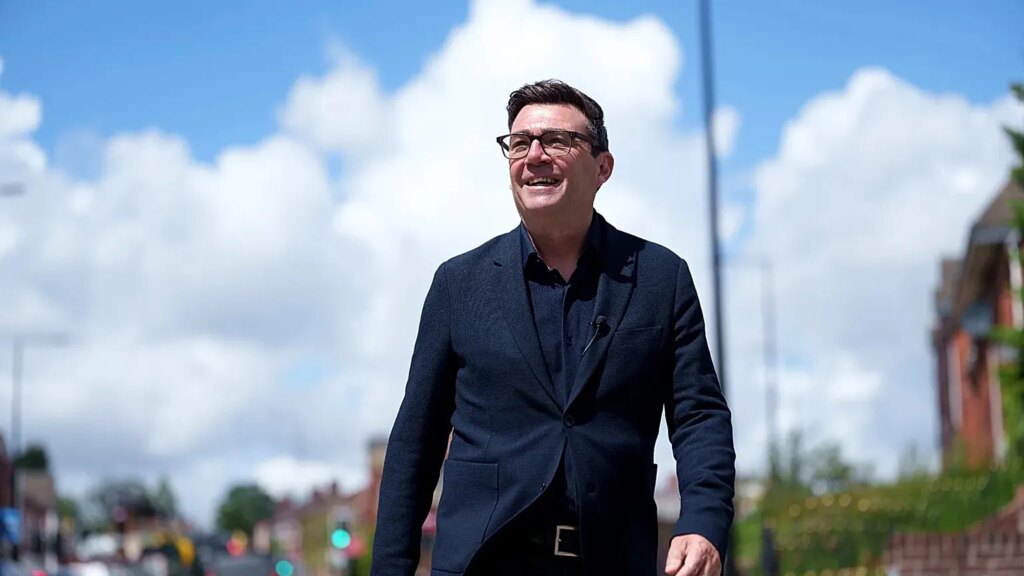
"This generation of politicians, including myself, has not managed to confront a political culture and economic system that fails to serve ordinary citizens adequately," Burnham stated.
Andy Burnham was announced as the Labour Party’s new leader and is poised to become the UK’s seventh prime minister within ten years, starting Monday.
 ADVERTISEMENT
  ADVERTISEMENT
The Home Secretary, Shabana Mahmood, officially announced Burnham as the party’s new leader during a special press briefing on Friday.
In his acceptance speech, Burnham described the occasion as «proud» and «emotional» for both himself and his family, while paying homage to the departing Prime Minister Keir Starmer.
He further pledged comprehensive reforms in British politics, criticizing his generation of politicians for insufficient support for working-class communities throughout the UK.
«This generation of politicians, myself included, has neglected to challenge a political culture and economic model that doesn’t adequately serve ordinary citizens,» he noted. «Today, we commit to doing better.»
After his main contender withdrew last week, Burnham had an unopposed path to Downing Street. He secured 379 nominations from Labour MPs out of a possible 403 for the party leadership.
Nevertheless, this uncontested ascent has raised concerns among some analysts and government officials, while opposition leader Kemi Badenoch accused Labour of avoiding scrutiny out of fear.
This development follows Keir Starmer’s announcement last month to resign as Prime Minister amid mounting pressure after Labour’s poor local election results in May.
Essential points from Burnham’s address
In his Friday speech, Burnham presented five main objectives set to define his leadership and to «make us better.»
First, he emphasized fostering greater unity within the Labour Party, aiming to form «one Labour team.»
«We cannot defeat Britain’s new right if internal conflicts consume us and we pull in opposite directions,» he stated. «Such divisions have always and disproportionately affected those who rely on Labour the most.»
His second objective is to institute «new politics,» halting political point-scoring and concentrating on resolving significant national issues.
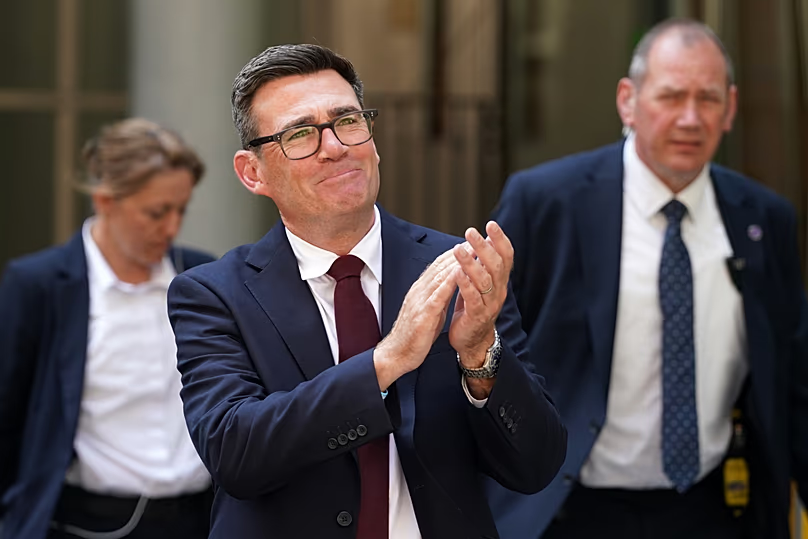
Burnham also declared intentions to steer the party in a «distinctly Labour» direction.
«We will not attempt to out-green the Greens or out-reform Reform, nor repeat past mistakes of adopting too many Tory policies,» he explained, highlighting what he viewed as several «wrong turns in the 1980s.»
«Political authority became centralized while economic power was privatized,» Burnham remarked, emphasizing that this led to wealth and influence being «concentrated in the hands of fewer people and places.»
He further pledged to serve as «a leader for the north, south, east, and west—representing Scotland, Wales, and Northern Ireland.»
While acknowledging the north of England’s significant impact on him, Burnham pledged to repay this by extending his efforts «to every region.»
«This moment calls for representing all areas of the country and uniting people behind a shared purpose,» he stated.
Lastly, Burnham committed to devolving power away from London toward the wider UK.
«Greater control over vital services will enable improved affordability and function for residents,» he added.
He also described himself as a «pro-business leader» aiming to transfer more authority to promote reindustrialization and upgrades in the education sector.
Who is Andy Burnham?
Originating from Merseyside in northwest England and raised in Culcheth, Cheshire, Burnham credits his political awakening to the 1982 TV drama «Boys From The Blackstuff,» which depicted the struggles of five unemployed Liverpudlians during Margaret Thatcher’s era.
He pursued English studies at the University of Cambridge before embarking on a journalism career with various trade publications. In his early 20s, he transitioned to politics, working as a researcher for the late Tessa Jowell, former MP for Dulwich.
Burnham was elected MP for Leigh in 2001, holding the seat until 2017. During this time, he occupied senior governmental roles, including secretary of state for health and chief secretary to the Treasury. He ran unsuccessfully for Labour leadership twice, losing to Ed Miliband in 2010 and Jeremy Corbyn in 2015.
In 2017, he became mayor of Greater Manchester, overseeing strong economic growth and earning praise for defending the region during the Covid-19 lockdown.
Known since then as the «king of the North,» Burnham returned to Westminster in June after winning the Makerfield by-election by a significant margin, defeating candidates from Nigel Farage’s Reform UK and Rupert Lowe’s Restore Britain.
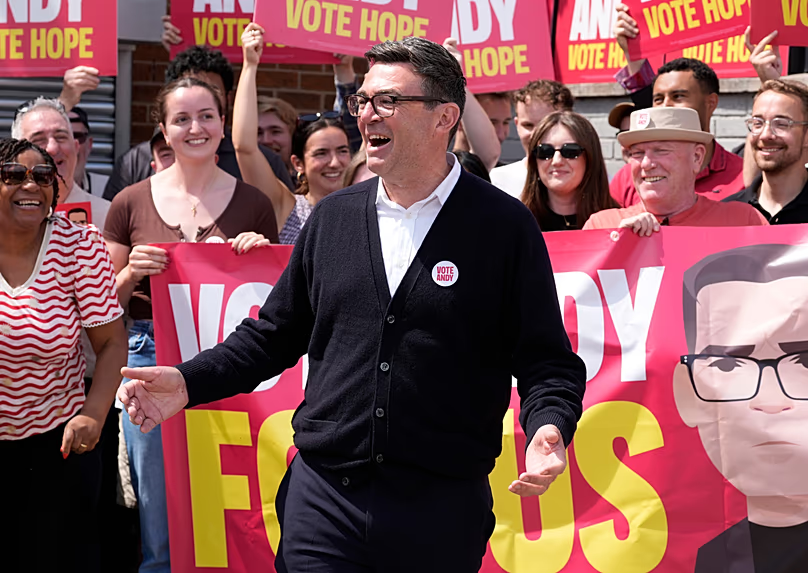
Since returning to Westminster, Burnham has consistently emphasized the necessity for political reform in Britain, focusing on decentralization and promising to promote greater power distribution throughout the UK via a «No. 10 North.» He has also declared intentions to dismantle trickle-down economics and neoliberal policies, aiming to launch «the most extensive council house construction effort since the post-war era.»
Regarding Europe, Burnham has advocated for the UK’s reentry into the European Union but adopted a more moderate tone on this subject during his Makerfield campaign.
«I believe Brexit has caused harm,» he commented in May. «However, I also think the last thing we should do now is reopen those debates.»