
The digital system for verifying non-EU travellers’ documents is causing delays and disruptions just as the holiday season approaches its peak. With lines growing and passenger frustration rising, airlines are urging for the possibility to pause these checks in July and August.
A shadow looms over Europe, or at least its external borders: the Entry/Exit System (EES), an automated tool for logging foreign nationals entering and departing the Schengen Area, which threatens to disrupt the holiday plans of millions of travellers.
 ADVERTISEMENT
  ADVERTISEMENT
The EES gradually replaces traditional passport stamps with a digital record indicating when travellers enter and exit the Schengen Area for brief visits, gathering biometric data including facial recognition and fingerprints, in addition to personal details from travel documents.
Currently, the system operates at all external borders of the 29 countries within the free movement zone, covering all EU states except Cyprus and Ireland, along with Switzerland, Liechtenstein, Iceland, and Norway.
Who is affected?
This system targets non-EU/Schengen nationals travelling to Schengen or EU countries for short durations.
A «short stay» refers to a maximum of 90 days within any 180-day timeframe and is intended for tourism, business, or family visits. Foreign nationals must secure a “short-stay” visa before arrival in Europe and must not surpass the allowed duration once admitted.
Travelers from certain countries—such as the US, UK, Australia, or those in Latin America—are exempt from visa requirements but remain subject to the EES checks.
Citizens of EU and Schengen member states are exempt from these controls, as well as nationals of Andorra, San Marino, Vatican City, and Monaco.
Other exceptions include non-EU nationals holding long-term visas or residence permits from a Schengen country, international train and aircraft crew members, and military personnel.
What is the purpose of the EES?
The EES aims to streamline border inspections, making them quicker and more effective while enhancing security by providing border officers and national agencies with traveller information that helps detect threats related to cross-border crime and terrorism.
A key objective is to curb irregular migration. By logging entries and exits—recording fingerprints and facial images in a digital database—the system should prevent overstays and the use of false identities in Schengen countries.
Since its introduction, over 40,000 individuals have been denied entry due to reasons such as expired or fake documents or inability to explain their travel purpose satisfactorily, according to the European Commission.
Additionally, more than 1,000 persons have been flagged as security threats to Europe.
What challenges are arising?
The EES reached full operational status on 10 April 2026, following a gradual implementation that started on 12 October 2025. The rollout proceeded over six months after all Schengen countries issued their “declaration of readiness” to activate the system. Nevertheless, the transition has not been without difficulties.
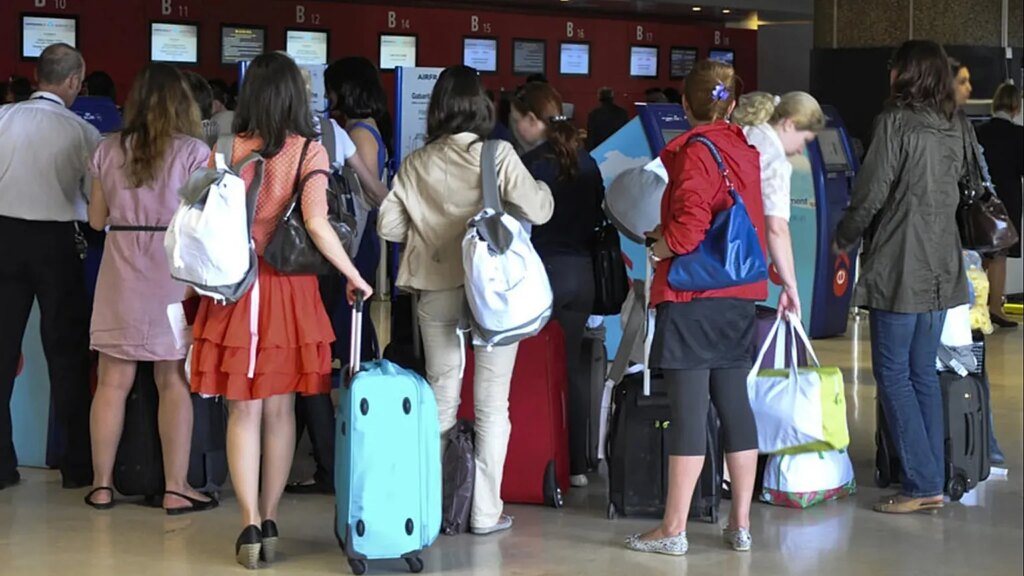
The EES is applied at land, sea, and air borders, but its introduction is causing bottlenecks and delays especially at airports, with lengthy queues and complex processes.
Airports and airlines encounter operational setbacks, including postponed flights and missed connections, both in major European hubs and smaller airports popular with tourists, partly because some terminals lack sufficient capacity, such as border guards, infrastructure, or automated border control equipment.
This situation results in planes departing with many empty seats at closing time while passengers remain stuck in border control lines. Waiting times have surged significantly, sometimes lasting up to five hours during peak travel periods, affecting millions of people.
According to a letter addressed to the European Commission by airport and airline associations, the conditions have “reached a critical level.”
Airlines for Europe, ACI Europe, and the International Air Transport Association called for “urgent intervention” and requested the option to temporarily suspend EES during July and August “whenever passenger traffic surpasses the operational capacity of border control facilities.”
Over the next two months, as holiday travel peaks, European airports are expected to process around 40 million more passengers than in May and June combined.
Uku Särekanno, deputy executive director of EU border agency Frontex, indicated that the situation should stabilize within one or two years, noting that collecting fingerprints from non-EU travellers at their first Schengen entry is “likely the most demanding phase” of the rollout.
How is the Commission responding?
Under current regulations, Schengen states are granted some temporary leeway to halt biometric data collection when border control authorities struggle to manage traveller volumes.
However, broader exemptions are not permitted.
Greece contemplated suspending biometric data collection from British visitors due to stress on its small island airports during the holiday peak, but the European Commission clarified that such suspension is only allowed during high passenger flows at specific border points and cannot target any nationality group.
In response to the aviation sector’s concerns, a European Commission spokesperson stated that all measures are being taken to minimize the impact on travellers across the EU, asserting that most airports see only limited effects.
“The Commission has been actively supporting member states and the aviation industry in implementing the new system and will continue to enhance this support as needed,” the spokesperson affirmed.
An «urgent meeting» with governments and aviation representatives has been convened by the Commission and is scheduled for the coming days.