
The ex-French finance minister advocated for reinvigorating the European Union by uniting six main countries to address critical challenges amid external threats.
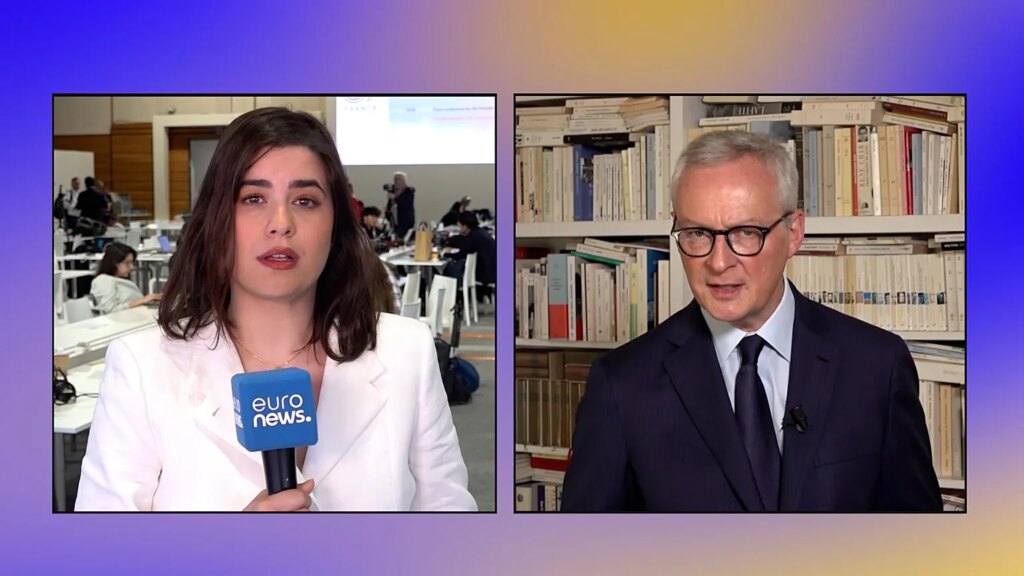
Speaking to Euronews alongside the G7 summit in Évian, France, former French Economy Minister Bruno Le Maire stated that collaborating through a coalition of six principal European nations instead of all 27 is the most effective approach to strengthen Europe.
 ADVERTISEMENT
  ADVERTISEMENT
His observations come at a time when the European Union seeks to make its decision-making mechanisms more efficient and responsive on vital topics such as defence and foreign policy.
«The fundamental conclusion that every European leader should draw from recent months, and indeed the past two years, is that to be influential and resilient, unity is crucial. However, this unity does not require all 27 member states,» he explained to Euronews.
«A renewed momentum for European integration must be fostered by establishing a core project involving six principal countries,» stated Le Maire, who held the distinction of being the longest-serving economy and finance minister since World War II and also served briefly as the minister for armed forces.
He named France, Germany, Italy, Spain, Poland, and the Netherlands — the six largest economies in the EU — as the nations that ought to coordinate on key issues affecting the bloc, from the conflict in Iran and backing Ukraine to developing semiconductor manufacturing within Europe and sustaining nuclear energy.
«Focusing on six countries rather than 27 is the optimal strategy to bolster Europe, confront challenges posed by various global powers, and achieve tangible outcomes,» he noted.
Le Maire highlighted the pressure exerted by the United States administration on the EU, which includes tariffs and threats related to regulatory standards, in retaliation for Brussels imposing antitrust penalties and digital regulations against American tech firms like Google and Amazon.
«It is no longer acceptable to tolerate blackmail […]. The stance of President Trump and the US administration, insisting ‘You must eliminate taxes on Google, Amazon, Facebook, and Microsoft, or else we will impose new tariffs,’ is entirely unacceptable among allied nations,» he said.
«To counter such threats and coercion, the six most robust European member states must present a united front […]. Division undermines any resistance to this pressure,» he added.
«standing united and making clear that the US will face difficulties accessing the European market if it does not respect Europe as a partner is the most effective path to concrete results.»
Excessive Discussion, Insufficient Action
Often obstructed by the unanimity rule, Le Maire told Euronews that needing consensus among 27 nations causes «lengthy debates but very few resolutions,» whereas what is required now are «decisive measures and reduced deliberations.»
He proposed a system where the six core nations advance initiatives first, with the remaining 21 member states invited to join as they wish, stating, «the priority is to make progress.»
This coalition concept is not unprecedented. Indeed, it already exists in some form.
Earlier this year, the finance ministers of Germany, France, Italy, the Netherlands, Poland, and Spain formed a new alliance named «E6», aiming to drive «decisive actions and swift advancements» in four strategic sectors: defence, supply chains, the Savings and Investments Union, and enhancing the euro’s international role.
«We are setting the pace, and other countries are welcome to join us,» said German Finance Minister Lars Klingbeil. The European Commission President Ursula von der Leyen supported this two-speed Europe model as a means to strengthen the European economy.
In May, the E6 issued a joint letter calling for accelerated progress on the Capital Markets Union (CMU), seeking to overcome the political stalemate in Brussels.
The CMU’s goal is to establish a unified, integrated capital market across all 27 member states to benefit companies, investors, and consumers alike.