
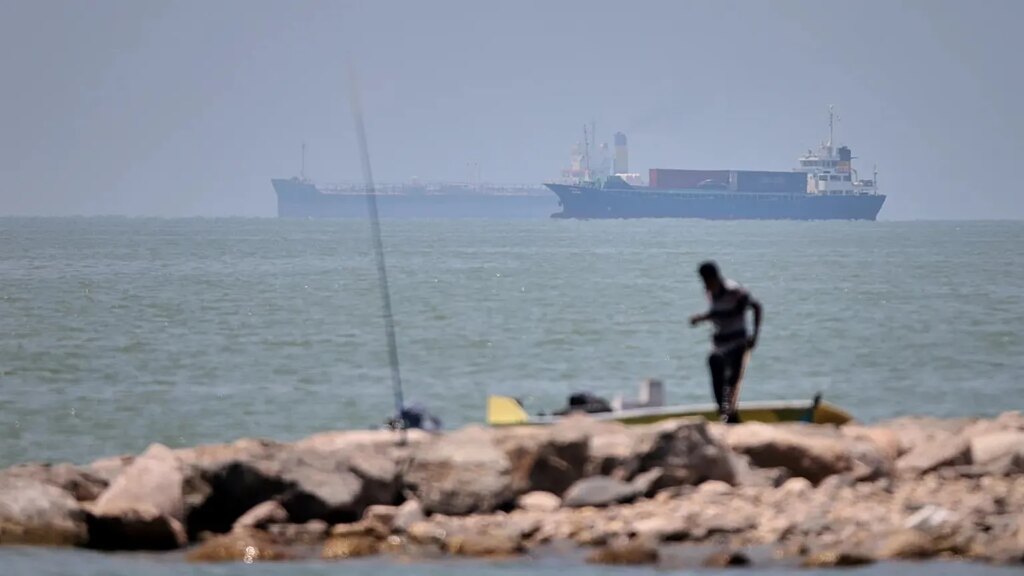
The globe’s key energy bottleneck might soon reopen, but for maritime activity to normalize, confidence in the insurance sector must first be restored. At the same time, Germany has dispatched two naval ships to potentially conduct mine clearance operations.
Despite apparent progress towards a ceasefire agreement between the United States and Iran, the global maritime industry remains cautious about restarting transit through the Strait of Hormuz.
 ADVERTISEMENT
  ADVERTISEMENT
The presence of naval mines, soaring insurance costs, and lingering distrust following prolonged military confrontations in this vital passage make reopening it as much a political and economic challenge as a logistical one.
Leaders in shipping welcomed the peace proposal revealed by the US and Iran in Évian at the G7 summit, aimed at fully restoring access to the strait within 60 days. The agreement is scheduled for official ratification this Friday in Switzerland.
The deal’s text, disclosed Wednesday, states the US will cease its naval blockade, with Iran committing to “its best efforts” to ensure the free and safe transit of commercial vessels through the Strait of Hormuz for a 60-day period. Concurrently, discussions on Tehran’s nuclear program will proceed between the two nations.
Though reopening might occur around June 19, returning to normal navigation is a complex endeavor. Energy intelligence company Kpler warns that investors anticipating a rapid normalization should expect a gradual, uneven process.
“Recovery is anticipated to progress in phases, not a straight trajectory, with significant variations across countries and product types extending into 2027,” Kpler’s report notes.
Following over three months of near-complete maritime inactivity in the strait—driving global energy price surges and social unrest—international shipping leaders estimate it will take “weeks or months” before operations return to standard levels.
Regaining trust
Jotaro Tamura, CEO of Mitsui OSK Lines, emphasized that a mere agreement between the US and Iran won’t immediately rebuild trust eroded by conflict.
“Considering the recent experiences over the past months, a realistic expectation is that normalcy may require at least several weeks to a month,” Tamura explained.
The Japanese executive added that the agreement needs to be “substantive and concretely reflected in situations” within the Strait of Hormuz to reassure shipping companies enough to resume operations.
Arsenio Dominguez, Secretary-General of the International Maritime Organisation, stated earlier this week that the agreement offers a chance to progress plans for evacuating thousands of seafarers stranded in the region.
“Their bravery and endurance amid ongoing uncertainty merit the highest commendation,” Dominguez remarked.
More than 100 oil tankers currently immobilized within the Gulf are expected to quickly traverse the strait once deemed secure.
However, Maersk CEO Vincent Clerc noted that resumption of regular shipping will depend on comprehensive surveys to detect mines and chart safe navigation paths.
“Uncertainties about navigational hazards remain, particularly considering the volume and size of vessels expected,” Clerc said, adding that understanding the full scope could take “several weeks.”
A representative from shipping firm Hapag-Lloyd expressed a more optimistic outlook.
“Following over 15 weeks of closure in the Strait of Hormuz, this news is positive for our teams and clients. We anticipate remaining vessels might transit the strait within this week while awaiting further updates,” they stated.
An estimated 118 fully loaded tankers trapped inside the Gulf are poised to depart within 10–15 days, momentarily increasing transit numbers. Yet energy analysts caution progress will be measured, with daily transits rising from about 15 to 40 during the first month as Iran’s role is clarified.
Who will control the process?
Iran’s Foreign Ministry spokesman Esmaeil Baghaei declared on Wednesday that maritime traffic through the Strait of Hormuz will be reinstated within a defined timeframe, with Iran exclusively overseeing the process.
“This responsibility rests solely with us, and no external parties will participate or interfere,” Baghaei affirmed.
Nevertheless, Western countries have outlined plans to deploy vessels to escort ships through Hormuz.
A joint declaration supported by 36 nations on the G7 sidelines emphasized the «urgent reopening» of the Strait of Hormuz with “unrestricted and unconditional freedom of navigation,» amid ongoing uncertainty about Iran potentially imposing transit fees.
“We pledge to contribute—within our constitutional frameworks—to this effort, including through a defensive, independent mission aimed at reassuring commercial shipping and conducting mine clearance,” the statement reads, signed by 22 EU countries alongside Canada, Japan, and Australia.
On Wednesday evening, the German government announced preparations for possible involvement of its armed forces in a mission to protect shipping in the strait. Defence Minister Boris Pistorius revealed on Thursday that two naval vessels are currently transiting the Suez Canal in preparation for mine clearance duties.
“At this moment, our minehunter ‘Fulda’ and tender ‘Mosel’ are navigating the Suez Canal en route to the Red Sea,” Pistorius said ahead of a NATO defence ministers meeting in Brussels.
“Our goal is to respond swiftly when required, to be ready operationally, and particularly to position ourselves in the Strait of Hormuz as soon as possible.”
Just two days prior, French President Emmanuel Macron announced that France and its partners are prepared to deploy a naval mission “within days” aimed at safeguarding the Strait of Hormuz by escorting vessels and removing mines.