
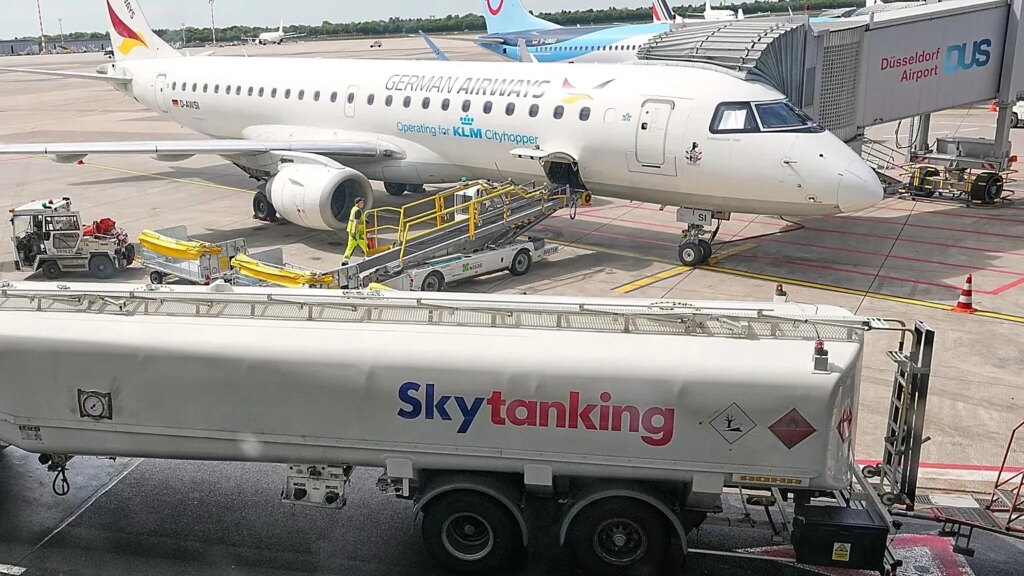
As the busiest summer months approach, EU energy ministers remain concerned that jet fuel supplies might be further constrained, although experts observe a “notable shift” towards expanding jet fuel output within European refineries.
European energy officials are exploring a strategic release of jet fuel reserves amid ongoing Middle East disruptions that risk compromising supply just as the peak summer travel period starts, according to a document reviewed by Euronews.
 ADVERTISEMENT
  ADVERTISEMENT
A briefing from the European Council prepared ahead of the EU energy ministers’ meeting on 26 June highlights that while crude oil and natural gas markets have yet to experience critical shortages, jet fuel remains the most vulnerable product as disruptions through the Strait of Hormuz enter their third consecutive month without resolution.
Officials are now evaluating the coordinated release of strategic fuel reserves, including jet fuel stockpiles, should commercial supplies fall short later this year.
“Jet fuel is gaining increased attention as demand approaches its seasonal summer peak. The likelihood of tapping strategic reserves to address commercial shortfalls by year-end is an immediate and tangible risk,” the document states.
The Strait of Hormuz’s closure has sharply reduced tanker movements through a vital global energy passage, cutting off a substantial portion of Middle Eastern oil exports and causing significant ripples across world markets.
To mitigate the shortage, the International Energy Agency (IEA) coordinated a release of 400 million barrels of oil on 11 March. Although the bulk of this global release was crude oil, the IEA specifically prioritized refined products like jet fuel within European emergency contributions due to regional deficits.
Despite oil prices dropping from conflict-induced peaks, refined products remain under intense pressure, with jet fuel impacted the most.
The Council’s briefing notes that jet fuel prices surged far more steeply than crude oil prices, with some regional markets experiencing approximately a doubling in cost during peak disruption.
In spite of this price volatility, George Shaw, an energy analyst at Kpler, observed a “significant shift” toward boosting jet fuel production in European refineries. Most EU refining capacity and output is concentrated in Germany, Italy, Spain, and the Netherlands.
Shaw also pointed out that increasing imports from the US are expected to continue. Nigeria represents another major supplier to Europe, alongside “smaller quantities” arriving from the Middle East.
“As the season advances, especially in August and September when consumption surges, the supply situation will undoubtedly become more pressured,” Shaw told Euronews.
Seasonal pressure
The European Airports Council (ACI Europe) cautioned the European Commission on 10 April via letter that a systemic jet fuel shortage could materialize for the EU if the Strait of Hormuz remains closed beyond three weeks.
These warnings were echoed by IEA CEO Fatih Birol, although several airlines moderated their stance in subsequent weeks. Both Air Canada and Lufthansa have stated they do not anticipate jet fuel shortages or widespread flight cancellations during summer.
A representative from the International Air Transport Association (IATA) denied immediate short-term challenges in securing jet fuel before peak travel but acknowledged forthcoming difficulties.
“While immediate fuel supply shortages are not expected, current market trends underline broader systemic vulnerabilities,” the IATA spokesperson told Euronews.
The airline sector is particularly advocating for a temporary suspension of the EU’s «anti-tankering» regulations, which currently forbid airlines from carrying surplus fuel to decrease costs.
“The EU should revise its rules to allow suppliers and airlines to allocate and concentrate fuel reserves where they are most urgently needed, eliminating the huge administrative load of processing thousands of exemption requests,” the IATA spokesperson added.
Although widespread shortages have yet to emerge, EU energy ministers recognize that the risk increases alongside summer demand escalation.
So far, inventories and alternative supply routes have provided a buffer. Elevated pre-crisis stock levels, amplified imports from the US and Nigeria, and reduced demand in some areas have prevented severe disruptions impacting consumers, but these protections are not expected to endure indefinitely.
The potential for extended disruption is fueling broader discussions in Brussels regarding energy security. The document reveals the EU executive is preparing recommendations on coordinated reserve releases and demand management while advising governments against unilateral measures that might fragment the single market.
“The Commission is drafting formal proposals on demand management and the coordinated release of strategic reserves, including jet fuel stocks, to guarantee fair distribution amongst member states,” states the Council briefing.
Energy experts estimate that even in the most optimistic cases, recovery will be gradual.
Refining operations in Gulf States would require months to normalize following the reopening of the Strait of Hormuz, with product shipments to the EU needing an additional 30 to 40 days transit time, implying that fuel markets may stay tight throughout the summer regardless of when shipping resumes.