
The announced reductions coincide with European countries striving to strengthen their defense capabilities following Russia’s extensive invasion of Ukraine in 2022, which raised concerns over potential aggression against NATO members.
The United States intends to limit NATO allies’ access to deep strike capabilities as a part of its broader strategy to withdraw from Europe’s security framework.
 ADVERTISEMENT
  ADVERTISEMENT
Last year, the Trump administration notified NATO partners about plans to reduce military assets available to Europe, even in wartime or invasion scenarios. Until recently, the specifics regarding how the Pentagon will implement these cuts remained undisclosed.
Sources reveal that all assets connected to deep strike capabilities are set to be cut, Euronews has confirmed. This notably involves US long-range bombers such as the B2 and B-52 models. Additionally, naval resources, including missile-equipped submarines and aircraft carriers, will be redeployed to other operational zones.
According to reporting by the New York Times, the US also plans to reduce the number of F-16 and F-15E fighter jets provided to NATO from about 150 to 100, and maritime reconnaissance planes from 26 down to 15, alongside withdrawing all eight aerial refueling tankers formerly accessible to Europe.
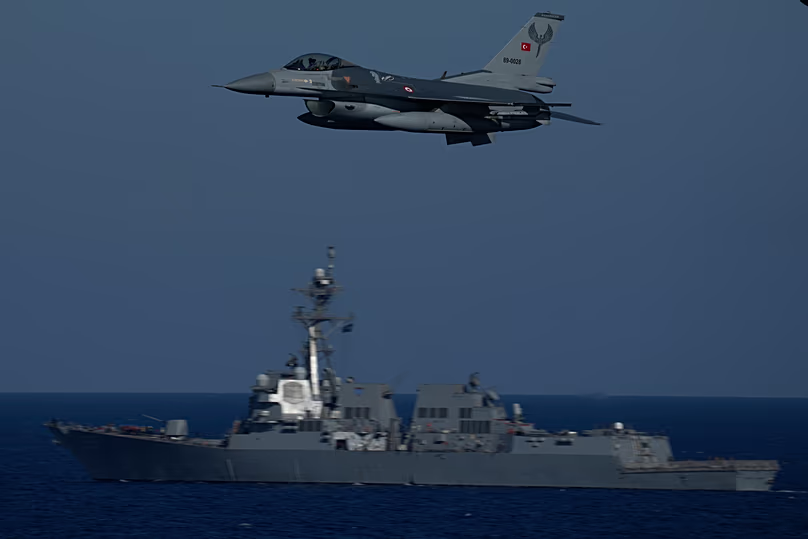
The major modifications in US support are being executed under NATO’s Force Model system, a framework helping allies and military coordinators to track troops and equipment ready for NATO missions based on deterrence goals and threat evaluations.
Validating these intentions, US European Command stated last week its aim to “adjust” its contributions to the NATO Force Model accordingly.
‘Paper tiger’
Despite senior NATO figures anticipating the reduction of US assets for months, top officials have publicly minimized the consequences, emphasizing that European partners have increased their defense efforts significantly and can fill the void left by the US.
«It is understood that adjustments are necessary, as the US needs to reorient, for instance, towards Asia,” Rutte commented to reporters recently.
Nonetheless, the current announcement comes at a strained juncture in US-NATO relations.
US President Donald Trump remains frustrated by European allies refusing to join the US and Israel’s conflict in Iran. He has threatened to “remember” how nations like Spain, Italy, and France denied US aircraft access to their airspace and bases en route to Iran.
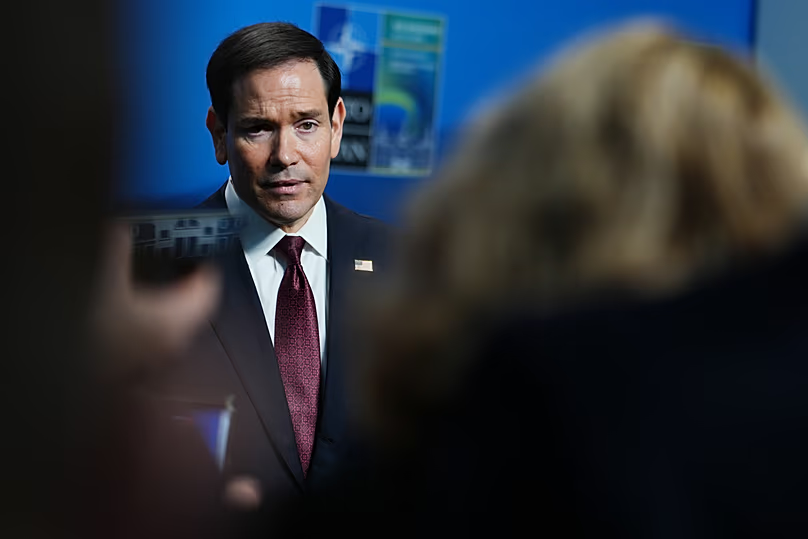
“The remedy would be to reopen the Strait of Hormuz,» Trump stated on social media in March, criticizing allies for unwillingness to assist and warning that “Without the U.S.A., NATO IS A PAPER TIGER!”
“COWARDS,” he added. “We will REMEMBER!”
Since then, a coalition of NATO members alongside countries like South Korea and Australia has been developing a plan to reopen the strait after hostilities cease, dispatching frigates and troops to the area for positioning ahead of the conflict’s resolution – although the timing of this remains uncertain.
Additional sources • AFP