
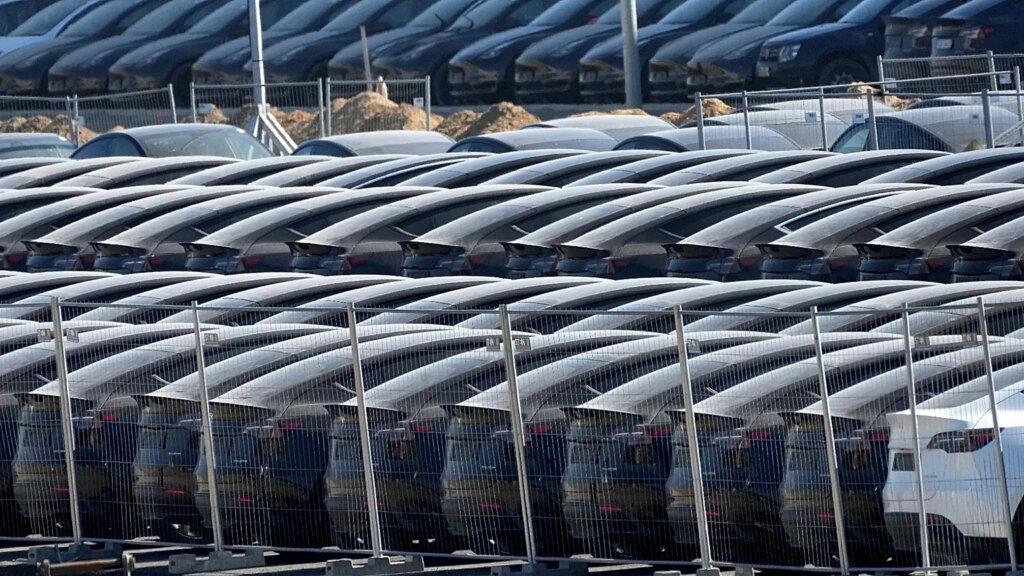
Without outright opposing the decarbonisation of fleets, the member states contend that Brussels should avoid excessive regulation and instead develop more incentives for large enterprises to invest in zero- or low-emission cars and vans.
According to a document obtained by Euronews, nine European capitals have united to resist a European Commission proposal mandating large corporate vehicle fleets to transition to electric vehicles.
 ADVERTISEMENT
  ADVERTISEMENT
A coalition spearheaded by Poland and comprising Bulgaria, the Czech Republic, Estonia, Hungary, Italy, Latvia, Slovakia, and Romania has initiated a joint challenge against the Commission’s proposed legislation, which would require companies with over 250 employees or annual revenue exceeding €50 million to decarbonise their car and van fleets.
This issue is scheduled for discussion at an EU transport ministers’ meeting in Luxembourg on Monday.
The Commission proposes that by 2030, corporate fleets from large companies must meet two separate mandatory quotas: approximately 69 percent of new vehicle acquisitions should be plug-in hybrids, while around 45 percent must be battery-electric or hydrogen-powered. These targets would be adjusted according to individual member states.
The nine governments recognize that corporate fleets significantly contribute to accelerating the adoption of cleaner vehicles and decreasing Europe’s reliance on imported oil, which constitutes nearly 60 percent of the bloc’s imports; however, they warn that binding quotas might harm competitiveness and impose extra obligations on businesses.
Consequently, they advocate for the EU to prioritize incentives over strict regulation.
«Focus should be on establishing an enabling EU framework based on guidelines, best practice exchanges, targeted incentives, and technical assistance rather than imposing the proposed regulation,» they state.
An analysis by the advocacy group Transport & Environment (T&E) reveals that in 18 out of 27 EU nations, the tax differential between electric vehicles and fossil-fuel cars does not sufficiently compensate for the higher cost of EVs.
Stef Cornelis, director of fleets and freight at T&E, indicated that Europe’s largest automotive markets—Germany, Spain, Italy, and Poland—are failing to motivate companies towards electrification.
“The EU fleets regulation represents the needed trigger to overcome this stagnation. Both the EU Council and Parliament should bolster the Commission’s proposal with higher ambition to enable Europe to swiftly reduce oil imports,” Cornelis affirmed.
T&E further highlighted that vehicles linked to corporate businesses represent 59 percent of new car registrations and account for 78 percent of oil consumption.
A major point of concern for the nine governments is the variable preparedness across the EU. They cite substantial disparities in charging infrastructure, leasing markets, tax regimes, grid capacity, and administrative procedures. They argue that uniform targets risk disadvantaging countries where the necessary ecosystem for electrification remains insufficiently developed.
«The Commission’s preparation of guidelines along with structured sharing of best practices could empower member states to adapt implementation according to their unique conditions,» states the document.
Preventing unintended consequences
Although the Commission’s proposal formally targets large companies, the nine governments warn that the requirements could extend through leasing and rental sectors because many small businesses depend on leasing instead of direct vehicle acquisition. They argue that fleet obligations imposed on leasing firms could in effect be passed on to SMEs.
«Applying targets to leasing companies without exemptions for certain client segments would practically subject SMEs to these requirements,» the document notes, adding that about 80 percent of vehicles obtained by SMEs are leased, not bought.
The opposing capitals also stress that special-purpose vehicles and fleets tied to critical infrastructure, emergency services, and public safety demand greater flexibility than currently offered in the Commission’s draft.
They argue that operational readiness must not be compromised in achieving climate objectives.
«Decarbonising corporate fleets should be pursued in a way that aligns with the Union’s broader aims of resilience, emergency preparedness, and economic security, especially considering the ongoing geopolitical climate,» the document concludes.